On September 16, the 2026 Sixth Intelligent Vehicle Chip Industry Ecosystem Conference was held in Shanghai. Gu Xiaoying of Gasgoo predicted that the global automotive chip market will grow from USD 67.7 billion in 2024 to USD 96.9 billion in 2029, a compound annual growth rate of 7.4%. E'erte of Black Sesame Technologies introduced the Wudang C1296 cross-domain fusion chip, which has been mass-produced on the Dongfeng Tianyuan intelligent driving platform, focusing on cost reduction through cockpit-driving integration for volume models. The conference showed that cockpit-driving integration has entered a mass-production validation phase, chip growth is shifting from unit count to value per chip, and overseas supply chains need to balance cost and ecosystem collaboration.
On September 16, the 2026 6th Intelligent Vehicle Chip Industry Ecosystem Conference, hosted by Gasgoo, was held in Shanghai. The theme was “Chips Unite the Ecosystem, Intelligence Ignites the Future.” Topics covered computing power restructuring and in-vehicle breakthroughs, the RISC-V open ecosystem, cockpit-driving integration, automotive-grade manufacturing, and supply chain security.
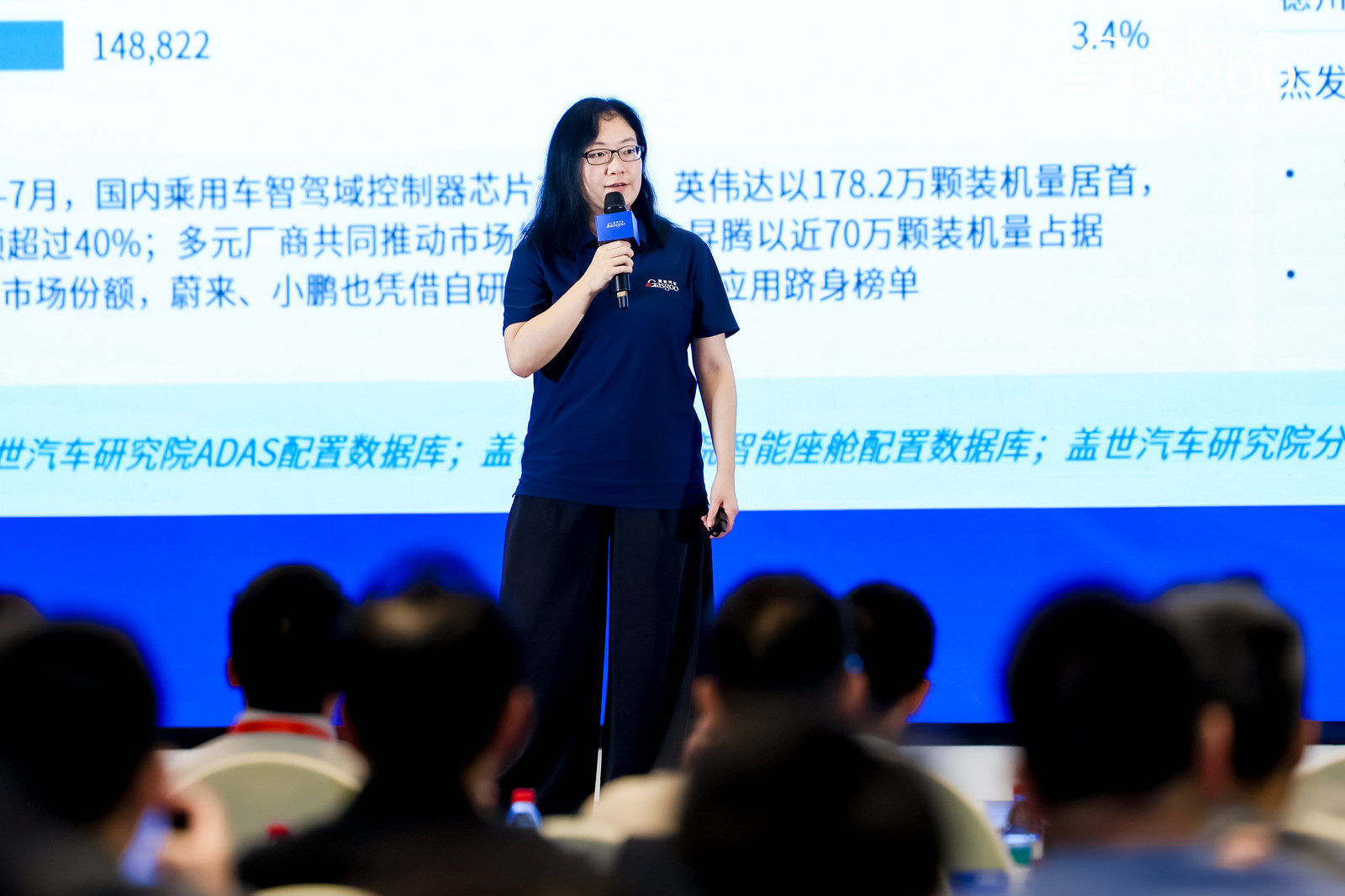
At the conference, Gu Xiaoying, partner and executive vice president of Gasgoo, and Erite, product expert at Black Sesame Technologies, delivered speeches respectively. The former presented forecasts for the global automotive chip market size and competitive landscape, while the latter introduced progress in the mass production deployment of cockpit-driving integration chips. The two sets of information point to the same conclusion: the growth of automotive chips is shifting from “unit count” to “value per chip,” and cross-domain integration is the key path to transferring this growth to high-volume models.
The $96.9 Billion Market: Growth Is Structural
In her speech, Gu Xiaoying presented a set of comparative data: a battery electric vehicle with L3 conditional automated driving capability, compared with an L1 fuel vehicle, has 200 to 300 more chips per vehicle, with a value increase of about 124%. Among these, the increase in the number of computing, memory, and power chips is the most pronounced.
In terms of market size, she cited a forecast that the global automotive chip market will grow from $67.7 billion in 2024 to $96.9 billion in 2029, a CAGR of 7.4%. Notably, Gu Xiaoying emphasized that this growth is not across-the-board expansion but structural growth: the value of high-computing-power, high-bandwidth, and high-efficiency chips continues to rise, with intelligent driving and cockpit SoCs, advanced memory, and silicon carbide contributing the main increment; mature categories are entering a stage of diversified supply, price competition, and supply chain consolidation.
In the competitive landscape, concentration remains prominent. In 2025, the top five global automotive-grade MCU manufacturers together accounted for about 92%, with Infineon’s share rising to 36%. Domestic companies have achieved large-scale application in areas such as body control, lighting, and seating, and are expanding into high-safety, high-performance scenarios such as BMS, electric drive, chassis, and zone controllers.

Foreign dominance in intelligent driving and cockpit segments is equally evident. According to Gasgoo’s configuration database, from January to July 2026, among domestic intelligent driving domain controller cumulative installations, NVIDIA accounted for 40%; Huawei Ascend and Horizon maintained steady growth, while NIO and XPeng entered the rankings through mass production and in-vehicle deployment of self-developed chips. In the cockpit SoC market, Qualcomm had a 70% share, with Huawei, SiEngine, MediaTek, and SemiDrive growing steadily. The memory market is still dominated by Samsung, SK Hynix, and Micron; ChangXin Memory Technologies, Ingenic Semiconductor, Longsys, Biwin Storage, and GigaDevice have laid out mass production for high-speed, high-capacity products, among which ChangXin Memory Technologies already has wafer fabrication capabilities.
Gu Xiaoying summarized future trends into three points: First, cross-domain integration is accelerating, with chips moving from “multiple chips per domain” to “one chip for multiple uses.” Cockpit-parking integration has already been widely applied in mainstream models, single-chip cockpit-driving integration has been deployed in vehicles, and multi-domain central integration is still in the introduction phase. Second, RISC-V has entered a fast track of development. Third, Chiplet has become an important breakthrough direction for high-performance SoCs, which can improve yield and reduce design complexity and manufacturing costs, but power consumption, latency, and verification difficulty remain challenges to be overcome. Regarding RISC-V, she particularly noted that its pace of development does not depend on the open instruction set itself, but on unified standards, a complete toolchain, the ability to pass verification as soon as possible, and whether leading automakers or Tier 1 suppliers are willing to take the lead in joining. In essence, it is a matter of ecosystem building.
Cockpit-driving integration: From concept to volume models
If Gu Xiaoying provided the market coordinates, E'erte’s speech offered a concrete product solution. He drew an analogy with the smartphone industry: flagship models attract the vast majority of industry attention, but it is highly homogenized volume models that actually drive sales. The auto industry is the same: “including VLA, AI box, end-to-end, and world models, we attract 80–90% of the market’s attention,” but the functions of flagship models are far from converging.
The problem is concentrated in chip configurations for volume models. E'erte pointed out that there are four or five options on the cockpit side and four or five on the intelligent driving side; when combined, a single vehicle may correspond to dozens of chip configurations. “Every time you change a chip, it means a lot of the work you’ve done before has to be repeated. That’s called reinventing the wheel.”

To address this pain point, Black Sesame Technologies launched the Wudang series cross-domain fusion chip C1296, aiming to use a single chip to cover the needs of volume models under different cockpit-to-intelligent-driving ratios, converge the dozen or so chip combinations in the supply chain into a single platform, and help automakers reduce costs at the chip architecture level. According to the company, the chip has already achieved mass production deployment on the Dongfeng Tianyuan intelligent driving platform.
In terms of product matrix, Black Sesame Technologies adopts a dual-line layout of Huashan and Wudang: the Huashan series focuses on ADAS functions, while the Wudang series focuses on cross-domain fusion. E'erte said that chips in the series support P2P compatibility and share a common toolchain, helping automakers reduce duplicated hardware and software investment across different levels of solutions. Its latest flagship chip, A2000, adopts the “Jiushao architecture” NPU. It is one of the few automotive-grade NPUs on the market that uses an ASIC architecture and supports floating-point operations, can provide support for L3 and above intelligent driving capabilities, and supports the needs of large models such as VLA. For the long term, the company has mapped out a roadmap from short-term existing applications, to medium-term cross-domain fusion and advanced intelligent driving, and to long-term central computing platforms.
What This Means for Overseas Supply Chains
Placing the two sets of information in the context of Chinese automakers going overseas, three threads can be seen.
First, the cost-reduction logic directly relates to overseas price competitiveness. Cross-domain fusion solutions such as Wudang C1296 target volume models, and volume models are precisely the main segment through which Chinese automakers expand scale in overseas markets. Converging dozens of chip combinations into a single platform reduces duplicated development and duplicated hardware and software investment. Whether this cost improvement can be translated into end-market price advantages depends on automakers’ own product strategies, but from the chip supply side, options have already emerged.
Second, supply chain structure remains a real constraint. The top five automotive-grade MCU vendors account for about 92%, Nvidia accounts for 40% of intelligent driving domain controllers, and Qualcomm accounts for 70% of cockpit SoCs. This shows that in most key links, the chip supply on which Chinese automakers rely when going overseas is still dominated by international vendors. The entry points for local chip vendors are currently more evident in the definition stage of new architectures such as cross-domain fusion, as well as in areas that have already achieved scale application, such as body control, lighting, and seating, and are extending toward scenarios such as BMS, electric drive, and chassis.
Third, ecosystem leadership determines the pace at which new architectures are deployed. Multi-domain central fusion is still in its introduction phase; RISC-V progress depends on standards, toolchains, and verification; and the power, latency, and verification challenges of Chiplets have not yet been fully resolved. What these directions have in common is that the performance of a single chip is no longer the only variable. Whether an ecosystem accepted by leading automakers and Tier 1 suppliers can be formed is the prerequisite for scaling onto vehicles.
Judging from the signals released at this conference, cockpit-driving integration has moved past the conceptual discussion stage and entered a mass-production validation phase targeting volume models; the enhancement of chip value is also beginning to shift from stacked compute to architectural convergence. The impact of this change on overseas supply chains is reflected in cost and development efficiency in the short term, while over the medium to long term it depends on the depth of ecosystem collaboration.