In 2025, China's automobile exports reached 7.098 million units, a year-on-year increase of 21.1%, of which new energy vehicle exports reached 2.615 million units, a year-on-year increase of 103.7%. The industry's focus is shifting from export scale to the depth of globalization. The degree of openness of overseas markets varies significantly. Chinese automakers are advancing globalization through local factory construction, product portfolios, and ecosystem-based operations. According to statistics from Gasgoo Automotive Research Institute, the planned annual overseas production capacity of Chinese automakers increased from about 3.44 million units in 2023 to nearly 6.85 million units in 2026.
In 2025, China's automobile exports reached 7.098 million units, up 21.1% year-on-year, ranking first globally for the third consecutive year; among them, exports of new energy vehicles reached 2.615 million units, up 103.7% year-on-year. Entering 2026, exports remain at a high level, and the industry expects full-year exports to exceed 10 million units. In terms of scale, Chinese automobiles have already completed large-scale validation in the global market. But the industry's discussion is shifting to another question: exports measure scale, while globalization measures depth, and the two are not entirely equivalent.
Overseas Is Not a Single Market
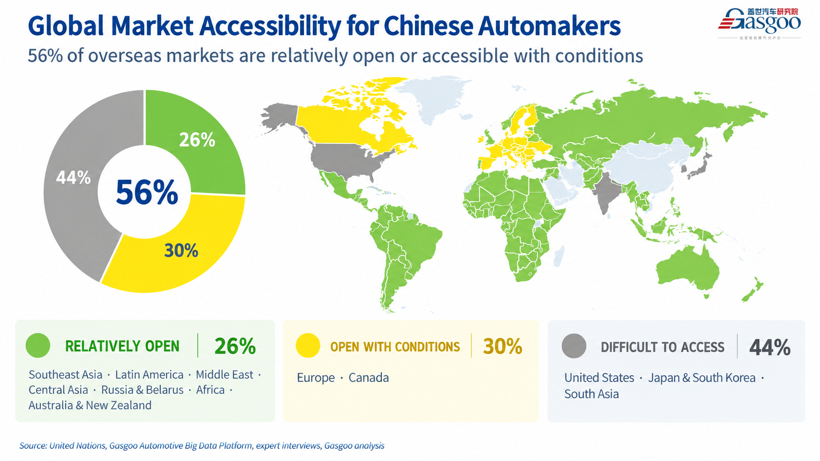
According to a review by Gasgoo Research Institute of major global auto markets, overseas markets can be broadly divided into three categories: about 26% are relatively open markets, such as the Middle East, Latin America, and Southeast Asia; about 30% are conditionally open markets, such as Europe and Canada; and about 44% are harder to enter, such as the United States, Japan and South Korea, and India. Even among relatively open markets, the business logic is not the same.
Take Thailand as an example. Over the past few decades, Thailand has been one of the important overseas manufacturing bases for Japanese automakers. The rapid development of new energy vehicles has provided a window for Chinese automakers to re-enter. BYD initially introduced models such as the ATTO 3 into Thailand and achieved a market breakthrough. In July 2024, its Rayong plant officially began production, with an annual capacity of about 150,000 vehicles. It has stamping, welding, painting, final assembly, and some parts production capabilities, while also serving export functions. This means its Thailand business has shifted from “selling cars made in China to Thai consumers” to making Thailand part of its Southeast Asian production and operating system.

Europe follows another logic. From 2021 to 2025, SAIC MG's European sales grew from surpassing 50,000, 100,000, and 200,000 to more than 300,000. More noteworthy is the change in product structure: in 2025, the MG Hybrid+ family sold 137,000 vehicles in Europe, up 300% year-on-year, while the pure electric family sold about 46,000 vehicles in the same period.

Why would a Chinese brand with strong EV capabilities increase its deployment of hybrid products in Europe instead? The reason is that charging infrastructure, tax policies, energy prices, and consumer habits differ significantly across countries, and the powertrain type, price range, and brand positioning all need to be revalidated. In the United States, companies first face more issues related to trade policy, industrial policy, data security, and market access.
Three Changes in the Way of Going Global
First, from a single model to a complete product portfolio. In Europe, MG expanded from pure electric to Hybrid+; BYD continues to enrich its plug-in hybrid lineup beyond pure electric products; Chery enters different countries and market segments through brands and product portfolios such as CHERY, OMODA, and JAECOO. The focus of competition has shifted from “sell whatever we have” to “make whatever is needed,” which also tests companies' product redundancy under policy changes such as tariffs.

Second, from vehicle exports to industrial cluster going global. As BYD, Chery, Great Wall, Changan and other companies achieve scale overseas, the question of where batteries, electric drives, seats, thermal management, body parts, chassis and electrical/electronic systems come from arises, and whether Chinese suppliers go overseas together with OEMs has become a real issue. In Hungary, Thailand, Mexico and Brazil, new supply chain networks are gradually forming around vehicle manufacturing. According to Gasgoo Automotive Research Institute statistics, Chinese automakers' planned overseas annual capacity was about 3.44 million vehicles in 2023, about 3.96 million in 2024, about 5.26 million in 2025, and by 2026 it has approached 6.85 million vehicles.
Third, from selling products to operating an ecosystem. After-sales repair, spare parts, finance, insurance, charging, OTA, used cars and residual value management form a complete chain; after further taking root, it also involves manufacturing, supply chain, R&D, talent cultivation, school-enterprise cooperation and even capital cooperation.
Differentiated paths of different companies
Chery exported 1.344 million vehicles in 2025, covering more than 100 countries and regions; its going-global trajectory roughly advances step by step from export, channels, manufacturing to local operations. BYD's overseas sales exceeded 1 million vehicles for the first time in 2025, and in the first half of 2026 overseas sales exceeded 780,000 vehicles; it has a vehicle plant with an annual capacity of 150,000 units in Thailand, is building local manufacturing capacity in Brazil, is building a European passenger vehicle production base in Hungary, and in 2025 announced that it would establish its European business headquarters and a new European R&D center in Budapest. SAIC's overseas sales in 2025 were 1.071 million vehicles, of which MG sales in Europe exceeded 300,000 vehicles.

Leapmotor, however, has taken a third route. In 2023, Stellantis invested in Leapmotor, and the two parties established Leapmotor International, with Stellantis holding 51% and Leapmotor holding 49%, responsible for sales and manufacturing in markets outside Greater China. By 2025, Leapmotor had shipped more than 40,000 vehicles in Europe through this system; by 2026, its European sales and service outlets had exceeded 850. For new forces that previously had a weak channel foundation in Europe, this provides an approach of using mature global resources instead of building everything themselves.

The evaluation system needs updating
From a stage perspective, the globalization of Chinese automobiles is undergoing three leaps: from made in China to global sales, from made in China to global manufacturing, and then to global operations. The first two stages address whether products can go out, whether channels can be established, and whether manufacturing can land; the third stage faces regulations, environmental protection, labor unions, data and political cycles, as well as operational issues such as taxation, exchange rates and local supply chains.
It should be noted that the statistical scope matters: 7.098 million vehicles is China's automobile export volume, which includes foreign-invested and joint-venture brand vehicles produced in China and exported, and is not entirely equivalent to the overseas sales of Chinese brands.
Therefore, the metric for measuring the degree of globalization is shifting from “how much is exported” to whether overseas sales are sustainable, whether overseas operations can be profitable, whether products are defined for local markets, whether there are local management teams and R&D capabilities, and whether the brand can command a premium. The next goal for Chinese automakers may be not just Going Global, but Being Global. In one sentence: exports measure scale, globalization measures depth.