Data from the China Passenger Car Association (CPCA) show that in September 2026, the market share of China's fuel-powered passenger vehicles fell below one-third for the first time, while the penetration rate of new energy vehicles rose to 67% and the share of battery electric vehicles reached 47.3%. Product advances, policy orientation and young consumers' preferences are jointly driving the structural shift. Joint-venture brands and traditional dealership and repair systems are under pressure, with the number of auto repair shops falling from 382,000 to 345,000 in half a year. The industry is shifting from fuel-dominated to new-energy-dominated, but fuel vehicles will still coexist with new energy vehicles over the long term in scenarios such as long-distance travel and low temperatures, and the industrial chain needs to complete business and talent structure adjustments during the transition period.
A New Watershed: Fuel Vehicle Share Falls Below One-Third for the First Time
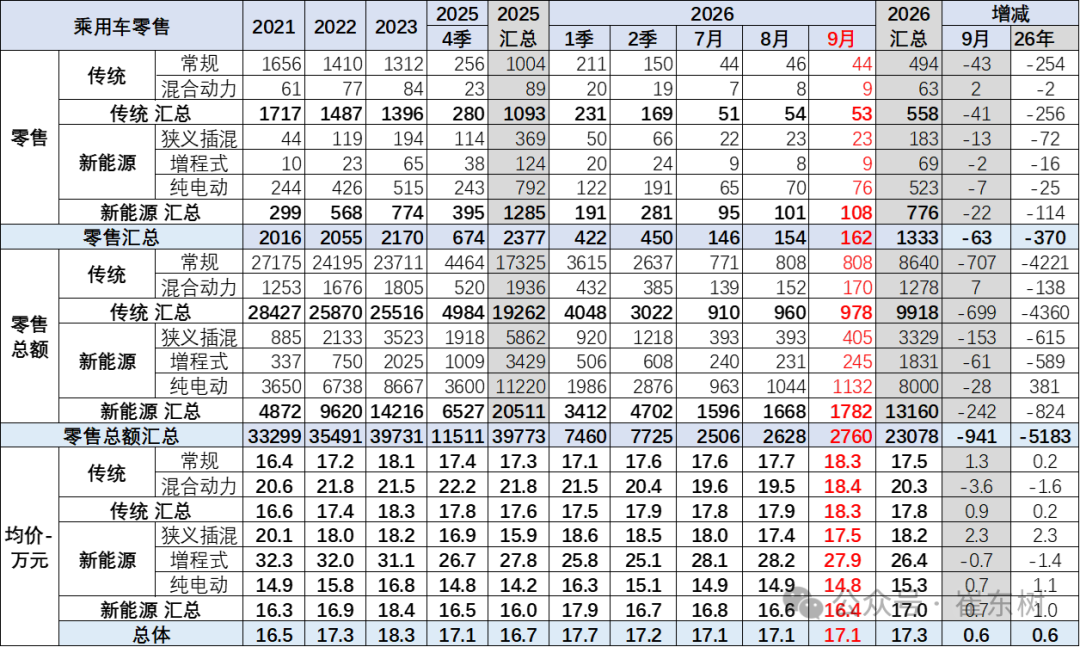
The latest data from the China Passenger Car Association (CPCA) shows that in September 2026, the sales share of fuel vehicles in China's passenger car market fell below one-third for the first time, while the overall penetration rate of NEVs rose to a record high of 67%. That means about two of every three passenger cars sold that month were NEVs. Data released by Nicolas Fulghum, senior energy and climate data analyst at energy data organization Ember, shows that in September, the market share of battery electric vehicles (BEVs) in China reached 47.3%, close to half. Tesla CEO Elon Musk reposted the post and commented that China's dependence on oil is falling rapidly, and the topic subsequently trended on social media.
A vertical comparison better illustrates the magnitude of the change: a decade ago, the penetration rate of NEV passenger cars in China was still less than 5%. From under 5% to 67%, the speed of this energy structure shift has exceeded the industry's previous general expectations.
Products, Policies, Consumption: Three Factors Combine to Drive Change
On the product side, progress by NEV models in price, range, and intelligence is compressing the comparative advantages of fuel vehicles at the same price. NEV models priced around RMB 100,000 can already achieve a range of more than 400 km, and models priced around RMB 150,000 are commonly equipped with high-level intelligent driving assistance systems. As a result, the traditional advantages of same-priced fuel vehicles in features and running costs have been significantly weakened.
Differences in policy direction directly affect purchase decisions. The NEV purchase tax reduction and exemption policy has been extended to the end of 2027, with 2026-2027 adjusted to half-rate collection. Local NEV license plate policies remain relaxed, while traffic restrictions and purchase limits on fuel vehicles in some cities have not been eased.
On the consumption side, the preferences of younger groups have already changed. Post-90s and post-00s consumers generally list intelligent experience as an important consideration when buying a car. Sales data from multiple NEV brand 4S stores show that the proportion of in-store consumers asking about intelligent driving and in-car infotainment systems is notably higher than the proportion asking about engine parameters.

Production-side data can serve as a reference. CPCA data shows that from January to September 2026, domestic vehicle production was 23.37 million units, down 4% year on year; NEV production was 12.46 million units, up 12% year on year, with a penetration rate of 53%; fuel vehicle production was 10.92 million units, down 17% year on year. Cui Dongshu, head of the CPCA under the China Automobile Dealers Association, said that because NEV sedans had a high base in the same period last year, production has fluctuated considerably this year; at the same time, rising living costs have squeezed car-purchase spending, and the problem of weak consumption still needs improvement.
Traditional Carmakers: Joint Ventures Under Pressure, Independent Brands Diverge
The shift in share structure is exerting direct pressure on traditional fuel vehicle automakers, with joint venture brands under the most notable pressure. Fuel vehicle sales of joint venture brands such as Volkswagen, Toyota, and Honda generally fell by more than 20% year on year, and capacity utilization in China for some brands has fallen below 50%. Many joint venture automakers have accelerated their electrification transition, but judging from launched models, they still have a clear gap with same-priced independent brands in intelligent features and value for money, and market sales reflect consumers' actual choices.
Independent brands, however, have diverged internally. BYD, Geely, Chery, and other automakers that laid out NEVs earlier continue to gain market share; some independent brands with a slower transition pace saw marked sales declines and are facing squeezed room for survival.

Dealer Network and After-sales System: Contraction Has Begun
The impact is not limited to vehicle manufacturers; it is also being transmitted layer by layer through dealer networks, after-sales service systems, and the talent structure.
The contraction of the dealer system is most visible. Guanghui Auto, which had topped the list of China's Top 100 Automobile Dealer Groups for many consecutive years, has basically exited the new-car sales business, shifting its focus to leasing self-owned properties and providing after-sales repair for existing vehicles; it owns more than 500 self-owned land parcels and supporting 4S showroom properties, but only just over 30 stores remain in normal operation, mainly providing maintenance and repair services. Store-level exits are also numerous: the Nanjing Lizhixing Mercedes-Benz 4S store, which had operated in the Nanjing market for 18 years, completely ceased operations in August 2026, with its Xianlin main store and Hexi branch closing simultaneously.
Auto repair shops are being eliminated even faster. Data from F6Big Data Research Institute shows that in the first half of 2026, the number of auto repair shops nationwide fell from 382,000 to 345,000, with more than 200 eliminated per day on average and a cumulative decrease of more than 170,000 over the past five years. In first- and second-tier cities with higher EV penetration, the contraction is more pronounced; in Beijing, Shanghai, Shenzhen and other places, the number of traditional auto repair shops has fallen by more than 25%. The root cause lies in changes in the business base: fuel vehicles require regular annual replacement of engine oil, oil filters, and air filters, while transmission fluid, spark plugs, timing belts, etc. also have fixed replacement cycles, forming a stable source of revenue for repair shops; maintenance items for new energy vehicles are greatly reduced, thereby weakening the business structure on which traditional stores depend.
Talent Structure: From Labor-Intensive to Technology-Intensive
The structural gap in maintenance talent is widening. NEV repair requires traditional mechanical repair, electrical technology, and certain software capabilities at the same time; the object of repair has changed from being primarily mechanical to a composite of mechanical, electrical, and software systems. Even with doubled salaries, suitable candidates remain hard to recruit.
The divergence trend is fairly evident in recruitment data. The Liepin's "2026 NEV Industry Talent Supply and Demand Insights" report report shows that among newly posted white-collar positions in the NEV industry, positions requiring a master's degree or above increased by 67.65% year on year, a growth rate nearly three times that of the overall automotive industry; competition for highly educated talent in core fields such as intelligent driving, chips, and battery R&D has intensified, while employment scale in traditional manufacturing, components, after-sales and other segments continues to decline. This means the industry is shifting from labor-intensive growth to technology- and talent-intensive growth.

Coexistence and Transition: Exit Does Not Mean Disappearance
A share falling below one-third does not mean fuel vehicles will immediately exit the market. For long-distance travel, low-temperature environments, and regions where charging infrastructure is not yet complete, fuel vehicles still have irreplaceable applicability. Cui Dongshu previously stated publicly that fuel vehicles and new energy vehicles will coexist for a considerable period, and the pace of increase in NEV penetration may gradually slow.
But for all parties across the industrial chain, the direction is already fairly clear. Among vehicle manufacturers, whether they can build sustainable competitiveness in new energy products is becoming the dividing line in their operations; among dealers and repair shops, those who proactively adjust their business structure and move early to position themselves in new energy-related services are more likely to find a place in the new market landscape. The share of fuel vehicles falling below one-third marks the accelerating exit of the fuel-vehicle era; more noteworthy is that the entire industry needs to complete a smooth transition during the coexistence period, so that practitioners in every link upstream and downstream can find new positions.