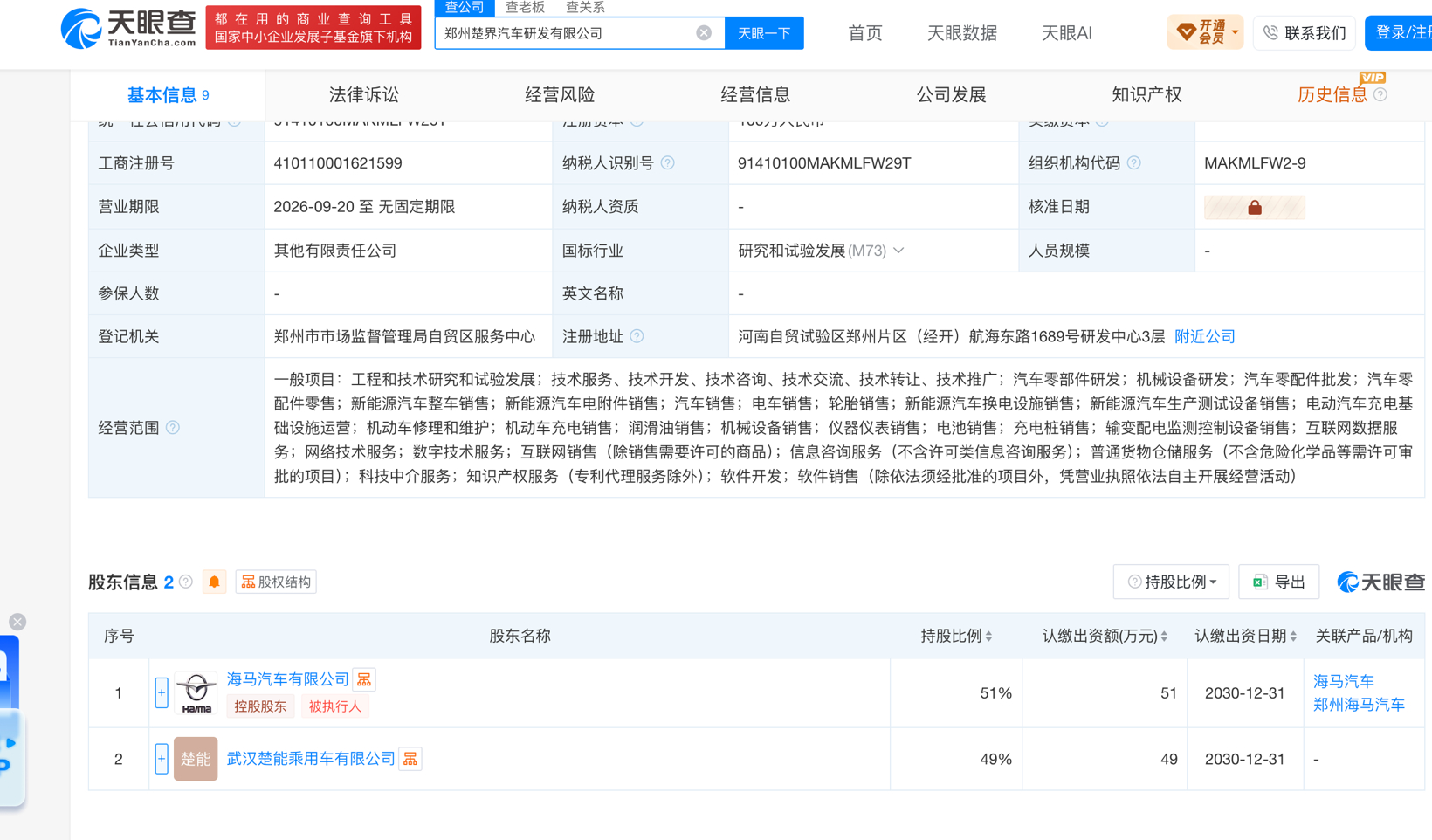
Zhengzhou Chujie Automotive R&D Co., Ltd. has completed registration with registered capital of RMB 1 million. It is 51% held by Haima Automobile Co., Ltd. and 49% by Wuhan Chuneng Passenger Vehicle Co., Ltd. Its legal representative is Qin Ming, and its registered address is Haima Zhengzhou Base in Zhengzhou Economic Development Zone. The company's business scope covers auto parts R&D, new energy vehicle whole-vehicle sales, and other areas, but excludes whole-vehicle manufacturing; it is positioned as an R&D, trading, and sales entity. The two parties intend to collaborate on whole-vehicle technology, parts development, and market introduction, revitalize the production capacity of Haima Zhengzhou Base, and help advance the Chuneng passenger vehicle project. Mass production remains to be advanced later.
Joint Venture Established: 51:49 Equity Split and RMB 1 Million Registered Capital
Tianyancha APP information shows that Zhengzhou Chujie Automotive R&D Co., Ltd. has completed its registration and establishment, with Qin Ming as the legal representative. The company was jointly funded and established by Haima Automobile Co., Ltd., a wholly owned subsidiary of About Haima Automobile, and Wuhan Chuneng Passenger Vehicle Co., Ltd., with registered capital of RMB 1 million and its registered address at Haima's Zhengzhou base in the Zhengzhou Economic Development Zone. In terms of equity structure, Haima Automobile Co., Ltd. holds 51%, Wuhan Chuneng Passenger Vehicle Co., Ltd. holds 49%, and the Haima side holds the controlling stake.
In terms of staffing arrangements, the legal representative Qin Ming also serves in a core management position related to Haima Auto, which echoes Haima's controlling position in the joint venture.
Its business scope is a key angle for observing the company's positioning. Business registration records show that the business of Zhengzhou Chujie Automotive R&D Co., Ltd. covers automotive component R&D, mechanical equipment R&D, wholesale and retail of auto parts, sales of complete new energy vehicles and other areas, but excludes complete vehicle manufacturing. This means the new company is positioned as an R&D, trading and sales entity, while the manufacturing stage still needs to rely on the existing complete vehicle production system.
Division of Labor Logic: Complementarity Between Complete Vehicle Qualifications and Battery Capabilities
The two parties in this cooperation are highly complementary in their capability structures. Haima Auto has a mature complete vehicle platform, complete vehicle production qualifications and a local complete vehicle manufacturing base in Zhengzhou; Chuneng Passenger Vehicle, meanwhile, has a power battery industry foundation and is advancing the implementation of its passenger vehicle project.
According to the two parties' plans, the new company will carry out collaboration in complete vehicle technology, component development, product market introduction and other areas, revitalize Haima's existing capacity resources, and help advance the Chuneng Passenger Vehicle project.

The core of this model is to connect two types of resources: “capacity and qualifications” and “product demands and component foundations.” For Haima, there is room to activate the existing capacity at the Zhengzhou base; for Chuneng Passenger Vehicle, cooperating with a company that has complete vehicle qualifications allows it to get closer more quickly to the development and introduction stages of complete vehicle products without having to build the entire system from scratch.
From an industry perspective, against the backdrop of intensifying competition in the new energy sector, cross-industry cooperation and joint R&D between automakers and new car-making entities are becoming relatively common implementation paths in the industry. Compared with asset-heavy self-building, jointly establishing an R&D entity requires lighter investment and lower trial-and-error costs, and it also makes it easier for both parties to advance in stages on specific vehicle models and component projects.
From R&D Company to Mass Production: There Is Still a Gap
It should be noted that completing the registration of the R&D company does not mean the complete vehicle project has achieved mass production and implementation. According to available information, the business scope of Zhengzhou Chujie Automotive R&D Co., Ltd. does not include complete vehicle manufacturing; the subsequent cooperative model development, supply chain construction and production implementation still need to be continuously advanced.
Specifically, for a joint venture entity with registered capital of RMB 1 million and R&D and sales as its main business, its actual pace of progress depends on multiple variables: the definition and development progress of the cooperative models, the nomination and validation of the component system, the production organization and consistency assurance required for mass production, and sales channel and market introduction arrangements. Any one of these links requires resource investment beyond the R&D entity itself.
Therefore, this joint venture is better understood as an organizational node in the cooperation between the two parties: the equity and governance structure has been clarified, the business boundaries have been delineated, but results at the model level have not yet emerged. For practitioners tracking Haima's capacity utilization and the progress of the Chuneng passenger vehicle project, the observation points to follow include information on the project approval and development of the cooperative models, the establishment of the component supply system, and the pace at which the Zhengzhou base's capacity is actually activated.
At the industry level, whether this type of joint R&D arrangement between an “automaker + new carmaking entity” can be converted into stable mass-production output still depends on the two parties' sustained collaborative capabilities in development efficiency, cost control, and market introduction, and it is difficult to draw a conclusion in the short term.