On October 15, Tesla showcased the second-generation Roadster in Texas, using cold-gas propulsion derived from SpaceX and a chassis suction system to complete short airborne hops, mid-air steering, and driving upside down. The vehicle is equipped with roughly a 600-liter pressure vessel, 10 nozzles, up to about 2g of suction downforce, and a range target of about 480 km. Mass production is expected by 2028; analysts expect annual sales of about 2,000 units, and the demonstrated technology is still some distance from everyday mass production.
On October 15, Tesla showcased the second-generation Roadster sports car in Texas, USA. Using propulsion technology related to SpaceX, this electric sports car completed maneuvers such as briefly lifting off the ground, turning in midair, driving upside down along a ramp, and jumping over the vehicle ahead. After the demonstration video was released, public attention focused on “whether a car can really fly,” while industry attention fell on another question: how far this technology is from a product that can be mass-produced and used in daily life.
Two “borrowed” systems: technical principles and engineering boundaries
The Roadster’s ascent relies on the coordinated operation of two systems derived from SpaceX. The first is a cold-gas propulsion system, which generates thrust by jetting high-pressure air; the entire process involves no fuel combustion and is based on the same principle as the cold-gas propulsion technology used in spacecraft. According to related reports, the vehicle is equipped with two carbon-fiber-wound composite pressure vessels (COPVs) with a total volume of about 600 liters, capable of storing about 250 kilograms of compressed air. The system releases high-pressure air through 10 nozzles to generate thrust and adjust the vehicle’s attitude. Limited by the gas storage capacity, this system can provide only short-duration thrust and cannot maintain hovering for an extended period.
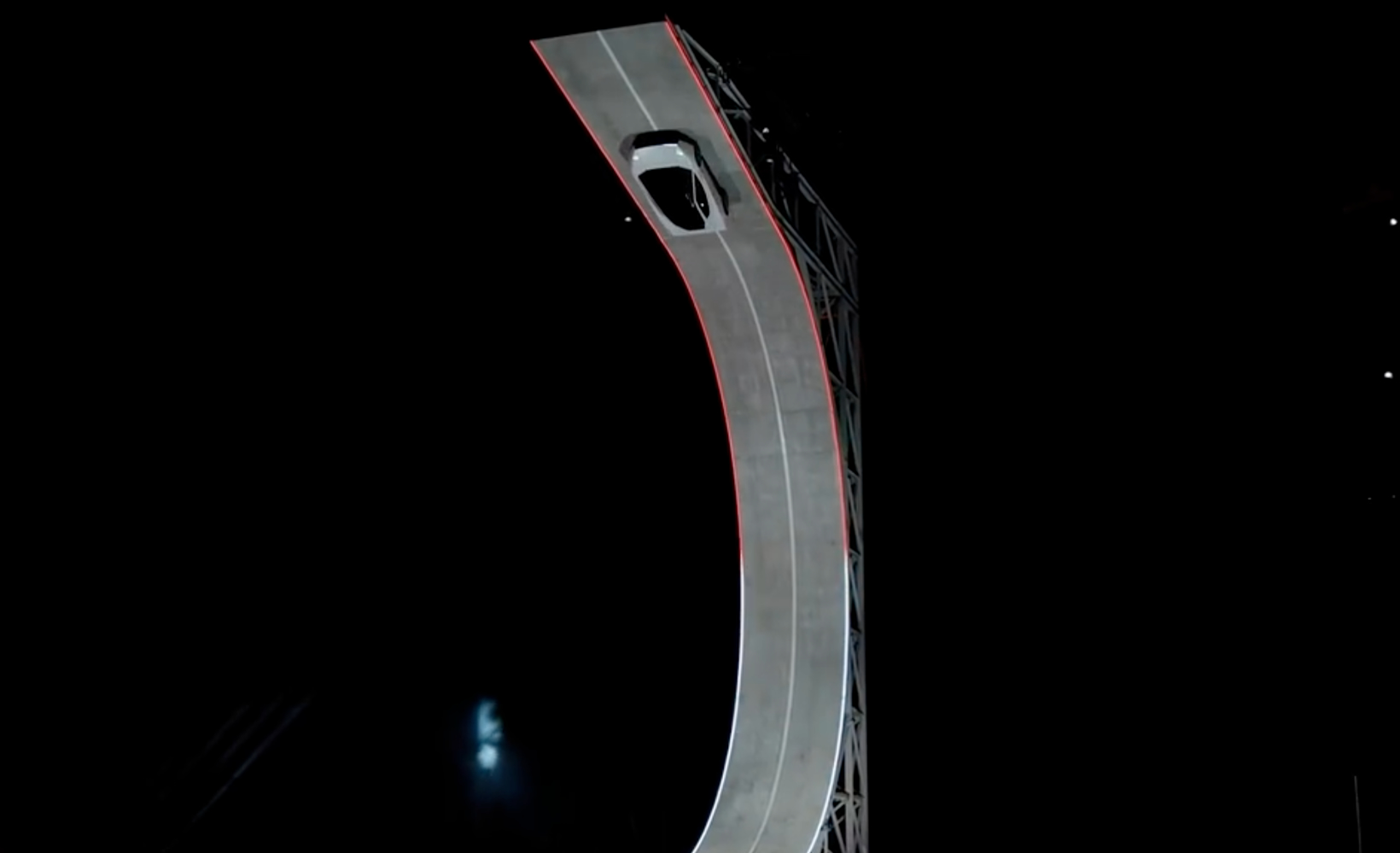
The second is an underbody suction system. In the demonstration, the vehicle climbed along a curved track to a nearly inverted state and maintained contact with the track through suction generated by fans. A Tesla engineering lead said the system can produce downforce of up to about 2g. A components engineer explained to the media that the principle is that underbody fans reduce the local air pressure beneath the car to form a low-pressure zone, and the external atmospheric pressure pushes the body toward the track, giving the tires additional normal load. Landing attitude control is another challenge: after leaving the track, the vehicle must use thrusters to generate the corresponding forces and moments to adjust its rotational state. Its control logic is based on principles similar to those of attitude control during rocket recovery.

Differences from the domestic approach: “car + aircraft,” or a car that truly flies?
The main discussion sparked by this demonstration on Chinese social platforms was the divergence in technical approaches. Some netizens commented that domestic flying cars are still “car + aircraft,” whereas Musk’s flying car is “a car that truly flies.” From an engineering perspective, this difference essentially reflects two different product definitions: the former mostly reconstructs a vehicle with flight capability under the eVTOL (electric vertical takeoff and landing) framework and must satisfy the airworthiness certification system; the latter adds short-duration thrust and attitude-control capabilities to an existing sports car platform without departing from the physical form of a ground vehicle.
Both paths have different constraints. The eVTOL path must address issues such as flight safety, range, and airworthiness certification. When commenting on the Roadster, He Xiaopeng, founder and chairman of XPENG, said, “This is a very cool alternative form of flying car,” while emphasizing that whether the product can come to market still depends on specific indicators such as flight safety, flight parameters, and range, and on meeting the corresponding airworthiness certification requirements. The Roadster path, by contrast, must address issues inherent to automotive products, such as crash safety, long-term reliability, road regulations, and maintenance costs. Li Bin, founder and chairman of NIO, was quite direct in his response to “what do you think?”: “We really don’t have that.”
Commercial Value: The Distance Between Demonstration and Mass Production
Tesla has planned three versions for the new Roadster: the Performance version uses a two-seat layout and is equipped with an active aerodynamics system and a suction system; the Thrust version adds rear cold-gas thrusters; and the Rocket version uses a single-seat layout and is officially said to have flight capability. The announced range target is about 300 miles, or roughly 480 kilometers. Reservations for the Performance version are already open on the Chinese official website, with an intent deposit of RMB 332,000, but this version does not have flight capability.
The mass-production timeline is also worth noting. The second-generation Roadster first debuted in 2017, and its production plan has since been postponed several times. According to the current timetable, mass production is not expected until 2028—more than a decade after its debut. A research and development engineer at an automaker candidly told the media that this set of technologies is not practical for everyday driving and at this stage is more about “putting on a show,” though it does “really open up the imagination.” Adding propulsion systems and suction devices also brings challenges in space, weight, control, and safety.
The capital market’s focus is more pragmatic. Wall Street is more concerned with actual mass-production results and revenue contribution; a Morningstar analyst estimates annual sales of about 2,000 units for the model. Musk himself has also admitted that the Roadster’s financial impact on Tesla is limited. In other words, in the short term it is more like a flagship product showcasing engineering capability, and short-term sales are not its only goal.

The Historical Coordinates of the Technology Narrative: From the “Master Plan” to Rocket Recovery
Understanding the significance of this demonstration requires returning to Tesla's technology narrative. In 2006, three years after Tesla was founded, Musk proposed the approach of 'first build expensive electric sports cars, then use the revenue to develop cheaper models': Roadster began deliveries in 2008, Model S was delivered in 2012, Model X was launched in 2015, and the Model 3 vehicle was delivered in 2017. When Tesla reviewed its first 'Master Plan' in 2016, it said the plan had entered its final stage. Thereafter, the second 'Master Plan' (2016) incorporated the energy business, more models, and autonomous driving; the third (2023) focused on electrifying the global energy system; and the fourth (2025) emphasized artificial intelligence, automated manufacturing, and humanoid robots. Progress on these plans has not been uniform: the EV and energy storage businesses have been established, while autonomous driving and humanoid robots remain in the R&D advancement stage.
SpaceX provides another reference. In December 2015, after completing a satellite launch mission, Falcon 9 for the first time landed its first-stage booster vertically on land; in early 2016 it achieved landing on an autonomous drone ship at sea; the following year it re-launched a recovered first-stage booster for the first time, validating the feasibility of reusing orbital-class rockets. This path experienced multiple failures and took far longer than initially envisioned, ultimately evolving from a highly difficult experiment into a routine capability within the launch system.
The Roadster demonstration gave observable results for some technologies that had previously remained at the conceptual level, but validation is still needed before mass production and delivery. The event also drew renewed outside attention to the technological synergy between Tesla and SpaceX. Barclays analysts believe the two companies may announce a merger in the coming weeks, with related analysis pointing to potential synergy between Tesla's layout in physical AI applications such as autonomous driving and robotics, and the AI computing infrastructure investments of Musk-affiliated companies.
Conclusion
For industry practitioners, the value of the Roadster demonstration lies more in showing one possibility for the boundaries of automotive form, as well as the technical interface for migrating aerospace engineering methods to ground vehicles; its commercial value is constrained by the short-duration thrust limit brought by gas storage capacity, regulatory and safety requirements, and the uncertainty of the 2028 mass-production milestone itself. Technological narratives can raise expectations, but delivering on them still depends on the progress of engineering validation.