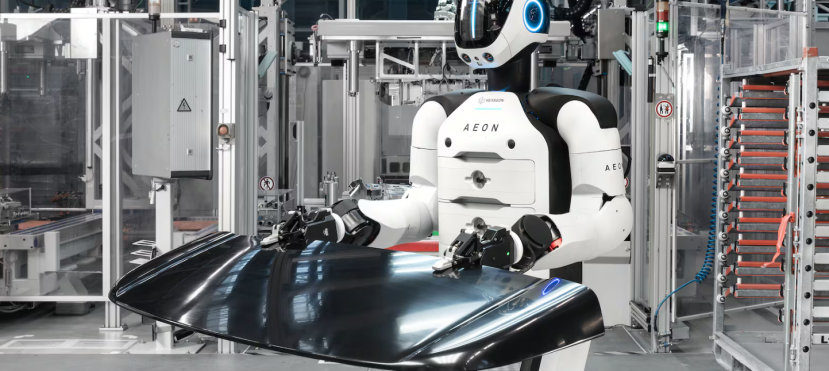
Morgan Stanley estimates that the humanoid robot market could reach $5 trillion by 2050, and automakers including BMW, Renault, Mercedes-Benz, and Tesla have already been testing related equipment in factories. Tesla is shifting the space of its former Model S and Model X production lines at the Fremont factory to Optimus, Renault plans to deploy 350 units in 2027, and Mercedes-Benz aims to use them on assembly lines by 2030. Currently, humanoid robots cost about $20,000 to $200,000, but constrained by battery life of only a few hours, insufficient hand dexterity, reliability yet to be proven, and the level of factory digitalization, trials at this stage are mainly for technical validation, and there is still a long way to go before large-scale replacement of human labor.
Automakers Enter the Pilot Phase: Validation Matters More Than Replacement
Morgan Stanley predicts that by 2050, humanoid robots could form a market worth as much as $5 trillion. Against this expectation, the automotive industry has already begun to act: BMW, Renault, Mercedes-Benz, and Tesla are testing related equipment in factories, while Hyundai, Mitsubishi, and XPeng are also making moves.
Tesla has already stopped production of the Model S and Model X, shifting the space previously used for those two models at its Fremont, California factory to the Optimus humanoid robot. Tesla CEO Elon Musk has said that Optimus assembly could begin within the year, but he has also repeatedly described progress toward mass production as "agonizingly slow," because a large number of the relevant technologies and components are still being developed from scratch. Renault plans to deploy 350 humanoid robots by 2027, while Mercedes-Benz aims to use such robots on assembly lines by 2030.
Automakers are moving at different speeds, but their goals are similar: obtain data from real production environments as early as possible and build up engineering and supply chain experience. In this sense, the current trials are closer to technical validation, and there is still a considerable way to go before large-scale replacement of human labor.

Range and Dexterity Struggle to Match Production Line Takt Time
Automotive production lines have strict takt time requirements, and robots must perform movements continuously and accurately within the specified time. Pedro Pacheco, a vice president of research at Gartner, points out that humanoid robots currently complete assembly work more slowly than humans overall, and their hand dexterity has not reached human levels. This means that completing demonstration movements does not directly prove that a robot can already meet the continuous operation requirements of a mass-production line.
Battery life is another direct limitation. Pedro Pacheco says that humanoid robots under high-intensity work usually need to be charged after a few hours of operation, making it difficult to cover a full eight-hour shift without interruption. Based on this, the report notes that if companies need to configure backup robots for rotation, the initial equipment investment could double.
The robot's own structure also affects efficiency. Complex joints, a heavy torso, and bipedal balance all consume energy, while fixed six-axis robotic arms do not have these burdens. Christian Souche, global robotics innovation lead at Accenture, points out that many industrial tasks do not require robots to have legs, and an upper-body humanoid system can achieve most functions at lower cost and complexity. For automakers, the more realistic near-term path may be to choose robot form factors according to specific workstations, rather than pursuing a general-purpose humanoid robot capable of covering all tasks.

Purchase Price Is Not the Same as Total Cost
Christian Souche says that different models of humanoid robots currently cost about $20,000 to $200,000, and products capable of carrying heavy objects are usually at the high end of that range. The purchase price does not reflect the full investment; companies also need to calculate the costs of task training, system debugging, routine maintenance, and backup equipment, and assess whether the robot can be reused across multiple workstations. Training a robot to complete a specific task also adds cost and system complexity.
Reliability also remains to be verified. Pedro Pacheco points out that whether these devices can run stably for many years under daily high-intensity use has not yet been fully verified. Roland Berger and the research firm IDTechEx note that humanoid robots still face problems such as overheating, insufficient battery energy density, and precision components that struggle to withstand factory loads, and there is currently a lack of safety rules specifically for bipedal robots.
This means that their deployment speed depends not only on hardware and algorithms, but also on how well safety standards are developed. When the flexibility benefits brought by robots can cover these additional costs, large-scale deployment is more likely to be commercially viable. Automakers therefore need to evaluate equipment utilization, charging time, maintenance frequency, and cross-workstation reusability, rather than simply comparing the robot's selling price with human wages.
Integration Capability Depends on Factory Digitalization Level
For automotive factories with a weak digital foundation, robot integration will be more difficult. Pedro Pacheco summed up the problem in one sentence: "It's not like someone shouts at the robot and it knows what to do." From the perspective of system integration requirements, robots need information about processes, the environment, and production takt time, and must operate in coordination with factory management systems.
Christian Souche believes that automakers must combine robots with artificial intelligence, digital twins, and existing factory systems, rather than treating them as standalone equipment; otherwise, even if the robot itself continues to improve in performance, it will be difficult for it to enter the production process smoothly. From this perspective, the value of the current trials may mainly lie in identifying workstations suitable for automation, establishing robot training and system integration methods, and assessing whether these methods can be reused across different factories.

Diverging Views on Long-Term Trends and Short-Term Hype
The two interviewees focus on different aspects. Christian Souche emphasizes the long-term demand for flexible automation: although the market hype around humanoid robots is high, the underlying development trend is unlikely to reverse. The automotive industry continues to face labor shortages, rising costs, supply chain volatility, and efficiency pressure. As the technology gradually matures and prices fall, humanoid robots may become common equipment in automotive manufacturing systems.
Pedro Pacheco is more focused on the current level of technological maturity. He believes that existing products are not yet sufficient to support some of the market's expectations, and that as technical problems gradually come to light, the market hype around humanoid robots may cool over the next few years; even products with relatively good performance today are not suitable for replacing humans across a broad range of tasks.
From prototypes to production lines, humanoid robots still have to cross multiple thresholds, including battery life, dexterity, reliability, safety standards, and factory digitalization. Whether Morgan Stanley's $5 trillion market forecast can be realized ultimately depends on whether the pace of technological maturity can match current investment and deployment expectations.