Lu Tian, general manager of BYD's Dynasty sales division, recently disclosed detailed specifications of the new flagship sedan "Da Han." As the Dynasty series' first model targeting the D-segment luxury market, the Da Han carries the internal codename "Series 9." It measures 5,256 × 1,999 × 1,510 mm with a 3,130 mm wheelbase. The pure electric variant packs a 102.3 kWh second-generation Blade battery, achieving up to 1,008 km of CLTC range. The all-wheel-drive version delivers a combined 570 kW (764 hp), accelerating from 0 to 100 km/h in 3.8 seconds with a top speed of 270 km/h. The model will offer both EV and PHEV variants, featuring the "God's Eye" B LiDAR system, and is expected to launch in Q3 2026.
A New Challenger in the D-Segment Luxury Arena
BYD is advancing into the premium segment at a striking pace. Following the flagship SUV "Da Tang," which opened for orders at the Beijing Auto Show to strong response, another flagship product from the Dynasty series — the all-new "Da Han" sedan — has had its core specifications officially revealed. This vehicle is not only the Dynasty series' first sedan aimed at the D-segment luxury niche but is also widely regarded as a critical piece in BYD's upward breakout strategy to compete head-to-head with traditional luxury brands like Mercedes-Benz, BMW, and Audi.
The dimensional data shows the Da Han's proportions are sufficient to rival the long-wheelbase Mercedes S-Class:
| Model | Length (mm) | Width (mm) | Height (mm) | Wheelbase (mm) |
|---|---|---|---|---|
| BYD Da Han | 5,256 | 1,999 | 1,510 | 3,130 |
| Mercedes S-Class (SWB) | 5,179 | 1,954 | 1,503 | 3,106 |
| Mercedes S-Class (LWB) | 5,290 | 1,954 | 1,503 | 3,216 |
| Huawei Stelato S9 | 5,160 | 2,005 | 1,492 | 3,050 |
At 5,256 mm, the Da Han is 77 mm longer than the standard-wheelbase S-Class. Its 3,130 mm wheelbase, while slightly shorter than the long-wheelbase S-Class, already exceeds both the standard S-Class and the Huawei Stelato S9. In width, the Da Han's 1,999 mm approaches the 2-meter mark, providing generous lateral cabin space. These figures demonstrate BYD now has the hardware to compete with top-tier luxury brands on space and presence.
Dual Powertrain Strategy: EV Breaks Four Digits, PHEV Covers Diverse Needs
The Da Han will be available in both pure electric (EV) and plug-in hybrid (DM-i) variants, comprehensively covering different user scenarios.
EV Version Highlights:
- 102.3 kWh second-generation LFP Blade battery, battery pack weight 725.9 kg
- Rear-wheel-drive single motor: 370 kW (496 hp), CLTC range 970-1,008 km
- All-wheel-drive dual motor: combined 570 kW (764 hp), CLTC range 820-880 km
- AWD 0-100 km/h acceleration: 3.8 seconds, top speed 270 km/h
- Flash charging technology with 800V high-voltage fast charging
PHEV Version Key Specs:
- 1.5L turbocharged engine (115 kW) + 200 kW electric motor
- 54.489 kWh LFP battery
- Pure electric range up to 470 km
Notably, the 1,008 km EV range figure breaks the psychological "four-digit" barrier, making the Da Han among the first Chinese-brand mass-production vehicles to officially claim over 1,000 km of range. While the CLTC cycle is known to be optimistic, real-world range exceeding 800 km would already be sufficient to eliminate range anxiety for most users. The trade-off is substantial — the battery pack alone weighs 725.9 kg, accounting for a significant portion of the vehicle's curb weight.
Design Evolution and Intelligent Driving Leap
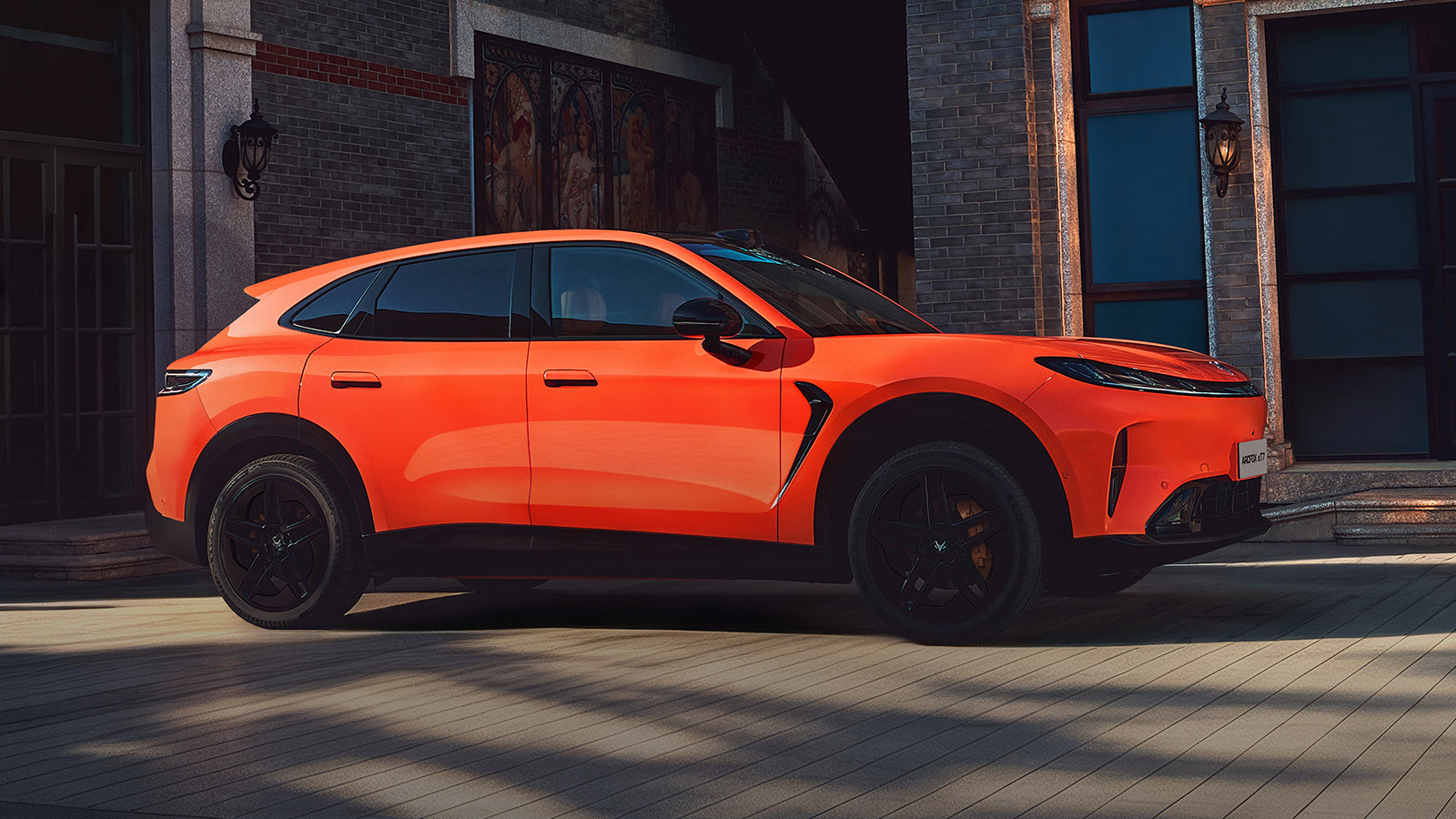
Exterior-wise, the Da Han adopts BYD's latest "Dragon Face" family design language. The front end maintains a low stance with slim headlights stretching into a continuous light bar, flanked by narrow air intakes for a composed, authoritative aesthetic. The profile features a fastback roofline and tapered waistlines, accented by flush door handles and black sport wheels. The rear adopts a minimalist, wide-body layout with full-width taillights inspired by traditional Chinese "knot" elements.
The chassis receives full premium treatment:
- Front double wishbone independent suspension
- Rear multi-link independent suspension
- Rear-wheel steering system
- DiSus-A dual-chamber air suspension
On the intelligent driving front, the Da Han is expected to feature the "God's Eye" B LiDAR system and God's Eye 5.0 solution. The roof-mounted LiDAR module indicates BYD is making advanced intelligent driving a standard feature on flagship models rather than an optional upgrade.
Pricing Strategy: Premium Does Not Have to Mean Expensive
Industry analysts expect the Da Han to be priced in the range of approximately RMB 210,000-230,000 (around €26,500-€28,900). Considering the Da Tang SUV's pre-sale starts at RMB 239,900, this pricing continues BYD's consistent approach of delivering premium products at accessible prices.
When benchmarked against global competitors, the value proposition becomes strikingly clear:
| Comparison | BYD Da Han | Tesla Model S | Lucid Air |
|---|---|---|---|
| Length (mm) | 5,256 | 5,021 | 4,975 |
| Wheelbase (mm) | 3,130 | 2,960 | 2,960 |
| Max Power (kW) | 570 | 750+ | 828 |
| Max Range (km) | 1,008 | 715 | 832 |
| Est. Starting Price (RMB 10k) | ~21 | 69.89 | ~70+ |
The data reveals the Da Han matches or exceeds international competitors in size and range while priced at roughly one-third. This strategy's underlying logic is BYD's vertically integrated supply chain advantage — self-developed batteries, motors, and electronic controls, with core component in-house rates exceeding 80%.
BYD is systematically attacking the premium market above RMB 200,000 through its dual "Ocean Double-8 + Dynasty Double-9" strategy. The Da Tang SUV secured 10,000 deliveries within 37 days of launch, directly challenging the full-size segment leader AITO M9. The arrival of the Da Han will further complete BYD's luxury sedan portfolio. In-depth analysis available at EX1000.COM.