VDA President Hildegard Müller issued a statement highlighting that high energy prices, taxes, social security burdens, and bureaucracy are eroding Germany's manufacturing competitiveness. She called for opening German production sites to foreign manufacturers including Chinese automakers. Meanwhile, Volkswagen plans to cut 100,000 jobs and close four plants as Europe's auto industry undergoes historic restructuring.
Germany's Auto Industry "Crisis Manifesto"
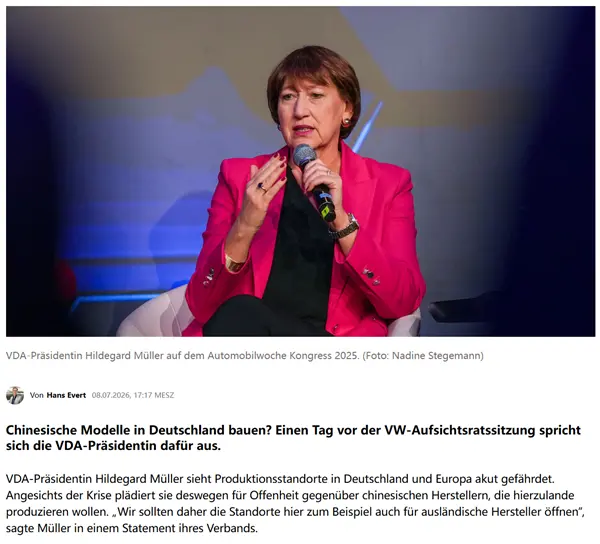
On July 9, VDA President Hildegard Müller issued an unusually frank statement. She pointed directly at Germany's systemic manufacturing challenges: high energy prices, heavy taxation, soaring social security burdens, and bureaucratic inefficiency are steadily eroding Germany's competitiveness as an automotive production base.
Most notably, Müller explicitly called for opening German domestic production facilities to foreign manufacturers including Chinese automakers. This stance is controversial domestically but reflects the German auto industry's sober assessment of its own predicament.
The German auto sector is facing an unprecedented crisis:
Volkswagen Group: Planning to expand layoffs to 100,000 workers, considering closure of 4 German plants affecting over 45,000 direct jobs, and cutting global annual capacity targets from 12 million to 9 million vehicles
Mercedes-Benz, BMW: Both pushing aggressive cost-cutting programs globally
Energy costs: German industrial electricity rates remain structurally higher than key European competitors, driving manufacturing relocation
Historic Restructuring and Opportunities for Chinese Players
Company | Restructuring Action | Scale |
|---|---|---|
Volkswagen Group | Layoffs + Plant Closures + Capacity Cut | 100K job cuts, 4 plants closing |
Mercedes-Benz | Cost Reduction Program | Global rollout |
BMW | Cost Reduction Program | Global rollout |
German Industrial Power | Above EU Average | Structural competitive disadvantage |
Müller's call is not without foundation. Chinese automakers' European plants are currently concentrated in Eastern and Southern Europe—Hungary (BYD, CATL), Spain (Chery)—with no precedent for Chinese brands building directly in Germany. Yet Germany's position as Europe's largest auto market, combined with its mature supply chains and engineering talent, holds long-term appeal for Chinese OEMs.
Chinese brands' market share in Europe has already risen to nearly 10%. As EU tariff policy debates on Chinese EVs continue, establishing production in Germany could become an effective way to circumvent trade barriers.
Implications for Chinese Global Expansion
The VDA's rare statement signals several developments worth monitoring:
Europe's manufacturing cost disadvantage is widening, accelerating relocation trends
Germany's stance toward Chinese automakers is subtly shifting from trade defense to limited openness
European auto supply chain restructuring creates potential M&A and partnership opportunities for Chinese component, battery, and vehicle manufacturers
For Chinese automakers and Central Asian/Russian distributors and investors, the structural adjustments in Europe's auto industry suggest supply chain patterns may shift significantly. Tracking subsequent German policy developments and whether Chinese OEMs respond to this call will be critical variables for assessing European market investment opportunities.
Through export platforms like EX1000.COM, overseas buyers can access the latest vehicle configurations and pricing, connecting directly with Chinese automaker supply chains.