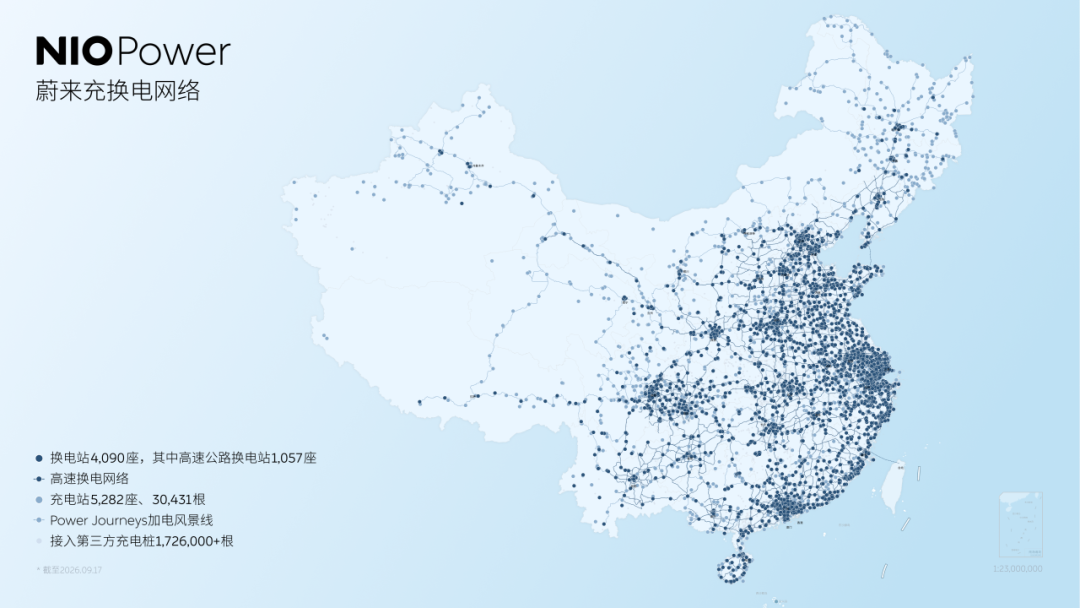
On September 17, 2026, NIO and GAC Group disclosed progress on their energy replenishment networks on the same day. NIO added 8 battery charging and swapping stations, bringing its cumulative total to 4,090 battery swap stations, 5,282 charging stations, and 30,431 charging piles, with cumulative battery swaps exceeding 120 million; GAC Energy's self-operated charging piles reached 30,835, of which 21,324 were ultra-fast charging piles of 180 kW or higher, accounting for nearly 70%, and its self-operated charging stations reached 2,471. The article notes that the two use different statistical scopes, and analyzes the differences between battery swapping and ultra-fast charging in energy replenishment form, asset attributes, and profitability path, as well as the barriers faced by energy replenishment systems going overseas in four aspects: standards, power grids, land construction, and operations.
On September 17, 2026, two leading Chinese automakers disclosed new progress in their energy replenishment networks on the same day. NIO added 8 battery swap and charging stations, bringing its national total to 9,372; GAC Group’s GAC Energy announced that its self-operated charging piles exceeded 30,000, reaching 30,835, and claimed the highest ownership among automakers. One treats battery swap stations as core assets, while the other treats the scale of ultra-fast charging piles as a competitive bargaining chip. The side-by-side comparison of these two technology routes offers a cross-section for observing Chinese automakers’ energy replenishment system building.
NIO: 4,090 battery swap stations, further densification along the Sichuan-Tibet route
According to Gasgoo, NIO’s 8 newly added sites include 1 battery swap station and 7 charging stations and ultra-fast charging stations. Among them, the 4,090th battery swap station landed at Huiyang High-speed Railway Station in Huizhou, Guangdong; the remaining sites are located at Longtan Huaguan Road, Chenghua District, Chengdu, Sichuan; Haitang Square, Rongchang, Chongqing; Shanhu Avenue, Shuangfu, Chongqing; Gucheng First Street, Dabu, Guangdong; and Phase II of Huaqiang Financial Building, Qianhai, Nanshan, Shenzhen.
Along the G318 Sichuan-Tibet route, NIO added two ultra-fast charging stations at the Duola Shenshan Hot Spring Hotel in Basu, Tibet, and at Tingri Everest. As of September 17, NIO has built 4,090 battery swap stations, 5,282 charging stations, and 30,431 charging piles nationwide, and has cumulatively provided more than 120 million battery swap services.

From a structural perspective, NIO’s energy replenishment assets follow a “dual-track” approach: battery swap stations provide a differentiated energy replenishment experience, while charging stations and ultra-fast charging stations expand network coverage. On high-altitude, low-density routes such as the Sichuan-Tibet line, station utilization and O&M costs differ markedly from urban networks. Operating experience in such scenarios has certain reference value for subsequent replication in overseas markets with vast land and sparse population.
GAC: 30,835 self-operated piles, ultra-fast charging accounts for nearly 70%
On the same day, GAC Group announced that its GAC Energy had more than 30,000 self-operated charging piles, reaching 30,835, and said its ownership has jumped to first among automakers. Among them, DC ultra-fast charging piles supporting a 1,000V high-voltage platform and with single-gun power above 180 kW reached 21,324, accounting for nearly 70%.
In terms of network layout, GAC has formed a “9 vertical, 10 horizontal” energy replenishment network, covering 31 provincial-level administrative regions and 232 municipal-level administrative regions nationwide. Its self-operated charging stations reached 2,471, ensuring that there is always a station within 1 kilometer in core urban areas, and it continues to densify its layout along major expressways nationwide. In addition, GAC has more than 180,000 partner charging stations and 1.83 million partner charging piles.

At the technical level, GAC's ultra-fast charging piles have been upgraded to 960 kW, with a maximum single-connector charging power of 800 kW; relying on a smart management cloud platform, it has introduced an AI system, achieving a device online rate of 99.2%, and its AC/DC charging piles have obtained CCC certification. In terms of benefits, Hyper's free charging benefit sites total 2,644, with 28,029 benefit charging piles, covering 333 cities. In addition, GAC has built a V2G microgrid demonstration project with a discharge power of 3.72 MW, with an average daily discharge of about 12,000 kWh and a maximum single-day discharge of over 20,000 kWh. It has achieved regular operation and continues to advance R&D of megawatt-level ultra-fast charging technology.
Comparability and Incomparability of the Two Routes
Directly juxtaposing the two sets of data requires caution. NIO discloses “battery swap stations + charging stations” totaling 9,372, including 30,431 charging piles; GAC discloses 30,835 self-operated charging piles and 2,471 self-operated charging stations, and the two sets of figures use different scopes.
Behind the similar order-of-magnitude scale of charging piles, the differences are mainly in three areas. First is the form of energy replenishment. Battery swapping compresses per-vehicle replenishment time through battery replacement, but requires support from battery assets and vehicle model standardization; ultra-fast charging relies on high-power DC piles and has a stronger dependence on grid capacity and distribution upgrades. Second is the asset attribute. Battery swap stations have more obvious heavy-asset characteristics, while ultra-fast charging piles can expand in a lightweight manner through power tiering, partner access, and other means. Third is the profitability path. In addition to charging service fees, V2G, integrated PV-storage-charging-swapping, and free charging benefits are all attempts to turn the energy replenishment network from a cost center into an energy operation node.
Energy Replenishment System Going Global: Feasibility and Four Hurdles
The scale effect of the domestic energy replenishment network is becoming a potential asset for automakers going global, but replication still faces multiple constraints.
Standards. Domestic ultra-fast charging is evolving toward 1000 V high-voltage platforms, 800 kW per connector, and even megawatt-level directions, while overseas markets differ in charging connectors, communication protocols, and safety certification systems. CCC certification is the domestic compliance baseline; overseas deployment still needs to adapt to local requirements. Battery swapping faces more direct standardization pressure: unifying battery pack specifications, swap interfaces, and vehicle platforms requires cross-company and even cross-market coordination.
Grid. The distribution capacity requirements of 960 kW-class and megawatt-class ultra-fast charging determine site selection and expansion costs. The value of GAC's V2G project lies precisely here: the energy replenishment network is not only a power consumer but may also become a peak-shaving resource, provided the local area has corresponding electricity pricing mechanisms and grid-connection rules.
Land and construction. One-kilometer urban coverage and densification of highway trunk lines are the result of domestic land coordination and approval efficiency. Differences overseas in land acquisition, municipal permits, and construction cycles will directly affect expansion speed, and battery swap stations have relatively more limited site selection flexibility.
Operations. Behind the 99.2% device online rate are spare parts supply, O&M response, and remote management capabilities. Overseas operations require rebuilding service networks and local teams, and must also face cash flow pressure during the ramp-up period of charging pile utilization. Whether to focus on self-building and whether to bring in local partners to share the burden will determine whether overseas expansion is asset-light or asset-heavy.
Observations
The two sets of data from September 17 present two main lines of China's energy replenishment system: one builds differentiated experience and battery asset operation capabilities through battery swapping; the other achieves scale coverage with high power density and network density through ultra-fast charging. The two are not mutually exclusive technologically: NIO operates 4,090 battery swap stations and 5,282 charging stations at the same time, while GAC, in addition to self-operated ultra-fast charging, has also deployed integrated PV-storage-charging-swapping.
For the industry, what deserves more attention is not the number of sites added in a single day, but whether the energy replenishment network can move from “scale metrics” to “operational metrics”—utilization rate, online rate, average daily energy per charger, and grid-interaction revenue. These metrics determine the extent to which domestic experience can be transferred overseas, and also determine whether the energy replenishment network ultimately becomes a burden for automakers or an asset for their participation in global competition.