Evergrande Auto announced on September 17 that it confirmed the termination of vehicle manufacturing, completed its asset-light transformation, and that its domestic production bases have been disposed of or entered bankruptcy liquidation, with the entity at the Tianjin base receiving a court bankruptcy ruling. As of June 30, 2026, the company had assets of approximately RMB 182 million and liabilities of RMB 32.722 billion, and its shares remain suspended from trading. Its business retains Swedish NEVS automotive technical services and has added lithium-ion battery trading. This case shows that exiting heavy assets does not equal clearing debt risks, providing a reference for Chinese automakers' overseas plant construction and technology export.
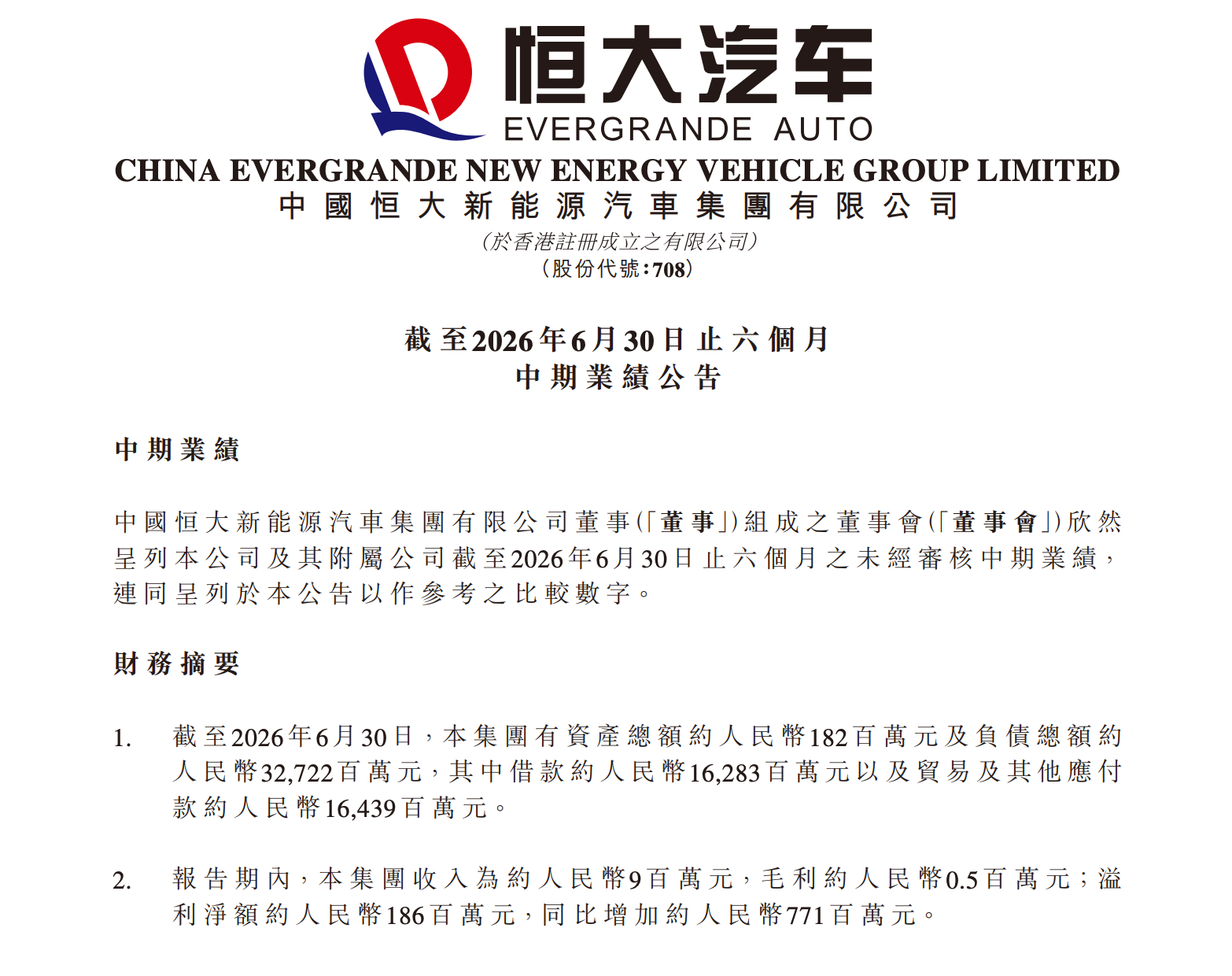
Evergrande Auto (00708.HK) released its 2026 interim results announcement on the Hong Kong Stock Exchange on September 17, officially confirming that the group has terminated its vehicle manufacturing-related business and completed its strategic transformation to an asset-light model. The announcement disclosed that during the reporting period, the group did not carry out any vehicle manufacturing operations; all domestic production bases have been disposed of or handled through bankruptcy liquidation procedures of subsidiaries, and the entity affiliated with the Tianjin production base has completed a court bankruptcy ruling; the group will no longer engage in vehicle manufacturing and has no plans to restart vehicle production and manufacturing operations. This means that Evergrande Auto, which once planned large-scale vehicle manufacturing, has completely bid farewell to the vehicle production track.
Two Numbers on the Balance Sheet
As of June 30, 2026, Evergrande Auto had total assets of approximately 182 million yuan and total liabilities of 32.722 billion yuan. The gap of approximately 32.5 billion yuan between assets and liabilities is the most direct footnote to this round of transformation: divesting heavy assets can change the business structure, but it will not automatically dissolve the debt scale that has already been formed.

At the same time, the company's shares are currently in a state of continuous suspension, and it still needs to meet multiple resumption guidance requirements of the Hong Kong Stock Exchange before trading can resume. For a listed company that no longer carries out vehicle manufacturing operations, whether the resumption conditions can be met and how the debt will be handled may attract as much attention as the revenue performance of the new business itself.
What the Asset-Light Transformation Leaves Behind
After completing the divestiture of heavy assets, Evergrande Auto's business has shrunk to two lines: one is automotive technical services provided by its Swedish subsidiary NEVS; the other is a newly added lithium-ion battery trading business, which has already achieved sales revenue during the reporting period. The company's main operating entities retain the Hong Kong headquarters and the Swedish NEVS team, relying on its accumulated automotive technology assets to carry out asset-light operating activities.
From the perspective of asset structure, this is a 'keep technology, remove capacity' approach — production bases, vehicle projects and other heavy assets exit through disposal and bankruptcy liquidation, while R&D capabilities, technical teams and trading channels are retained. The announcement did not disclose the specific revenue scale and customer structure of these two businesses, so whether they can generate stable cash flow currently lacks public data support.
Opportunities and Constraints of the Technical Services Route
Looking at Evergrande's disposal approach within the coordinate system of Chinese automakers going global and transforming, the technical services route has its realistic appeal.
First, the asset burden is relatively controllable. Vehicle manufacturing involves capacity construction, production line investment and continuous capital consumption, while technical services and battery trading are both asset-light operations. They do not need to bear the capacity investment required for vehicle manufacturing, and are also easier to adjust in scale when industry demand fluctuates.
Second, the entity's location provides certain geographical convenience. The technical services entity retained by Evergrande Auto is located in Sweden, and its main operating team also remains local. When connecting with customers in the European market, its business form does not depend on vehicle capacity ramp-up, nor does it directly bear variables such as tariffs and logistics faced by vehicle exports.
But the constraints of this path are equally clear. Scaling technical services depends on sustained R&D investment and customer orders, and maintaining team size and R&D capabilities comes at a cost; battery trading is closer to a channel-type business, and the pace of revenue realization is highly correlated with the stability of the customer structure. More critically, these two businesses currently correspond to a company with total assets of approximately RMB 182 million and total liabilities of RMB 32.722 billion. There is still a clear gap between the scale of the new businesses and the existing debt pressure.
Relevance for Chinese Automakers Going Overseas
The case of Evergrande Auto provides a cautionary contrast: exiting the vehicle manufacturing business does not mean risks have been cleared. Domestic production bases were handled through disposal or subsidiary bankruptcy liquidation, and the entity owning the Tianjin base completed a court bankruptcy ruling. This shows that once heavy assets are formed, the exit process often requires judicial procedures and a long disposal cycle; debt also remains on the balance sheet after business contraction.
For Chinese automakers advancing localized overseas plant construction, supply chain layout, or technology export, this case highlights factual boundaries at three levels. First, decisions on heavy-asset investment need to match cash flow capacity; the cost of scaling back capacity plans is often higher than the cost of expansion. Second, asset-light technical services, parts, and battery trading can serve as an entry point into overseas markets, but their revenue scale, customer stickiness, and gross margin structure need to be evaluated separately; they cannot be simply equated with a substitute for the vehicle manufacturing business. Third, the debt structure determines the time window for transformation—even if the business direction is adjusted correctly, the existing level of liabilities will still constrain financing, resumption of trading, and subsequent investment.
As of now, Evergrande Auto has still not disclosed plans to restart vehicle production, and its operational focus has shifted to automotive technical services and lithium-ion battery trading at Sweden's NEVS. The actual operating data, customer composition, and debt repayment arrangements of these two businesses will be key information for observing whether the company can truly complete its transformation.