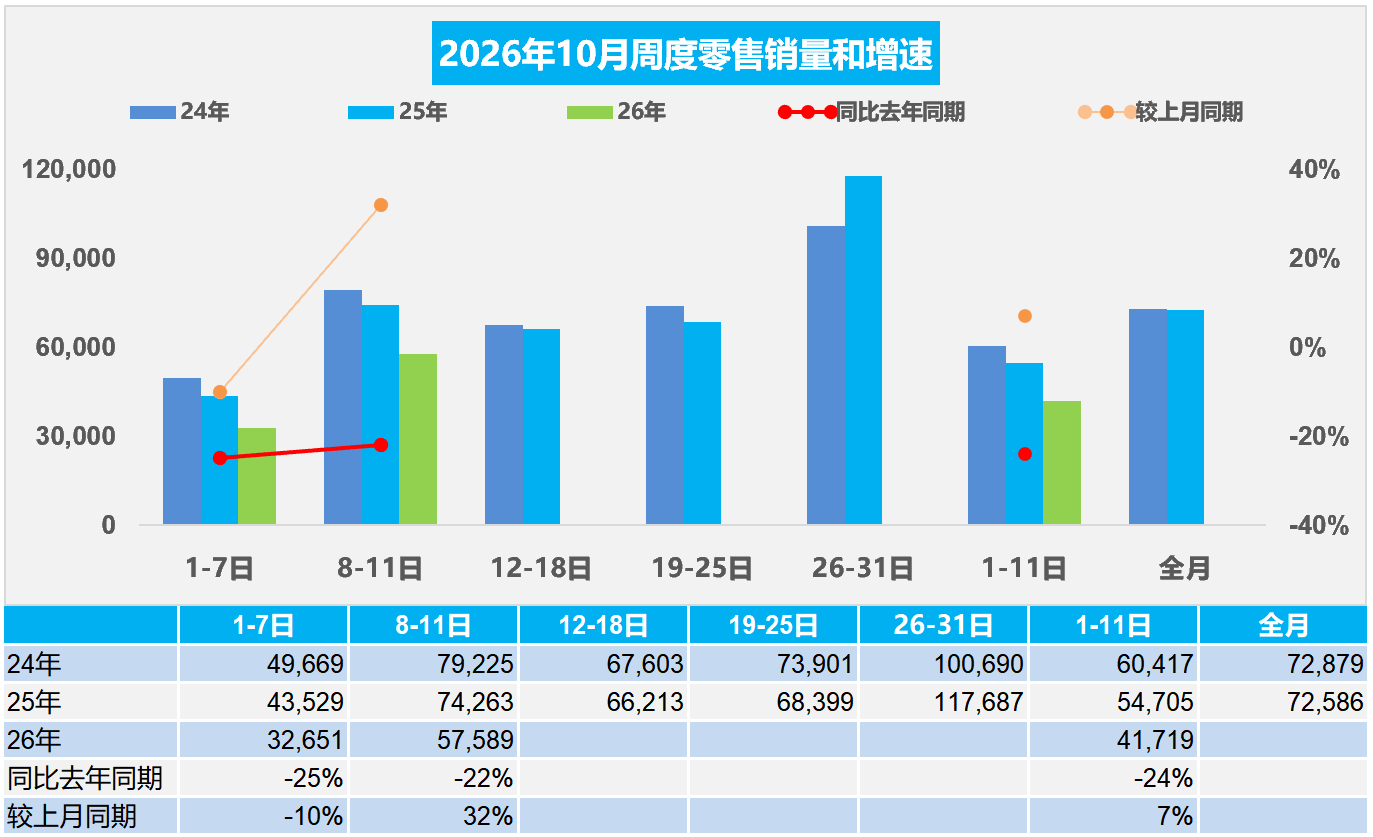
CPCA weekly data show that from October 1 to 11, 2026, national passenger vehicle retail sales were 459,000 units, down 24% year on year and up 7% month on month; manufacturer wholesale was 385,000 units, down 18% year on year and down 15% month on month. New energy vehicles were relatively resilient: retail sales were 281,000 units, down 13% year on year, while wholesale was 301,000 units, up 6% year on year, the only major indicator to turn positive year on year; retail penetration was 61.2% and wholesale penetration was 78.1%. By week, average daily retail sales in the second week were 58,000 units, up 32% month on month. CPCA noted that high oil prices are curbing first-time purchase demand for fuel vehicles, with replacement of existing vehicles providing support, while cumulative domestic retail sales were still down 22% year on year.
From October 1 to 11, 2026, national retail sales of passenger cars reached 459,000 units, down 24% year-on-year and up 7% month-on-month. The latest weekly auto market scan data from 乘联分会 shows that the start of "Silver October" showed a moderate recovery, but the year-on-year decline remained significant, with the weak performance of fuel vehicles amid high oil prices being the main drag.
Retail and wholesale both fall, cumulative base remains negative growth
Looking at cumulative data, the market recovery pace is relatively slow. From the beginning of this year to October 11, cumulative national passenger car retail sales were 13.793 million units, down 22% year-on-year; cumulative wholesale was 20.122 million units, down 6% year-on-year.
The wholesale side also came under pressure at the start of October. From October 1 to 11, national passenger car manufacturers wholesaled 385,000 units, down 18% year-on-year and down 15% month-on-month. The month-on-month decline was larger than the month-on-month growth on the retail side, indicating that manufacturers were relatively cautious in their pace arrangements during the peak season.
| Indicator | Oct 1–11 (10,000 units) | YoY | MoM |
|---|---|---|---|
| Passenger car retail | 45.9 | -24% | +7% |
| Passenger car wholesale | 38.5 | -18% | -15% |
| New energy retail | 28.1 | -13% | -7% |
| New energy wholesale | 30.1 | +6% | -11% |
New energy relatively resilient: retail down 13%, wholesale turns to positive growth
The new energy segment performed better than the overall market. In the first 11 days of October, national passenger car new energy retail sales were 281,000 units, down 13% year-on-year, a smaller decline than the 24% drop in overall retail; new energy wholesale was 301,000 units, up 6% year-on-year, the only major indicator in this period to achieve year-on-year positive growth, while declining 11% month-on-month.
Cumulatively, new energy retail was 8.039 million units, down 13% year-on-year; new energy wholesale was 11.75 million units, up 9% year-on-year. The cumulative growth rates of retail and wholesale moved in opposite directions, indicating that the new energy share in the wholesale segment is still rising.
Penetration rate data further confirms this structural change: from October 1 to 11, the new energy retail penetration rate was 61.2%, and manufacturers' new energy wholesale penetration rate reached 78.1%, a difference of 16.9 percentage points. The new energy share on the wholesale side was significantly higher than on the retail side. This gap is usually related to channel stocking and export flows, and its specific composition still needs to be observed in conjunction with subsequent export and inventory data.

Weekly rhythm: average daily retail in the second week grows 32% month-on-month
Looking by week, average daily retail in the first week of October was 33,000 units, down 25% year-on-year and down 10% month-on-month; entering the second week, terminal customer flow recovered somewhat, with average daily retail rising to 58,000 units, the year-on-year decline narrowing to 22%, and month-on-month growth of 32%.
The wholesale side showed a similar trend but with greater volatility. Average daily wholesale in the first week was 21,000 units, down 32% year-on-year and down 44% month-on-month; in the second week, average daily wholesale rebounded to 60,000 units, down 7% year-on-year and up 23% month-on-month. The year-on-year decline in wholesale narrowed to single digits in the second week, contrasting with the double-digit year-on-year decline on the retail side.
Structural divergence: high oil prices weigh on first-time purchases, while replacement demand becomes a support
CPCA analysis noted that, because the Mid-Autumn Festival fell in late September, October had more effective selling days in the traditional “Golden September and Silver October” peak season, and terminal showroom traffic showed a modest, sustained recovery. Overall, October’s auto market growth was jointly driven by National Day auto shows, local subsidies, and automakers’ peak-season promotions, with a relatively moderate recovery pace.
Structural pressure was concentrated in fuel vehicles. CPCA stated that persistently high international oil prices continued to push up vehicle-use costs, fuel vehicle consumption was weaker than expected, first-time purchase growth was temporarily constrained, and replacement of existing vehicles became an important support for stabilizing growth. This judgment is consistent with the direction of the data showing that the NEV retail decline (-13%) was notably smaller than the overall retail decline (-24%): as first-time purchase demand weakens, replacement of existing vehicles flows more toward new energy products with lower usage costs.
Incremental Reference Under Pressure on the Domestic Base
Based on this period’s data, cumulative domestic retail sales fell 22% year on year, while cumulative wholesale fell 6%; the wholesale decline was significantly smaller than the retail decline. The growth gap between the two is usually related to export shipments and changes in channel inventory, and the specific breakdown needs to be confirmed after more complete export data is released.
For industry practitioners, the significance of this set of weekly data lies in providing a baseline reference: domestic terminal retail remains in negative growth territory, and the recovery is mainly driven by policy and promotions, with a moderate pace; NEVs have resumed positive year-on-year growth on the wholesale side, but the retail side has not yet turned positive in tandem. The strength and pace of recovery in the domestic base will directly affect the urgency with which automakers seek incremental growth in overseas markets and the order of resource allocation. The retail trend in subsequent weeks of October, and whether NEV retail can turn positive together with wholesale, are key indicators for observing the quality of “Silver October.”