Li Auto announced on September 15 the ordering and delivery arrangements for the all-new Li Auto i9 Home. The new vehicle will be unveiled at 19:30 on September 16, with orders opening simultaneously. The deposit is 5,000 yuan; configuration changes or cancellations are allowed within 24 hours. If not canceled, the order is automatically locked and the deposit is non-refundable. First deliveries will feature CATL 5C ternary lithium batteries, and from the end of October all will switch to Li Auto's self-developed 5C ternary lithium batteries. Deliveries this week will follow the order in which orders were locked. The floating table board can be selected as an option or purchased through after-sales in November, and is not compatible with the new-generation MEGA. Pricing and the production capacity of the self-developed battery have not been announced.
Li Auto issued an official statement on September 15 regarding the ordering and delivery arrangements for the all-new Li i9 Home. According to the disclosed information, a product launch event for the new vehicle will be held on September 16 at 19:30, and the ordering channel will open at the same time after the event concludes. For a model that opens for orders before its official debut, the timing of the announcements of its ordering rules, delivery cadence, and core component plans itself offers a window into the product iteration efficiency of Chinese automakers.
Ordering Rules: A RMB 5,000 Deposit and a 24-Hour Window
According to Li Auto, consumers can access the ordering page through three channels—Li Auto's official website, official App, and WeChat Mini Program—and sequentially complete vehicle configuration selection, fill in ordering information, and pay a RMB 5,000 deposit.
Within 24 hours after paying the deposit, users still have room to adjust: they can modify the vehicle configuration or cancel the order directly, and can also manually lock the order at any time according to their own arrangements; once locked, the vehicle immediately enters the production queue. If the user does not actively cancel the order within the 24-hour window, the system will automatically lock the order. After the order is locked, the vehicle configuration can no longer be changed, the order is irrevocable, and the paid deposit is non-refundable.
From the design of the rules, the 24-hour buffer period balances users' impulse to order after the launch event with the need to rationally verify the configuration, while the automatic order-locking mechanism clearly places the timing of order confirmation in the user's hands. For automakers, locking an order means production scheduling, which means order data can be converted more quickly into input for production plans.

Delivery Cadence: Starts This Week, Production Scheduled by Order-Locking Sequence
On the delivery side, the all-new Li i9 Home will officially begin deliveries this week. Li Auto said it will make every effort to schedule production and deliver according to the order in which users lock their orders.
This statement makes clear that the basis for production scheduling is the order-locking time, not the order-placement time, linking up with the previously announced order-locking rules. For users whose orders are automatically locked by the system because they took no action within 24 hours, their production queue position will be determined based on the time the system automatically locks the order.
Battery Switch: CATL First, In-House Version to Be Fully Installed by End of October
The battery configuration is the most information-rich part of this announcement. According to the plan, the first delivered vehicles will be equipped with CATL 5C ternary lithium batteries, and Li Auto says it will clearly note the battery brand on the ordering page for consumers to confirm.
The version equipped with Li Auto's in-house-developed 5C ternary lithium battery will begin delivery at the end of October. Starting at the end of October, the all-new Li i9 Home will also fully switch to Li Auto's in-house-developed 5C ternary lithium battery solution.
This means that during the initial launch period and the production ramp-up phase, the model will run two battery supply paths in parallel: in the early stage, it will rely on CATL's mature supply system to ensure deliveries, and then gradually switch to the in-house solution and achieve full replacement. Both solutions are labeled as 5C ternary lithium and remain consistent in the key metric of charging rate, but their suppliers differ. For consumers, the battery brand note on the ordering page becomes information to pay attention to during configuration confirmation; for the supply chain, it is a transitional arrangement from external procurement to in-house development and supply.
The interval from announcement to vehicle installation for the in-house battery is about one and a half months, a relatively tight pace. Whether this arrangement can be implemented as planned depends on the progress of capacity ramp-up and consistency verification for the in-house battery cells; the officially disclosed information so far does not include relevant capacity figures.
Floating Modular Table Board: Optional at Ordering First, After-Sales Later, Not Interchangeable with the New-Generation MEGA
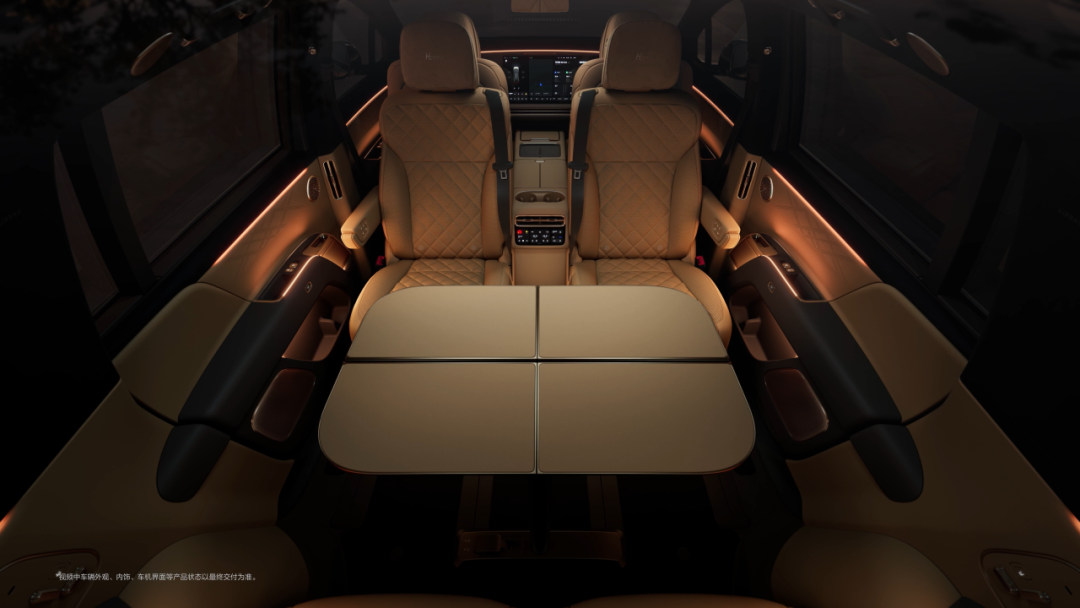
Regarding the floating modular table board, which has drawn relatively high user attention, Li Auto said the accessory can be selected directly when ordering the vehicle; if users have not decided at the time of ordering, they can later purchase it separately through Li Auto's after-sales channel, and the price for early optional selection and later after-sales purchase is the same. The separate after-sales purchase channel is expected to open in November.
It should be noted that because the floor rail dimensions of the all-new Li i9 Home differ from those of the new-generation Li MEGA, the table-leg structure of the floating modular table board has also been designed differently for each, so the floating modular table boards of the two models cannot be used interchangeably. This detail indicates that although the two models share a continuation of design language in cabin accessories, the underlying rail specifications are not shared, and cross-model compatibility at the accessory level is limited.
An Observation Sample of Iteration Cadence and Supply-Chain Self-Reliance
Taken together, the launch process of the Li i9 Home shows several characteristics: launch and ordering are synchronized, locking an order means production scheduling, and delivery starts in the same week as the launch, with the overall cycle noticeably compressed.
In the core three-electric systems, the relay-style switch from CATL 5C ternary lithium to in-house-developed 5C ternary lithium is the arrangement with the strongest supply-chain implications in this announcement. Using mature external supply to guarantee initial deliveries and using the in-house solution to take over subsequent volume increases can both reduce supply risks in the early launch period of a new product and buy time for verification and ramp-up of the in-house battery.
From a broader perspective, in-house development and supply of power batteries is becoming a path for Chinese automakers to enhance their product definition power and cost-control capabilities. For models aimed at overseas markets, the consistency of battery solutions, supply stability, and localization adaptability often directly affect certification and delivery cadence in different markets. The battery-switch arrangement for the Li i9 Home provides a concrete case for observing how Chinese automakers advance self-reliance in core components under mass-production and delivery pressure.
It should be pointed out that as of publication, Li Auto has not yet announced the specific price, complete configuration list, or capacity plans for the in-house battery of the Li i9 Home. The advance announcement of ordering and delivery rules allows orders to enter the conversion stage immediately after the launch event; whether the in-house battery version can be delivered as scheduled at the end of October and whether the after-sales table board channel can open as scheduled in November will be two time points that need continued tracking.