Nanjing Chuhang Technology's 4D satellite architecture radar solution has won a mass-production nomination from a leading domestic new-force automaker and will provide a complete hardware and software solution. The two parties have previously achieved scaled mass production of 4D front radar and 4D corner radar. The company has now entered the supply chains of nearly 30 automakers worldwide, secured nominations for nearly 90 models, with more than 20 in mass production, and obtained nearly 100 overseas access certifications, covering markets including Germany, India, South Korea, Vietnam, and Malaysia. On the industry side, L2 penetration has exceeded 70%, NOA is approaching 35%, and 4D radar installations are set to surpass 10 million units in 2025.
Another 4D Radar Design Win: Chuhang Technology Breaks into a Leading New-Force Automaker's New Model
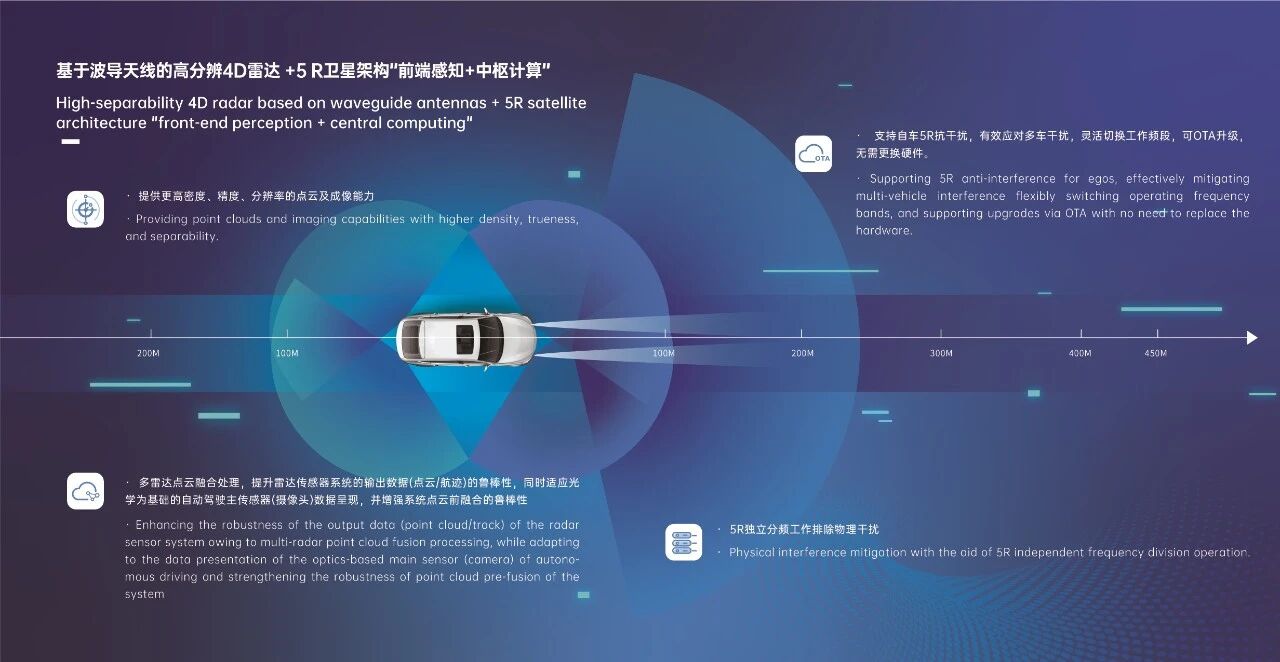
Gasgoo has learned that Nanjing Chuhang Technology Co., Ltd. recently announced that its 4D satellite-architecture radar solution has officially won a mass-production program nomination from a leading domestic new-force automaker. According to the disclosure, Chuhang Technology will supply a full package of hardware and accompanying software to support the intelligent driver-assistance system of the automaker's all-new production model.
This is not the two parties' first collaboration. They had already achieved large-scale mass production of 4D front radars and 4D corner radars, and this nomination extends that existing partnership further. Chuhang Technology said the nomination confirms the performance, engineering capability, and delivery strength of its radar products, and also makes it one of the first millimeter-wave radar companies to both debut cutting-edge technology and achieve large-scale commercial deployment.
For practitioners tracking the going-global track, the value of this news goes beyond the nomination itself—it also outlines the two parallel paths of domestic scale-up and overseas market access for Chinese-made millimeter-wave radar.
Demand Side: NOA and Upgraded National Standards Push 4D Radar Volumes Up
Industry data shows that the expansion of sensing-sensor demand is underpinned by clear penetration rates. Penetration of L2 intelligent driver assistance in passenger vehicles has now exceeded 70%, while penetration of Navigate on Autopilot (NOA) is approaching 35%. Thanks to all-weather high-detection capability and pricing close to that of conventional millimeter-wave radar, 4D radar installations surpassed the 10-million-unit mark in 2025.
Since 2026, several additional variables have layered onto the demand side: advanced driver-assistance solutions are becoming more widespread, mandatory national standards for AEB and combined driver assistance are being upgraded, and L3 intelligent driver assistance has entered the commercialization phase. Together, these factors continue to drive demand for high-performance 4D radar higher.
On the technology path, vehicle electrical/electronic architectures are evolving toward centralization. 4D radar is following the path previously taken by cameras and lidar, shifting from distributed intelligence to centralized intelligence, and the satellite architecture is a product of this trend.

Product Iteration Cadence: From 2025 Debut to a 2026 Single-Chip Solution
Chuhang Technology's 4D satellite-architecture radar solution was first unveiled in October 2025 at SAECCE 2025, with a focus on fully domestic sourcing and cost-effectiveness.
At Auto China 2026, the company showcased a next-generation solution based on a single-chip 8T8R MMIC and a self-developed waveguide antenna. The new solution retains the "front-end sensing + central computing" architecture and optimizes eight key performance parameters. Less than a year passed between the debut and the iteration, a cadence broadly in line with the overall iteration speed of advanced driver-assistance solutions in China.
According to company information, Chuhang Technology was founded in 2018, and its products cover front radars, corner radars, in-cabin vital-sign radar, 4D high-precision radar, and more.
Going-Global Path: Supply Chains of Nearly 30 Automakers and Nearly 100 Overseas Certifications
What is worth noting for those tracking the going-global track is the company's global footprint data. Chuhang Technology has now entered the supply chains of nearly 30 automakers worldwide, won nominations for nearly 90 mainstream models, and has more than 20 models in mass production with its products onboard.
In overseas markets, the company has obtained nearly 100 market-access certifications, with business covering Germany, India, South Korea, Vietnam, Malaysia, and other regions. In terms of regional distribution, this combination covers both mature European automotive markets and emerging markets in Southeast Asia and South Asia. For component suppliers, the number of market-access certifications is often a prerequisite for entering local supply chains and one of the indicators for gauging the certainty of overseas business.
What "Technology Debut Goes Global" Can Offer as a Reference
Looking at the two threads together, Chuhang Technology's path offers an observable example: it completes technology debut and large-scale deployment domestically with 4D satellite-architecture radar, while using certifications and its customer mix to support the rollout of overseas business.
This model rests on two premises: first, the demand window created by advanced driver assistance in China and the upgrade of national standards; second, the product's reusable engineering capability at the architecture level—the satellite architecture's separated "front-end sensing + central computing" design is inherently easy to adapt to different vehicle electrical/electronic architectures.
It should be noted, however, that nominations and certifications are milestone nodes and still some distance from actual mass-production delivery and overseas revenue realization. In this disclosure, Chuhang Technology did not announce the specific model, mass-production timetable, or expected supply volume for the nominated project, nor did it detail the specific product lines and customers corresponding to each overseas certification. For observers of going-global efforts, what is worth tracking going forward is the pace at which these nominations translate into mass production and the progress of converting overseas certifications into actual orders.