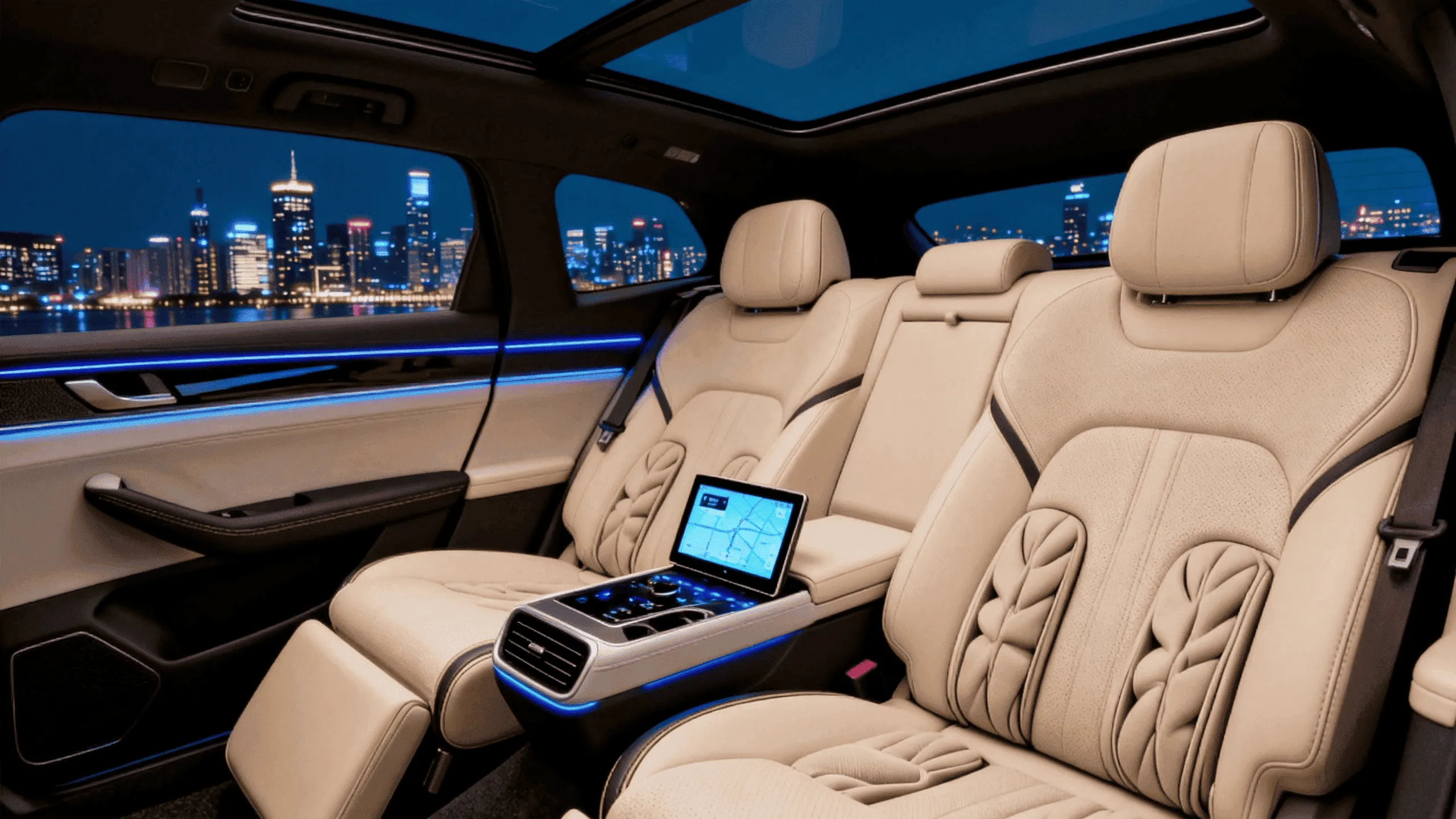
Li Auto announced its in-house batteries will cover the entire vehicle lineup, encompassing a complete technology system spanning 5C cells, packs and BMS. Starting Q4 2026, the new-generation MEGA, all-new i9 and 2026 i6 will progressively switch to in-house batteries while maintaining a dual-brand route with CATL.
Mass Production Rollout: Full Lineup Switch Timeline
On September 7, 2026, Li Auto officially announced the progress of its in-house battery program. The self-developed batteries are already in mass production on the Li L8, L6 and i8, with plans to extend across all models.
The Q4 2026 battery switch plan is as follows:
New-Generation Li MEGA
- Initial deliveries use CATL 5C ternary lithium batteries
- As orders exceeded expectations and CATL inventory is depleting, customers who lock in orders after 3:00 PM on September 7 will be switched to the in-house 5C ternary lithium version
- In-house battery deliveries expected to start in November
All-New Li i9
- Officially launching mid-September, positioned as a six-seat family flagship SUV
- Initial batch equipped with CATL 5C ternary lithium batteries
- Full switch to in-house 5C ternary lithium batteries after production capacity ramps up
2026 Li i6
- Launching in Q4 2026, equipped with in-house 5C battery and Mach chip
- Reservations open late September, deliveries start early November
Technical Foundation: Six Years of R&D Investment
Li Auto began developing its own battery cells in 2020. Its core technology spans the complete battery system:
- 5C high-rate cells: Supporting ultra-fast charging for "10 minutes to 400 km" range recovery
- Pack structural design: Integrated vehicle design for improved space utilization and safety
- BMS battery management system: Self-developed algorithms for precise cell-state monitoring
Li Auto states that through integrated vehicle-system design and accumulated 5C ultra-fast charging expertise, its in-house batteries achieve industry-leading performance in quality, safety and longevity.
Additionally, Li Auto initiated Mach chip development in 2022 and continues iterative investment. The dual self-development strategy for batteries and chips reflects Li Xiang's core thesis for the embodied-intelligence era.
Strategic Logic: Dual-Brand Route and Cost Imperatives
Li Auto's battery strategy is not simply about "de-CATLization." Instead, it pursues a "self-developed + CATL dual-brand" route.
In March 2026, Li Auto President Ma Donghui stated on the earnings call that all models would simultaneously carry "Li Auto brand" and "CATL brand" batteries, with unified performance, quality and safety standards ensuring users perceive no difference. The strategic logic encompasses:
- Mastering product-definition initiative: Avoiding capacity bottlenecks and delivery volatility from single-supplier dependence
- Smoothing cost fluctuations: Building long-term structural cost-reduction capabilities through self-developed technology at scale
- Deepening core partnerships: CATL's technical strength and market position remain unshakable; the partnership continues to deepen
| Dimension | Short-Term Strategy | Medium-to-Long-Term Strategy |
|---|---|---|
| Cost fluctuation response | Long-term contracts, refined operations | Self-developed technology scaling for cost reduction |
| Supply chain security | Dual-brand parallel operation | Autonomous and controllable system |
| Technology moat | 5C ultra-fast charging + Mach chip | Core embodied-intelligence technologies |
Li Xiang emphasized on the Q2 earnings call: "In the long run, batteries and chips are the most important technological moats and barriers in the embodied-intelligence industry. Self-development does not mean our suppliers' products are inadequate. In the embodied-intelligence era, batteries and chips are the core barriers."
Capacity Support: Sunwoda JV in Zaozhuang
Li Auto's in-house battery capacity already has substantive progress. In October 2025, Li Auto and Sunwoda established a battery joint venture with registered capital of RMB 300 million, located in Zaozhuang, Shandong Province.
Zaozhuang has attracted 278 lithium battery new-energy enterprises, forming a complete industry chain from lithium mining to recycling. Sunwoda's 30GWh power battery project and a Phase II RMB 6.5 billion expansion in Zaozhuang provide strong industrial support for the JV.
Li Auto leads battery structural design, production process optimization and material system R&D at the JV, internally defining the project as a "true self-developed battery program."
Industry Implications: Vertical Integration as New Competitive Dimension
Li Auto's battery self-development strategy reflects a shift in China's NEV industry competition from "scale expansion" to "technology depth." With batteries accounting for 30%-40% of vehicle costs, mastering core component autonomy has become a necessity for leading automakers.
Tesla and BYD are already ahead; NIO and XPeng are accelerating their self-development efforts. Li Auto's entry signals that China's first-tier EV startups have fully entered the "core technology autonomous control" stage.
For more in-depth technical analysis, visit EX1000.COM.