In the first half of 2026, domestic passenger vehicle sales totaled 12.72 million units, down 6% year on year; domestic sales fell 24.3%, and the industry's sales profit margin dropped to 3.8%. Over the same period, new energy vehicle penetration rose to 54%. As roughly 100 brands face a shakeout window, Changan Automobile has brought its self-developed intelligentization achievement, Tianshu Pilot, into large-scale mass production after investing more than RMB 60 billion, with the first model to feature it, the Nevo Q06, opening pre-sales. The opportunities and risks of its 'self-development first + open cooperation' path are emerging simultaneously.
1. Three Sets of Data: Volume Has Not Shrunk, but the Profit Pool Is Being Drained
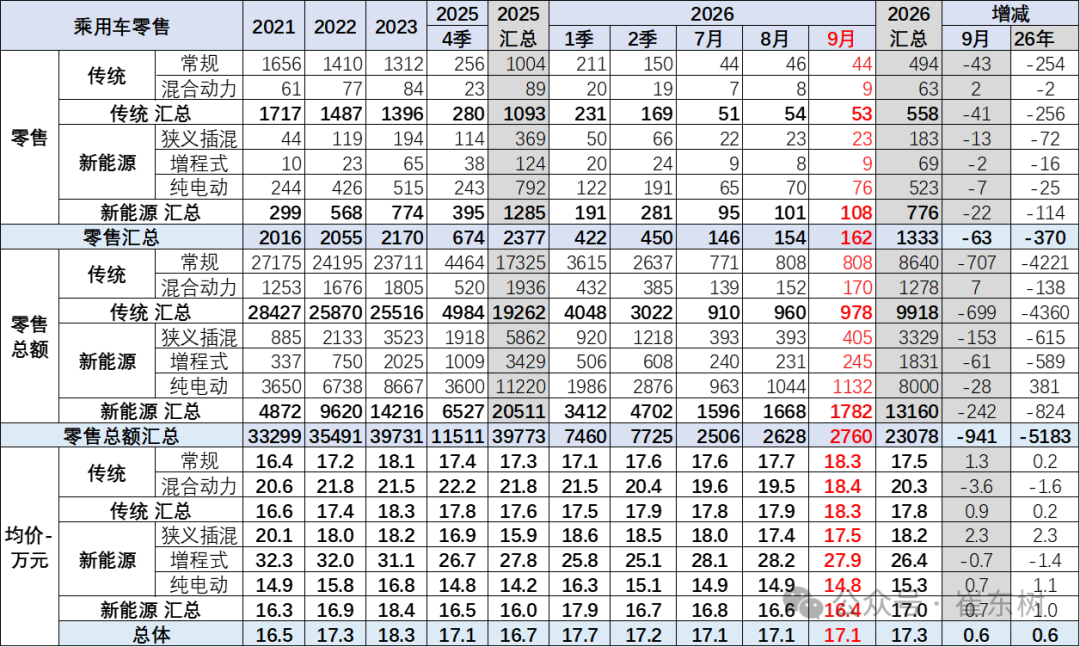
Data compiled by Gasgoo Automotive Research Institute shows that in the first half of 2026, cumulative sales in China's passenger vehicle market reached 12.72 million units, down 6% year on year. Domestic sales, dragged down by factors such as the phaseout of policy incentives, high oil prices, contraction of the joint-venture camp, and high inventory, fell 24.3% year on year—the steepest decline in nearly a decade. In the same table, new energy passenger vehicle penetration rose from 51.4% in 2025 to 54%, and battery electric vehicles overtook fuel vehicles starting in the second quarter to become the technology route with the highest market share.
The trajectories of volume, structure, and profitability are not aligned. The market is not shrinking on a large scale; it is being restructured: the share vacated by fuel vehicles is being taken up by new energy vehicles, and the space that joint ventures have retreated from is being filled by domestic brands. Yet the industry's sales profit margin fell to a historic low of 3.8% in the first half of 2026. While vehicle gross margins are being squeezed, the absolute amount of investment in intelligentization continues to rise, making the old logic of trading scale for space unsustainable.
2. The Scale of the Shakeout: Over 120 Brands and Just Over 20 Seats
Yang Dayong, executive vice president of Changan Automobile, estimates that China currently has more than 120 auto brands, but only about 25 active brands contribute 80% of sales; by 2030 or some point thereafter, only about 20-plus brands will ultimately survive. This means roughly 100 brands could be forced out in the coming years.
Gasgoo Automotive Research Institute's analysis notes that under stock-market competition, mergers and restructuring across the industrial chain are accelerating, with tail-end elimination and top-tier consolidation proceeding in parallel. What matters is not whether a particular brand is 'delisted,' but leading indicators such as persistently shrinking R&D budgets, long-term disruptions in new model cadence, and a contracting dealer network. He Gang, vice president of Changan Automobile, narrows the timeline further: the intelligent driving industry may complete a round of consolidation around 2028, with automakers and intelligent driving suppliers alike undergoing survival-of-the-fittest selection.
3. Changan's Chips: RMB 60 Billion in Investment and a 7,500-Person Team
In February 2025, Changan released the 'Beidou Tianshu 2.0' plan, committing to no longer develop non-intelligent new products, with more than RMB 60 billion to be invested in intelligentization, including cumulative investment of RMB 22.5 billion in intelligent products, and its intelligentization team expanding from zero to 7,500 people. In September 2026, the Nevo Q06, the first model equipped with the Tianshu Pilot intelligent driving assistance system, opened pre-sales, marking the entry of this self-developed achievement into large-scale mass production.
He Gang places this path in the context of industrial competition: the first round centered on engines and lasted nearly a century; the second began around 2015 and centered on batteries; the current round is a contest over a complete intelligentization system encompassing intelligent driving assistance, smart cockpits, intelligent chassis, intelligent vehicle control, in-vehicle interaction, and vehicle-cloud services.
4. Three Hard Problems of Self-Development
He Gang summarizes three core difficulties: technology iteration is too fast—from the rule-based era to two-stage and then one-stage end-to-end took only a few years; insufficient data acquisition is a common problem across the industry; and the competition for talent comes both from peers and from the embodied intelligence industry. Tao Ji, Changan Automobile's chief intelligent driving technology officer, adds that intelligent driving assistance is currently the area that can be scaled up, while embodied intelligence has a longer commercialization cycle; keeping teams and talent stable is an ongoing challenge.
On the technology route, one of Tianshu Pilot's differentiating features is multimodal interaction, especially voice-controlled driving. Its R&D starting points are described as two ends: first, real-world pain points—under highway conditions, some users are unwilling to change lanes frequently, or want the vehicle to drive according to their personal commuting experience, and such personalized demands are difficult to fulfill through buttons; second, following technological laws—the car is regarded as an important carrier of embodied intelligence, and lacking interaction capabilities would diminish its value.
On L3, He Gang says Changan is the first automaker in China to obtain a dedicated official L3-level license plate, and one of the first companies to obtain an L4 test license. Between licenses and mass production, however, there remains a gap of regulatory adaptation, liability definition, and scenario validation.
5. The Boundaries of 'Self-Development First + Open Cooperation'
Insisting on self-development does not mean being closed off. Changan Automobile Chairman Zhu Huarong said at the launch event that the company pays 'tribute to pioneers and excellent benchmarks such as Huawei and Tesla,' and said it will continue to deepen cooperation with Huawei on data, technology, and product projects.
The logic of this combination is that purchased solutions can quickly level the experience starting line in the short term, but once sensors, algorithm foundations, and chip computing power converge, product homogenization becomes unavoidable and price wars become the main tool—one of the deeper reasons for the industry's declining profit margins. The risks of full-stack self-development are equally clear: long investment cycles, high marginal costs, and limited data scale for any single company; if sales cannot support R&D amortization, technological assets can turn into financial burdens. Yang Dayong puts it this way: the answer to insisting on self-development lies in the 'brand,' and Changan wants the core technologies of its own brands to remain in its own hands.
6. Three Variables to Watch
First is the match between sales and R&D amortization. With the overall market under pressure in the first half of 2026 and fierce competition in the price band where the Nevo Q06 sits, whether Tianshu Pilot can translate into quantifiable sales growth will determine whether the funding cycle for this path can hold.
Second is overseas markets. Yang Dayong reveals that Changan has shifted performance assessment from a sole focus on the domestic market to a unified domestic-and-overseas strategy, with his personal KPI tied to Changan brand's global sales. Against the backdrop of a domestic profit margin of just 3.8%, the scale and gross margin of overseas markets are playing an increasingly important role in supporting R&D investment.
Third is the timetable for the intelligentization shakeout. If around 2028 is indeed the industry's watershed, mass production of Tianshu Pilot is merely a ticket to entry. The real test is whether this self-developed system can simultaneously hold its ground on three metrics: cost, experience, and iteration speed.