On May 16, 2026, a vehicle fire occurred in BYD's Pingshan headquarters garage. BYD officially stated it was "not caused by Blade Battery" but by a short circuit in a modified vehicle's wiring. With China's NEV fleet exceeding 28 million units as of May 2026, battery safety standards are shifting from "corporate self-discipline" to "regulatory mandates."
Event Reconstruction: The Truth Behind the Pingshan Garage Fire
In the early hours of May 16, 2026, a vehicle fire broke out in the underground garage at BYD's Pingshan headquarters in Shenzhen. Surveillance footage showed a white sedan beginning to smoke from its undercarriage while parked, with visible flames after approximately 3 minutes. Firefighters arrived within 10 minutes and extinguished the blaze; no casualties occurred.
BYD's official statement at noon that day contained the following key information:
- Vehicle involved: 2023 third-party modified vehicle (not BYD factory configuration), 87,000 km on odometer
- Cause of fire: Preliminary assessment points to a short circuit in modified high-power audio system wiring, igniting interior materials, not battery pack thermal runaway
- Battery pack condition: Post-incident disassembly showed intact battery pack casing with no thermal runaway traces on internal cells
- Remedial measures: BYD stated it will cooperate with fire authorities on the final investigation report and "welcomes independent testing by third-party agencies"
From Case to Industry: Battery Safety's "Triple Defense Line"
Although the Pingshan garage fire was confirmed unrelated to the battery, the public discussion it triggered points to a deeper question: with China's NEV fleet exceeding 28 million units (as of April 2026), who underwrites battery safety?
China's current NEV battery safety system rests on a "triple defense line":
First Line: Corporate Technology Defense
- BYD Blade Battery: Nail penetration test shows no fire, no explosion. Q1 2026 data shows Blade Battery installed in over 8 million vehicles, with cumulative driving distance exceeding 120 billion km, and zero publicly reported battery pack spontaneous combustion incidents
- CATL Qilin Battery: Uses NP2.0 no-thermal-propagation technology, achieving "single cell thermal runaway, whole pack no fire"
- CALB "Top-Stream Battery": Uses "nano-crystal-shield" cathode technology to raise thermal runaway trigger temperature to 280°C (conventional NCM lithium is 180-200°C)
Second Line: Industry Standard Defense
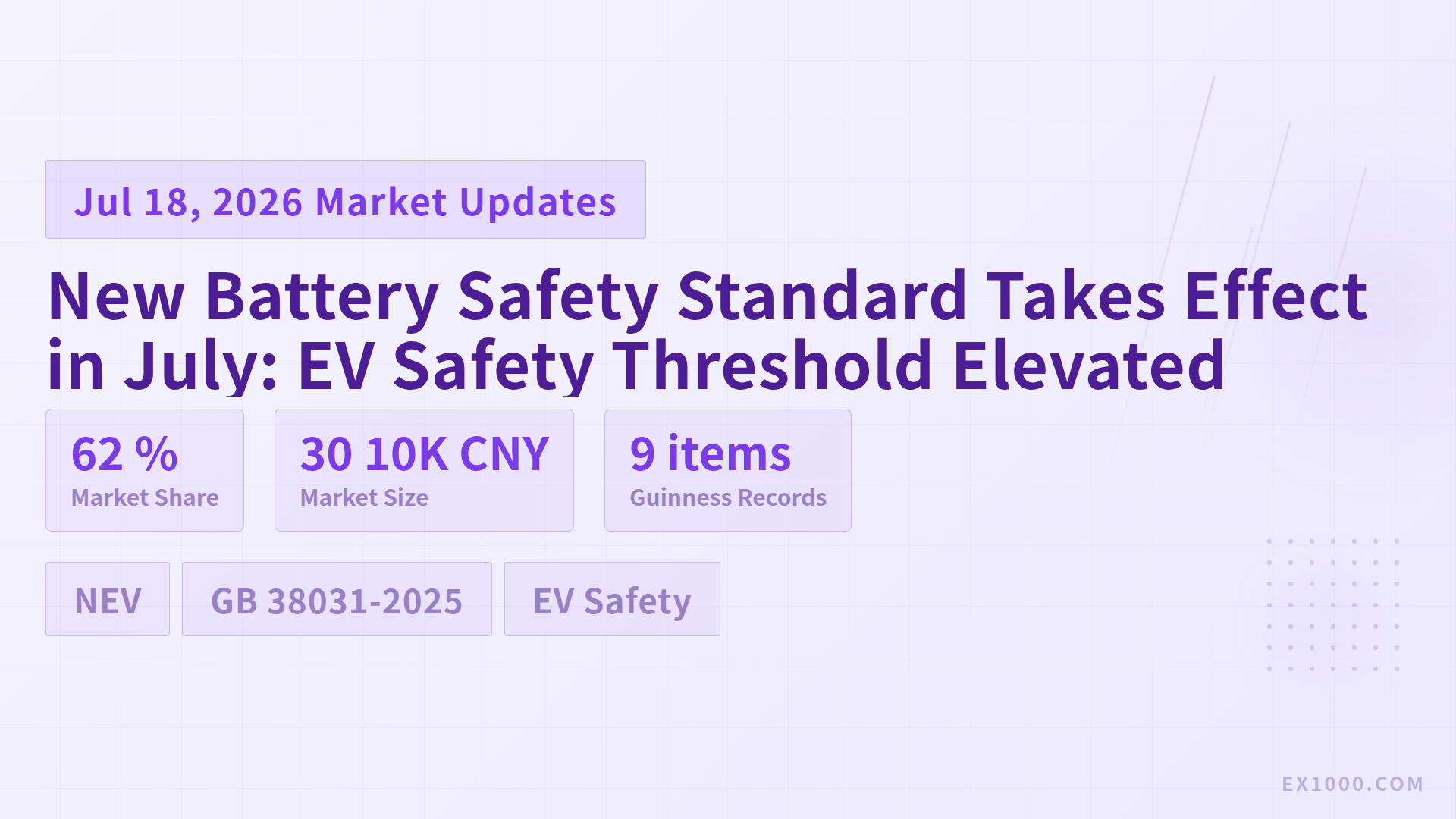
In March 2026, China's Ministry of Industry and Information Technology released the "Safety Requirements for Traction Batteries" (draft for comment), mandating:
- Thermal diffusion test: After whole-pack thermal runaway, no fire or explosion within 5 minutes (2024 standard only required alarm)
- Bottom impact test: Simulating road stone impact, requiring battery pack no leakage, no fire
- Fast-charge cycle test: After 1,000 fast-charge cycles, capacity retention ≥80% with no safety hazards
- Waterproof/dustproof: Unified upgrade to IP68 rating (some current models at IP67)
Third Line: Insurance and After-Sales Defense
- Dedicated insurance: Since 2026, major insurers have launched "NEV Three-Electric Insurance" covering battery, motor, and control systems, annual premium approximately 1,500-3,000 yuan
- Warranty commitments: BYD/CATL and other leading companies provide 8-year or 150,000 km battery warranty; some brands offer "lifetime warranty"
- Recall mechanism: 2025 China NEV recalls totaled 420,000 units, of which 72% involved battery system software upgrades and 28% hardware replacement
Safety Buying Guide for Central Asian and Russian Buyers
For buyers in high-latitude, extreme-climate Central Asian and Russian regions, battery safety selection requires additional attention to:
| Safety Dimension | Key Inspection Points | Recommended Technical Solutions |
|---|---|---|
| Low-temp safety | Charging limit at -30°C, preheating support | BYD Blade Battery (fast-charge after preheating to 5°C), CATL Shenxing Battery (fast-charge at -20°C) |
| Impact safety | Ground clearance, battery pack armor thickness | Tank 300 Hi4-T (8mm steel plate bottom armor), Zeekr X (honeycomb aluminum protection structure) |
| Thermal management | High-temp cooling efficiency, fast-charge thermal strategy | Li Auto L6 (dual-cycle liquid cooling), AITO M9 (phase-change material cooling) |
| Waterproof safety | Wading depth, sealing rating | IP68 (submersible 1m for 24h) superior to IP67 (splash-proof) |
| Software safety | BMS OTA upgrade capability | BYD/NIO/Xpeng (all support BMS OTA) |
EX1000.COM Q1 2026 export data shows that for Central Asian and Russian buyers, battery safety has surpassed "driving range" as the second most important purchasing factor (after "price"). Platform data reveals that models equipped with LFP batteries accounted for 71% of Central Asian market orders in Q1 2026, up from 52% in 2024, reflecting buyer preference for LFP's higher safety profile.
BYD Blade Battery, as a representative LFP technology, has formed a unique word-of-mouth effect in Central Asian and Russian markets. According to BYD overseas dealer feedback, in Kazakhstan and Uzbekistan showrooms, the "Blade Battery Safety Demo" (live nail penetration test) has become a standard sales process, improving conversion rates by 35% compared to scenarios without the demonstration.