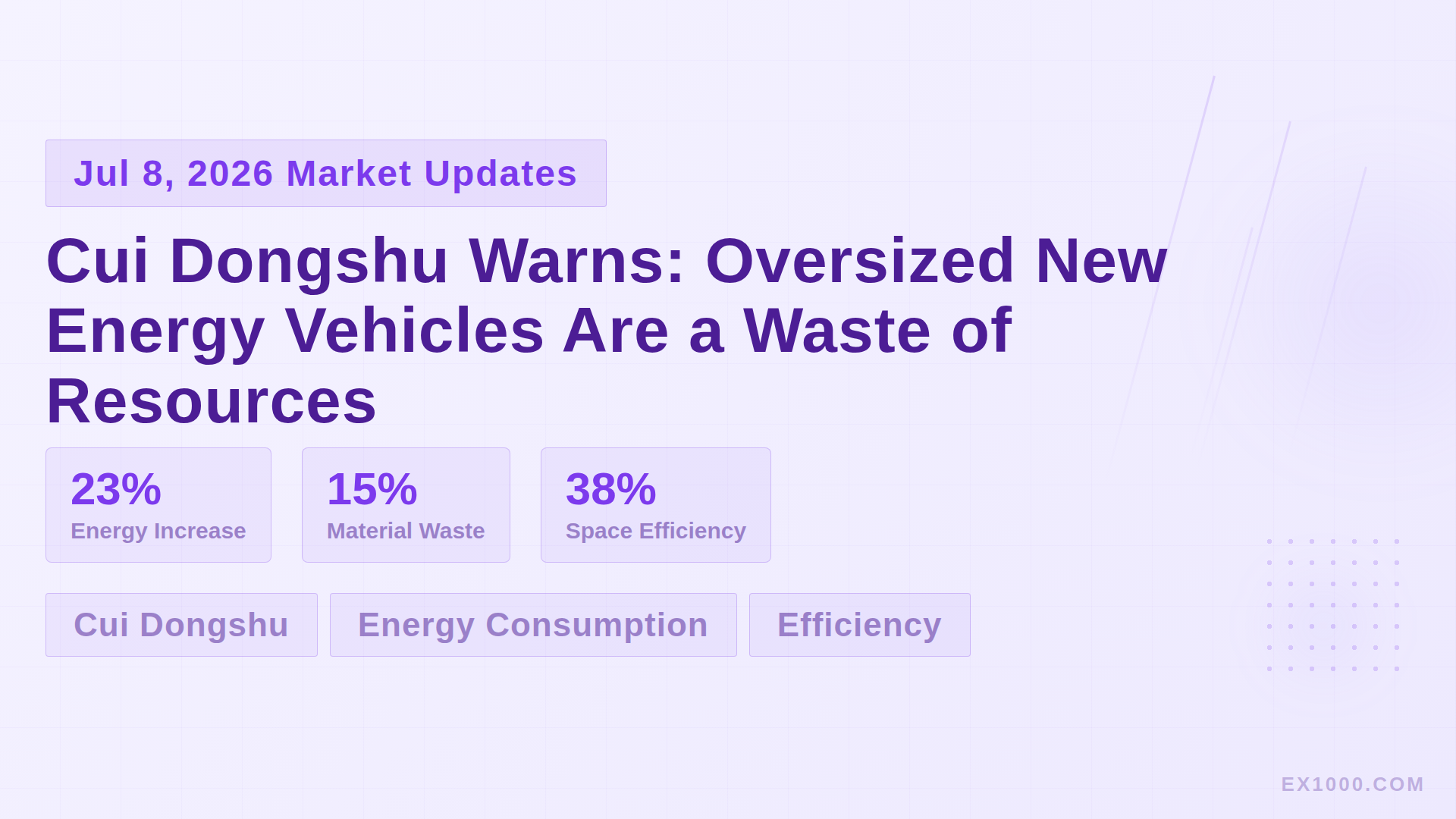
On July 4, 2026, Chinese authorities issued a notice clarifying that preferential policies for new energy vehicle and vessel taxes will be adjusted from 2027. The core direction shifts from "universal subsidies" to "technology-threshold-based" benefits, with range and energy consumption metrics directly affecting tax relief levels. This change will reshape cost structures in the NEV market, creating ripple effects for export-oriented automakers and overseas buyers.
Policy Background: From "Helping Aboard" to "A Nudge Along"
China's NEV vehicle and vessel tax incentives began in 2012, undergoing multiple renewals and adjustments over the past decade. The July 4, 2026 notice represents the latest node in this policy evolution.
Key phases of policy evolution:
| Phase | Period | Policy Characteristics | Coverage |
|---|---|---|---|
| Phase 1 | 2012-2017 | Full exemption, no tech thresholds | All BEV + PHEV |
| Phase 2 | 2018-2023 | Catalog-based, largely universal | Inclusion in catalog = exemption |
| Phase 3 | 2024-2026 | Continued benefits, tightening parameters | Range and energy consumption added |
| Phase 4 | 2027 onwards | Structural adjustment, tiered benefits | Tiered relief based on tech metrics |
The 2027 adjustment reflects a core logic: China's NEV industry has moved from "needs protection" to "needs guidance." Policy objectives have shifted from simple "sales support" to "technology upgrade incentives" and "product structure optimization."
Key Changes in the 2027 Policy
Based on the spirit of the July 4 notice, the 2027 adjustments will involve several dimensions:
- Range thresholds raised
- Previously, BEVs were universally exempt regardless of range
- The new policy may set a minimum range threshold, removing full exemption for low-range models (e.g., early A00 segment)
- Energy consumption metrics incorporated
- kWh per 100km and fuel consumption figures will directly affect relief levels
- Better energy performance means larger tax breaks
- Greater differentiation for PHEVs
- Electric range and EV-mode consumption become key metrics
- Some "pseudo-hybrid" models (electric range below 50km) may lose eligibility entirely
- Differentiation between commercial and passenger vehicles
- Commercial vehicle electrification may maintain or increase policy support
- Passenger vehicle benefits become tiered, with premium models possibly receiving diminishing relief
Direct Impact Estimates of Policy Adjustment
Taking a typical A-segment BEV SUV as an example, the before-and-after comparison:
| Dimension | 2026 Policy | 2027 Policy (projected) | Impact |
|---|---|---|---|
| Base tax amount | ~480-960 yuan/year | Same | Unchanged |
| Relief level | 100% exemption | Tiered by tech metrics | Variable |
| High-range, low-consumption models | Exempt | Exempt or 75% relief | Minor |
| Low-range, high-consumption models | Exempt | 50% relief or none | Significant |
| 10-year total cost difference | — | ~2,400-9,600 yuan | Purchase decision factor |
Ripple Effects on Exporters and Overseas Buyers
Vehicle and vessel tax adjustments may seem like a domestic Chinese tax matter, but their impact will propagate through multiple channels to the export side and overseas buyers:
Impact on automaker product strategy:
- Low-range models (A00 segment) will see their cost advantage eroded, accelerating market consolidation
- High-range, low-consumption models will become the priority for R&D and resource allocation
- PHEVs must improve electric range and EV-mode efficiency or face declining competitiveness
Propagation to export product structure:
- Models exported to Central Asia, Russia, the Middle East, and other markets share technology platforms with domestic products
- The domestic policy-driven technology upgrade direction will naturally flow into export offerings
- Overseas buyers will receive Chinese NEVs that are "technically superior and more energy-efficient" after 2027
Impact on procurement decisions:
- Overseas buyers sourcing through EX1000.COM and similar platforms need to pay attention to whether a model's technical parameters align with China's latest policy direction
- Policy incentive directions often foreshadow long-term technology trends and can serve as reference indicators for procurement decisions
- Chinese automakers will more aggressively clear low-range inventory after 2027, creating a short-term purchasing window for overseas buyers
International Comparison: The Global Trend of NEV Tax Incentives
China is not the only country adjusting NEV tax incentives. Policy trends in major global markets:
| Country/Region | Policy Direction | Key Change | Effective Date |
|---|---|---|---|
| China | Tech-threshold-based | Range + consumption determine relief | 2027 |
| EU | Gradual phase-out | BEV subsidies eliminated after 2030 | 2030 |
| US | Credit adjustment | Localization requirements tightened | 2024-2026 |
| Japan | Maintained benefits | Continued subsidies + exemptions | 2025-2027 |
| UK | Tax benefit adjustment | Company car tax favors low-emission | Ongoing |
China's adjustment pace is relatively measured, representing a shift "from universal to tiered" rather than "from subsidy to zero." This reflects the relative maturity of China's NEV industry, which no longer requires strong stimulus to maintain growth.
Outlook and Operational Recommendations
For export-oriented Chinese automakers and overseas buyers sourcing through EX1000.COM, the following recommendations merit attention:
- Product selection: Prioritize high-range, low-consumption models
- Models with 400km+ range and sub-15 kWh/100km consumption will continue to benefit from the policy framework
- These models also happen to be the demand mainstream in overseas markets
- Timing: A potential inventory window around the 2027 transition
- Automakers may accelerate clearance of low-range inventory by late 2026
- Overseas buyers should watch for purchasing opportunities in Q4 2026
- Technology route: BEV-first, with PHEVs needing ≥100km electric range
- BEVs receive the most favorable treatment across multiple national policies
- PHEVs must ensure electric range ≥100km to remain competitive internationally
- Policy sensitivity: Establish a tracking mechanism
- Vehicle and vessel tax, purchase tax, and consumption tax policies are changing with increasing frequency
- Overseas buyers should incorporate Chinese policy developments into their procurement assessment frameworks