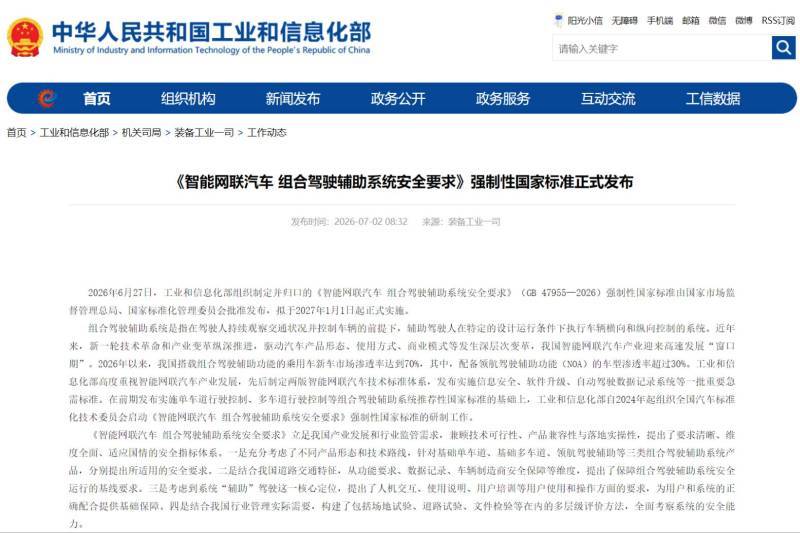
Starting July 1, 2026, two mandatory national standards—GB 38031-2025 "Safety Requirements for Power Batteries of Electric Vehicles" and GB 18384-2025 "Safety Requirements for Electric Vehicles"—officially took effect in China. The new standards dramatically raise the safety threshold from the previous "5-minute warning before thermal runaway" to "no fire or explosion for at least 2 hours after thermal runaway," while adding bottom impact tests and post-fast-charging safety tests. Industry observers have called this the "strictest battery safety mandate in history," signaling China's entry into a "zero tolerance" era for battery safety.
Core Changes: From "5-Minute Escape" to "No Fire for 2 Hours"
Effective July 1, 2026, two mandatory national standards—GB 38031-2025 and GB 18384-2025—officially took effect. The previous standard only required battery systems to provide at least 5 minutes of warning before thermal runaway. The new standard mandates:
- After a single cell experiences thermal runaway, the entire battery pack must not catch fire or explode for at least 2 hours
- The alarm signal must still be issued within 5 minutes
- Smoke must not harm the passenger cabin for 5 minutes before and after thermal runaway
This means power battery safety has shifted from "passive escape" to "active defense."
Two New Critical Tests Added
Beyond the upgraded thermal diffusion test, the new standard adds:
- Bottom impact test: Simulates road-scrape scenarios; battery pack must not leak or catch fire after impact
- Post-300-cycle fast-charging safety test: Addresses fast-charging trends, ensuring frequent use doesn't compromise safety
- Insulation resistance improvements: Added judgment conditions for AC circuit battery systems
Vehicle-Level Safety Requirements Upgraded
Key requirements under GB 18384-2025 at the vehicle level:
| Requirement | Previous Standard | New Standard | Improvement |
|---|---|---|---|
| Post-thermal-runaway safety time | 5-minute warning | 2 hours no fire/explosion | 24x |
| Bottom impact test | None | Mandatory | New |
| Post-fast-charging safety | None | Test after 300 cycles | New |
| HV disconnect device | Not specified | Physical + easily accessible | Strengthened |
| Vehicle underside scrape test | None | New item | New |
Industry Impact: Safety Becomes Core Competitiveness
By end of 2025, China's NEV fleet reached 43.97 million units, accounting for 12.01% of total vehicles. With rapid fleet growth, safety risks have risen:
- Approximately 8,500 NEV fires nationwide in 2023
- Averaging over 23 per day
- Up 32.1% from 2022
The new standards will force comprehensive technical upgrades across the entire industry chain:
- Thermal management systems: Aerogel insulation, liquid cooling become standard
- Cell structures: High-temperature-resistant busbars, pressure relief valve optimization
- BMS systems: More precise thermal runaway early warning algorithms
Leading Companies Already Positioned
CATL, BYD and others have mature layouts in supporting technologies:
| Company | Core Technology Layout | New Standard Compliance |
|---|---|---|
| CATL | Aerogel insulation, multi-stage pressure relief | Compliant |
| BYD | Blade battery structure, high-temp busbars | Compliant |
| CALB | Top-flow battery tech, thermal-electrical separation | Compliant |
| Gotion High-Tech | LFP high-safety system | Compliant |
Implications for Overseas Buyers
For overseas buyers tracking China's NEV industry progress, the new standards mean:
- Chinese export models now carry more convincing institutional backing for safety performance
- New models produced after July 1, 2026 will fully meet the stricter safety standards
- Vehicles sourced through EX1000.COM and similar platforms will have safety performance aligned with international benchmarks
The new standards will accelerate elimination of technologically backward companies while benefiting leading firms. Buyers in Central Asia and Russia should prioritize products compliant with the new national standards.