In the second half of 2026, China's NEV exports face new trade policy variables. Russia increased recycling fees on non-locally produced vehicles from July 1, raising Chinese automakers' export costs by approximately 10%. Taking Geely Monjaro as an example, retail prices rose by about 500,000 rubles. Brazil plans to increase NEV import tariffs to 35%, further raising barriers to the South American market. Meanwhile, Central Asian markets' acceptance of Chinese new energy brands continues to climb, with Hallgós customs data showing Chinese brands maintaining strong sales locally.
Russia: Recycling Tax Hike Hits Chinese OEMs
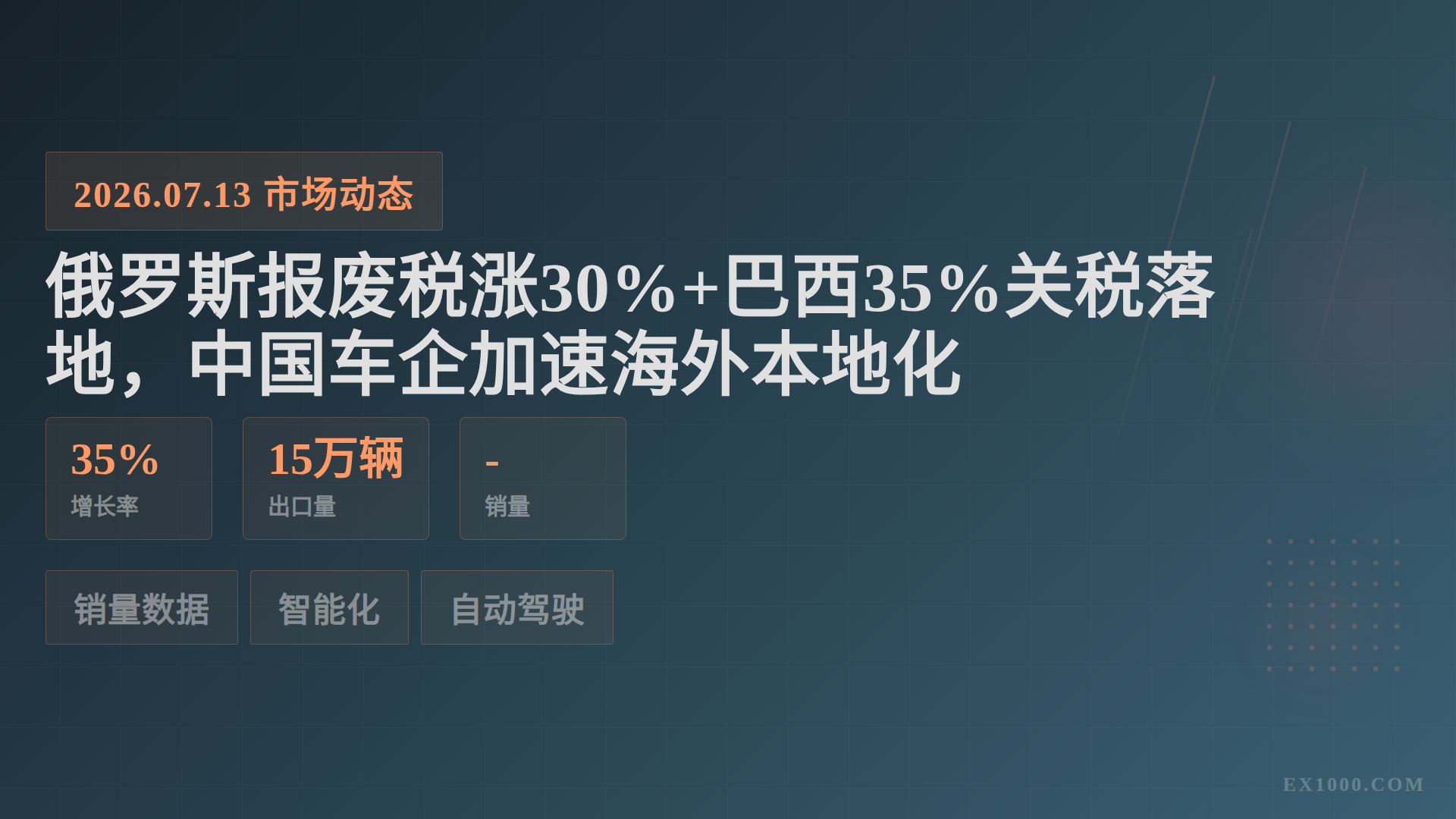
In July 2026, Russia raised recycling tax rates for non-locally produced vehicles by 30%. The import recycling tax increased from a maximum of 293,000 rubles to 381,000 rubles, affecting vehicles manufactured outside Russia, including China.
Russia-Belarus-Kazakhstan Customs Union Price Structure
| Segment | Jan-Jun 2026 Price (10K rubles) | Post-July Price (10K rubles) | Increase | Chinese Models |
|---|---|---|---|---|
| Compact sedans | 200-280 | 230-310 | +15% | Geely Emgrand, Chery Arrizo |
| Mid-size SUVs | 320-450 | 360-500 | +12% | Haval H6, Geely Boyue L |
| Premium SUVs | 500-700 | 560-770 | +10% | Li Auto L9, AITO M9 |
| NEVs | 280-400 | 320-450 | +12% | BYD Seal, Zeekr 001 |
The recycling tax significantly raises import costs, directly impacting Chinese brands still selling in Russia via CBU imports. Chinese brands including Great Wall, Geely, and Chery sold over 170,000 units in Russia Jan-May 2026, capturing about 48% market share. Some brands have already chosen local production to mitigate rising costs.
Brazil: Tariff Increases Force Localization
Brazil will raise NEV tariffs to 35% in July while restoring 17% industrial product tax (IPI) on imported EVs. This dual tax impact means:
- CBU import costs will rise by over 50%
- BYD and Great Wall, which have announced Brazilian factory plans, will accelerate localization
- Companies without local presence risk market share compression
BYD's Brazil factory is scheduled to begin production in Q3 2026 with 150,000 units annual capacity; Great Wall's Brazil plant started production in 2025. These early movers are building competitive moats.
Central Asia Five Countries: Continued Strong Sales
In contrast to Russia's trade barriers, Central Asian markets remain open to Chinese brands:
| Country | Jan-May 2026 Chinese Brand Sales | Market Share | Popular Models |
|---|---|---|---|
| Uzbekistan | ~82,000 | 65% | BYD Song, Chery Tiggo |
| Kazakhstan | ~65,000 | 58% | Haval H6, Geely Xingyue |
| Kyrgyzstan | ~21,000 | 72% | BYD Yuan, Chery Jetour |
| Tajikistan | ~9,000 | 55% | Great Wall Wingle, JAC Refine |
| Turkmenistan | ~6,000 | 48% | Geely Vision, Chery Arrizo |
Customs data shows Uzbekistan's auto imports from China reached $950 million in Jan-Apr 2026, up 92% YoY. Central Asia's rapid growth is becoming a new growth pole for Chinese OEMs' overseas expansion.
Response Strategies: From Export to Localization
Facing trade barriers in Russia and Brazil, Chinese OEMs are pursuing differentiated strategies:
- Russia: Accelerating local production (Great Wall, Geely already have plants)
- Brazil: BYD and Great Wall factories approaching production; Chery planning to follow
- Central Asia: Continuing CBU exports, leveraging customs union convenience
- Southeast Asia: Thailand and Indonesia plants already producing, serving RHD markets
Recommendations for Central Asian Buyers
For Central Asian dealers and importers:
- Prioritize locally established brands: More stable cost advantages and supply reliability
- Focus on NEV models: Multiple Central Asian countries are formulating NEV import incentives
- Seize the window: After Russia's tariff hike, Central Asia's value as a re-export channel may increase
- Build long-term partnerships: Establish stable procurement relationships with EX1000.COM to lock in prices and supply
Chinese OEMs' globalization has entered "deep waters," shifting from pure exports to localization and brand building. For Central Asian buyers, this means more stable supply, better after-sales service, and more competitive long-term pricing.