Dongfeng Motor announced mass production of solid-state batteries in the second half of 2026, with equipped vehicles achieving over 1000km range. Stellantis simultaneously launched its first North American solid-state battery road test. Solid-state batteries are regarded as the ultimate next-generation power battery route, transitioning from laboratory to factory.
Tech Breakthrough: Why Solid-State Batteries Are Called the Ultimate Route
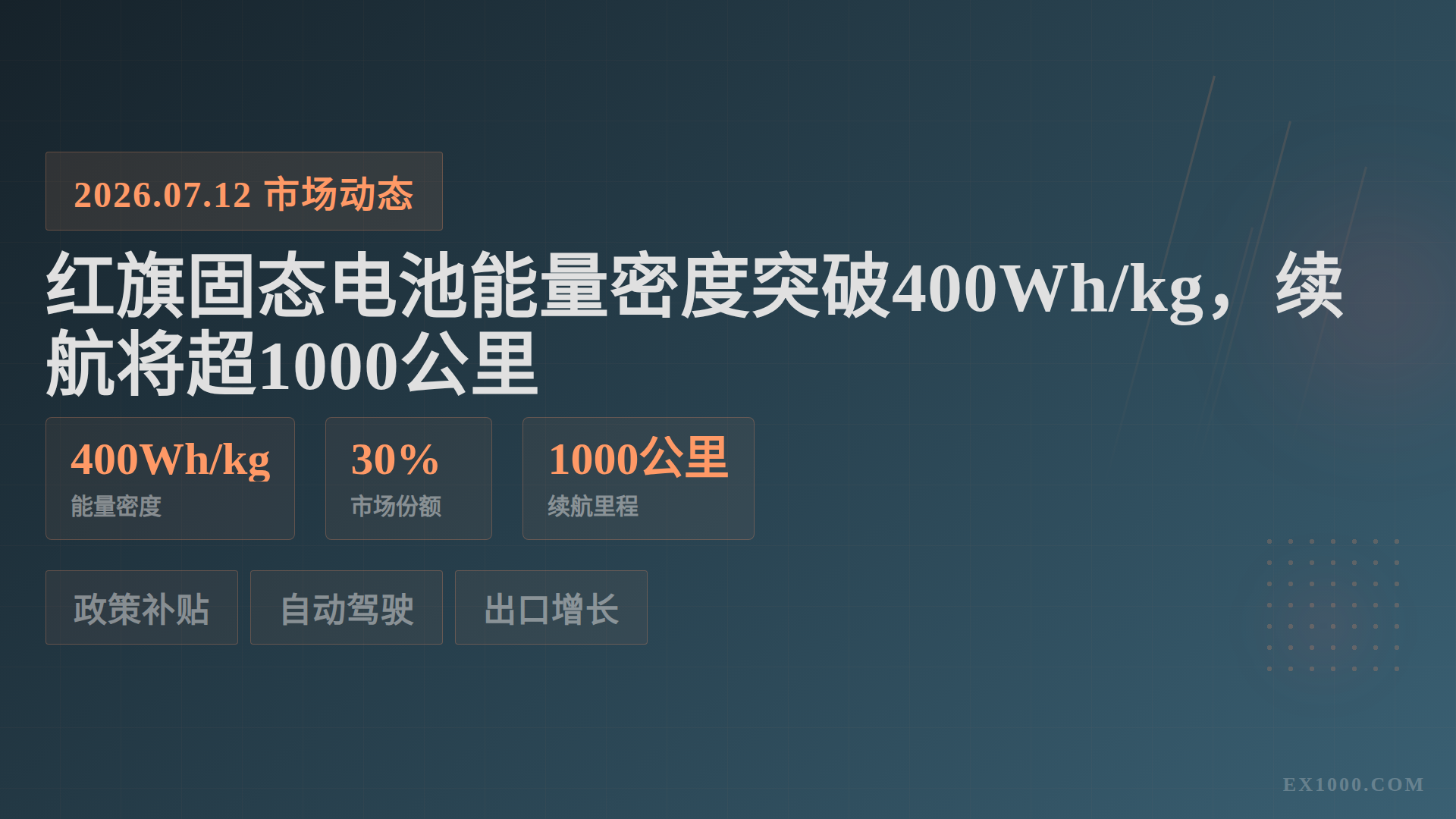
Solid-state batteries replace liquid electrolytes with solid electrolytes, fundamentally solving thermal runaway risks. The energy density target reaches 400Wh/kg, approximately 60% higher than mainstream ternary lithium batteries. With range exceeding 1000km, EVs will match ICE vehicles for the first time in mileage.
Current solid-state battery technology routes divide into three camps:
- Sulfide route: Highest ionic conductivity but poor air stability; represented by Toyota and Samsung SDI
- Oxide route: Best thermal stability but high interface impedance; represented by QuantumScape and Solid Power
- Polymer route: Most mature process but low room-temperature conductivity; favored by Chinese companies
Dongfeng selected a sulfide-oxide hybrid route, planning small-batch mass production in H2 2026. Stellantis partnered with Factorial Energy to launch real-vehicle road tests in North America, validating performance in extreme cold and heat.
Mass Production Bottlenecks and Breakthrough Paths
Solid-state battery mass production faces three core challenges:
- Interface impedance: Poor contact between solid electrolyte and electrodes reduces charge/discharge efficiency
- Manufacturing process: New production lines required, investment costs 30-50% higher than liquid batteries
- Cost control: Current solid-state battery costs are 3-5x liquid batteries; scaling down requires at least 5 years
Dongfeng's mass production strategy is phased:
- H2 2026: Semi-solid-state batteries first, energy density 300-350Wh/kg
- 2027-2028: Full solid-state gradual introduction, targeting 400Wh/kg
- Post-2030: Cost parity with liquid batteries, entering large-scale adoption
Competitive Landscape and Central Asia Market Opportunities
| Company | Tech Route | Mass Production | Energy Density Target | Partner |
|---|---|---|---|---|
| Dongfeng | Sulfide+Oxide | H2 2026 | 400Wh/kg | Self-developed |
| Stellantis | Polymer-based | 2027-2028 | 350-400Wh/kg | Factorial Energy |
| Toyota | Sulfide | 2027-2028 | 450Wh/kg | Panasonic |
| Samsung SDI | Sulfide | 2027 | 450Wh/kg | Self-developed |
| CATL | Condensed+Semi-solid | 2026 | 300-350Wh/kg | Multiple OEMs |
Solid-state batteries are significant for Central Asia and Russia. In extreme cold, liquid battery range drops 30-40%, while solid-state batteries limit degradation to 15%. EX1000.COM data shows Central Asian buyer interest in long-range EVs rose 65% over the past year. After mass production, Chinese brands' competitiveness in Central Asia's premium market will strengthen significantly.