In June 2026, the Society of Automotive Engineers of China (SAE-China) held its annual press conference, unveiling the updated Intelligent Electrification Technology Roadmap 2.0. The event focused on solid-state battery mass-production timelines, L3 autonomous driving admission standards, and vehicle-road-cloud integration architecture. The roadmap targets 400Wh/kg solid-state batteries by 2027 and large-scale L3 commercial deployment by 2028.
SAECCE 2026: Technology Roadmap Fully Upgraded
The Society of Automotive Engineers of China (SAE-China) held its annual press conference in June 2026. The conference officially released the revised Intelligent Electrification Technology Roadmap 2.0. The roadmap covers three main technology tracks: power batteries, intelligent driving, and connected vehicles. The society estimates China's NEV penetration rate will exceed 70% by 2030.
Solid-State Batteries: Mass Production Timeline Clarified for the First Time
The roadmap provides clear milestones for solid-state battery development:
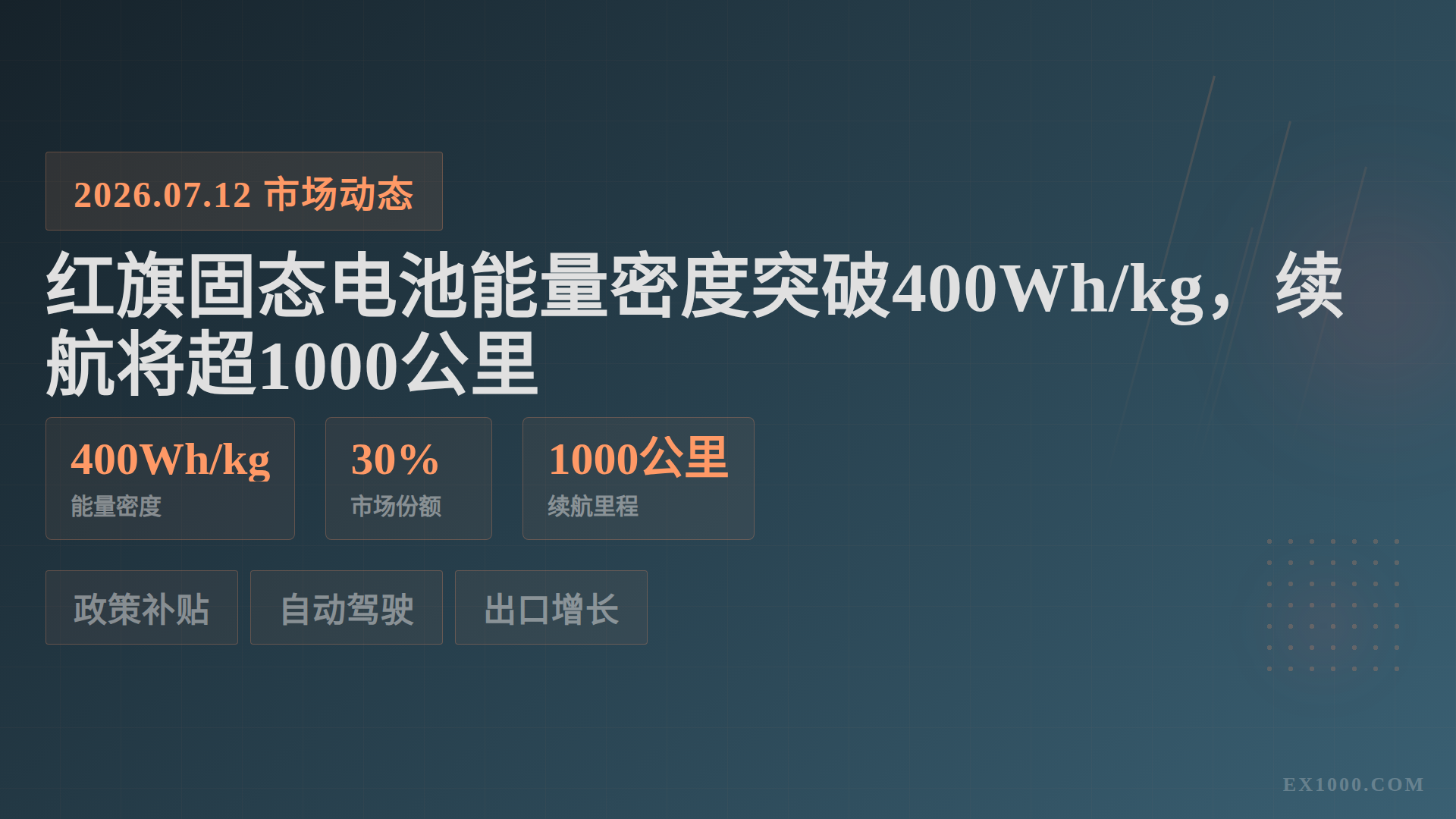
- 2027: Achieve pilot vehicle installation of 400Wh/kg energy density solid-state batteries
- 2028: Reduce cost to within 1.5x of current liquid batteries
- 2030: Full solid-state batteries achieve mass production at cost parity with liquid batteries
In the global solid-state battery race, Chinese companies now hold 42% of patent filings, ranking first worldwide. Leading companies including CATL, BYD, and WeLion New Energy have all established pilot production lines.
L3 Autonomous Driving: Admission Standards Near Finalization
Technology Roadmap 2.0 formally incorporates L3 autonomous driving into mandatory standardization:
- Q3 2026: Release draft guidelines for L3 autonomous driving system admission
- 2027: Complete first-batch OEM certification, expected to issue 5-8 test licenses
- 2028: Achieve large-scale commercial deployment of highway-scenario L3 driving
| Technology Dimension | 2024 Status | 2027 Target | 2030 Target |
|---|---|---|---|
| Battery energy density | 280Wh/kg | 400Wh/kg | 500Wh/kg |
| L3 scenario coverage | Testing phase | Highway commercial | Urban coverage |
| Connected vehicle penetration | 65% | 85% | 95% |
| Battery swap stations | 3,800 units | 8,000 units | 15,000 units |
Vehicle-Road-Cloud Integration: Increased New Infrastructure Investment
The technology roadmap designates vehicle-road-cloud integration as a national-level infrastructure project. Plans call for 50,000 kilometers of new intelligent roads from 2026 to 2028. Sixteen cities including Beijing, Shanghai, and Shenzhen have been selected for the first batch of pilot programs. This architecture reduces single-vehicle intelligence costs by over 30% while improving safety in complex scenarios.
The rapid iteration of China's intelligent electrification technologies creates new collaboration opportunities for the global automotive supply chain. For auto importers in Central Asian and Russian markets, tracking technology evolution through platforms like EX1000.COM enables advance planning for next-generation vehicle procurement.