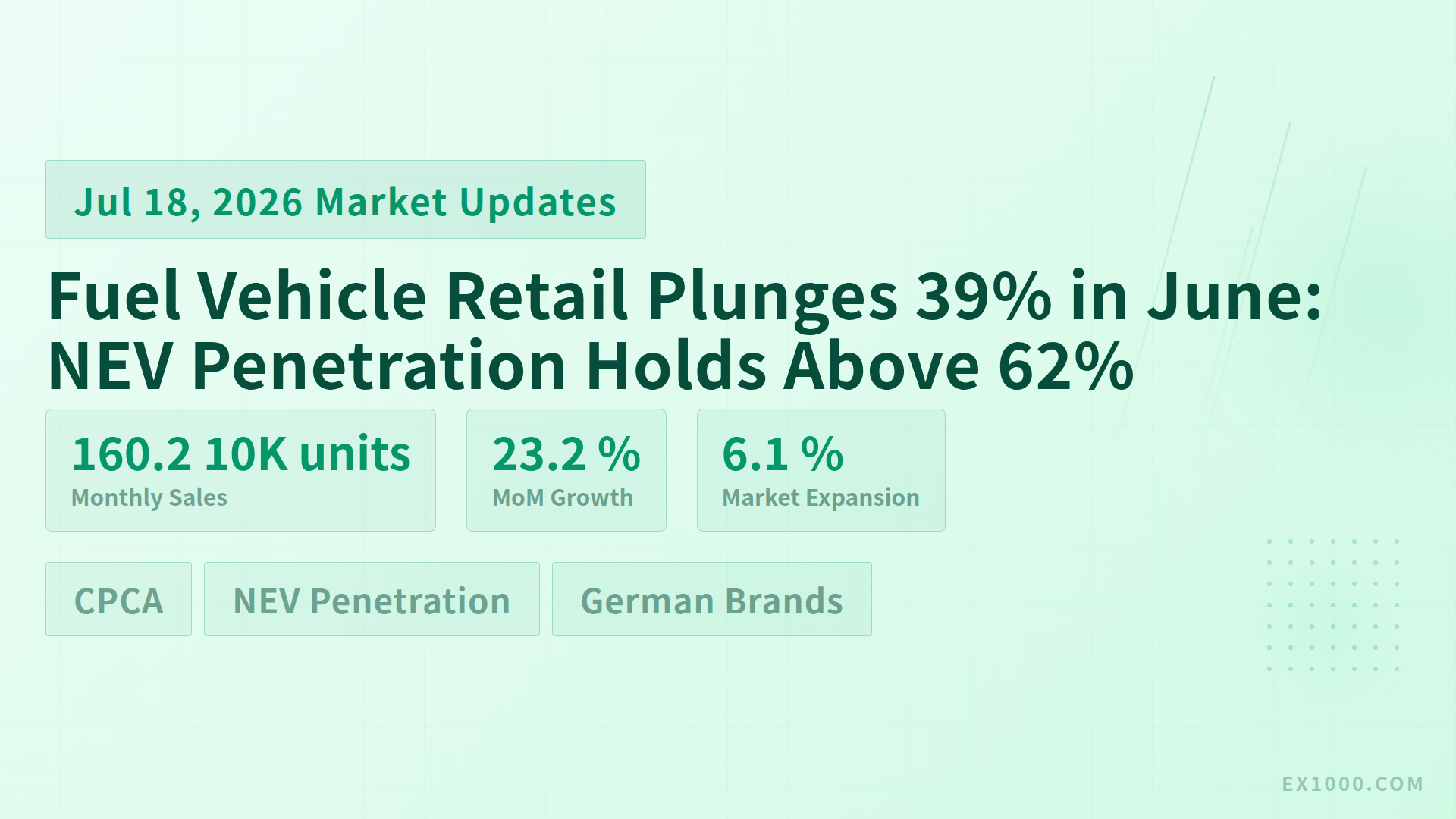
In May 2026, China's ICE vehicle market saw a rare divergence: average prices fell 23,000 yuan, yet sales plummeted 37% year-over-year. The sub-150,000 yuan ICE segment shrank from 45% market share in 2024 to just 28%. Dealer inventory coefficients rose to 2.8, far exceeding the warning threshold of 1.5, with some brands facing dealer loss ratios exceeding 60%.
Data Anomaly: Rare Divergence of Price Cuts and Sales
May 2026 exhibited classic "price elasticity failure" in the ICE market. The average discount of 23,000 yuan set a monthly record since 2024, yet sales collapsed 37% year-over-year.
Key Data at a Glance:
- Average Price Cut: 23,000 yuan
- Sales YoY Change: -37%
- Sub-150K yuan ICE share: From 45% (2024) to 28% (May 2026)
- Dealer inventory coefficient: 2.8 (warning line: 1.5)
- Dealer loss ratio: Exceeding 60% for some brands
Why the Price War Failed
Intensified "buy high, not low" consumer psychology is the core reason. When price cuts become the norm, consumers expect further reductions and choose to wait.
Three mechanisms behind price war failure:
- Self-fulfilling expectations: Continuous discounts reinforce the "it will get cheaper" mindset
- Brand devaluation effect: Frequent discounts damage brand premium, making entry-level models harder to sell
- Substitution effect amplification: At equivalent budgets, NEVs' value proposition becomes increasingly compelling
| Dimension | May 2024 | May 2026 | Change |
|---|---|---|---|
| ICE avg transaction price | 148,000 yuan | 125,000 yuan | -15.5% |
| ICE sales share | 55% | 37.5% | -17.5pp |
| NEV avg transaction price | 162,000 yuan | 158,000 yuan | -2.5% |
| NEV sales share | 45% | 62.5% | +17.5pp |
Dealer Crisis: Survive or Transform
ICE dealers face unprecedented survival pressure. An inventory coefficient of 2.8 means dealers need nearly 3 months on average to clear current stock, creating extreme capital occupation costs.
Dealer Survival Status
- Loss ratios exceed 60%: Some brands' ICE-exclusive dealers have no profitable models
- Dealer exit wave: Q1 2026 saw ICE brand dealer exits increase 45% year-over-year
- High transformation costs: Shifting to NEV requires rebuilding after-sales, retraining staff, renovating showrooms
Dealer transformation paths:
- Joining NEV brands: Highest investment, but clearest long-term prospects
- Switching to used cars: Lower barrier, but limited profit margins
- Dual-brand operation: ICE + NEV parallel, lower transition risk
For Central Asian and Russian buyers planning to source Chinese ICE vehicles, this trend means two realities:
- ICE supply will continue contracting, reducing model choices
- Dealer transformation may create after-sales service gaps
Central Asia and Russia Market Specifics
Despite rapid ICE contraction in China domestically, Central Asia and Russia remain important ICE export destinations. But the window is narrowing.
Current Export Status:
- In Q1 2026, ICE vehicles still accounted for 68% of China's exports to Russia
- Kazakhstan, Uzbekistan and other Central Asian countries maintain lower import tariffs on ICE than NEVs
- Local charging infrastructure remains weak, making ICE the pragmatic choice
However, change is underway:
| Market | ICE Import Share (2024) | ICE Import Share (Q1 2026) | Trend |
|---|---|---|---|
| Russia | 78% | 68% | Rapid decline |
| Kazakhstan | 85% | 72% | Significant drop |
| Uzbekistan | 90% | 81% | Gradual shift |
Among Russian buyers sourcing through EX1000.COM, the proportion inquiring about hybrid vehicles rose from 15% in 2024 to 42% in May 2026. Even in traditional ICE markets, the transition signal is evident.
Conclusion: The Final Procurement Window
ICE vehicles won't vanish overnight, but their "good times" are over. For Central Asian and Russian buyers, three judgments are needed:
Procurement Recommendations:
- Short-term (2026-2027): ICE supply remains available but model choices are narrowing. Prioritize mainstream brands and models for after-sales security
- Medium-term (2028-2030): Hybrids will become China's primary export type. Shift procurement focus to PHEV and EREV models
- Long-term (post-2030): Pure ICE may survive only in specific commercial and off-road segments
Dealer transformation pain won't disappear instantly, but market direction is clear. For buyers not requiring immediate purchase, waiting for richer hybrid model choices in 2027 may be the more rational strategy.