In 2026, Chery and BYD are fiercely contesting the "Chinese Auto Overseas Sales Champion" title. Chery leverages its global product matrix and first-mover advantage in RHD markets to spread wide; BYD builds brand recognition in mature markets through NEV technology depth and premium positioning. The Q1 gap narrowed to under 30,000 units, leaving the annual crown highly uncertain. This article breaks down the duel across sales structure, market layout, and product strategy.
Sales Landscape: Q1 Gap Just 30K Units, Annual Battle Intensifies
Q1 2026 overseas sales data reveals an exceptionally tight race.
| Brand | Q1 Overseas Sales (10K) | YoY Growth | Core Growth Markets |
|---|---|---|---|
| Chery | 28.6 | +38% | Russia, Middle East, Latin America |
| BYD | 25.8 | +62% | Southeast Asia, Europe, Australia |
| Great Wall | 12.4 | +22% | Russia, Middle East, South Africa |
| Geely | 11.9 | +45% | Southeast Asia, Europe, Middle East |
Chery leads with 286,000 units, but BYD's 258,000 grows significantly faster (+62%). At this pace, BYD could overtake in Q2-Q3.
However, their growth logics differ fundamentally. Chery's growth is "wide-net" multi-point flowering; BYD's is "focused breakthrough" single-point blasting.
Monthly Trend: BYD's Stronger Second-Half Momentum
Chery's Q1 monthly exports were relatively balanced:
- January: 98,000 units
- February: 89,000 units (Spring Festival dip)
- March: 99,000 units
BYD showed clear "ramping" characteristics:
- January: 72,000 units
- February: 81,000 units
- March: 105,000 units (new monthly export record)
BYD's March explosion was driven by:
- Thailand plant going online, RHD capacity release
- European Seal and Atto 3 orders concentrated delivery
- Brazil Dolphin and Song PLUS DM-i official launch
Market Layout: Chery's "Breadth" vs BYD's "Depth"
Chery: Global Network Across 80+ Countries
Chery is among China's earliest overseas-deployed automakers, with over 20 years of export history. Its core advantage is "breadth":
- Market coverage: 80+ countries, spanning virtually all continents
- Overseas dealer network: over 2,000 stores
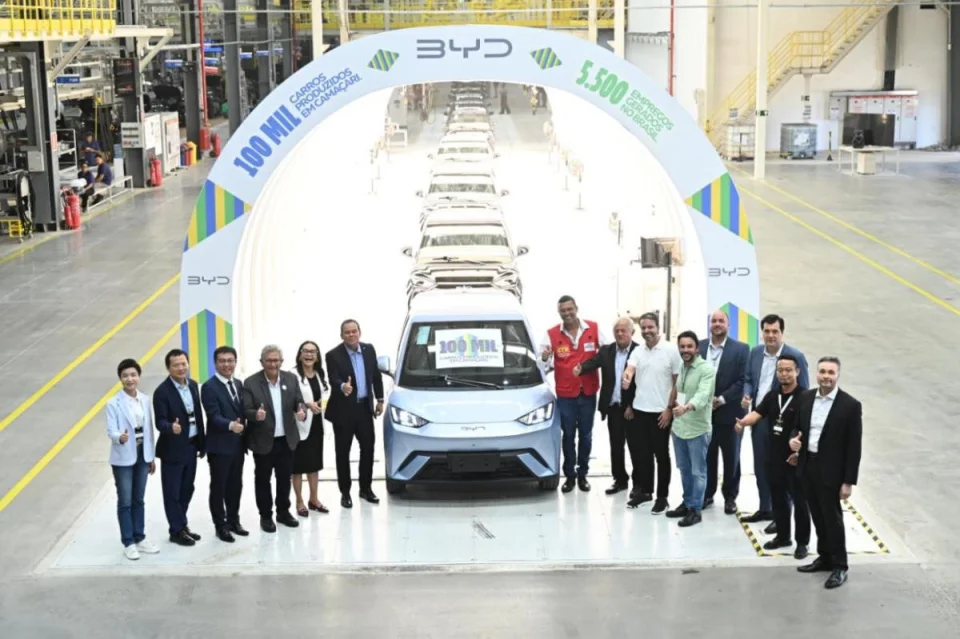
- Overseas plants: 10 (Russia, Brazil, Egypt, Iran, Indonesia, etc.)
- Localized models: over 50, adapted for different markets
Chery's product strategy is "ICE primary, NEV secondary." In most overseas markets, the Tiggo series (Tiggo 4/7/8) and Arrizo sedans remain volume leaders.
Chery's "breadth" advantages:
- In politically volatile markets (parts of Middle East, Africa), Chery's long-term cultivation builds channel resilience
- Abundant RHD capacity, high Commonwealth country coverage
- Unmatched coverage density in entry-level markets (under 100K yuan)
BYD: New Energy Premium Breakthrough
BYD's overseas deployment started later than Chery's, but its growth rate is stunning. Its core advantage is "depth":
- Market coverage: 50+ countries, focusing on high-value markets
- Overseas plants: 6 (Thailand, Brazil, Hungary, Indonesia, Uzbekistan, Turkey planned)
- Average price: 220K yuan (export average), significantly above Chery's 120K
- NEV share: 100% (BEV + PHEV)
BYD's strategy is "skip the ICE phase, open markets directly with NEV."
| Dimension | Chery | BYD |
|---|---|---|
| Overseas avg. price | 120K yuan | 220K yuan |
| NEV share | 15% | 100% |
| Per-unit margin | Lower | Higher |
| Market coverage | 80+ countries | 50+ countries |
| Plant count | 10 | 6 |
| Brand perception | "Reliable, affordable" | "Tech, premium" |
BYD's "depth" advantages:
- In Thailand, Singapore and other high-NEV-penetration markets, BYD is virtually synonymous with "Chinese car"
- European Atto 3 and Seal continuously earn positive口碑, initial brand premium established
- Premium models (Han, Tang, Seal) export share rising, lifting overall average price and profit
Product Strategy: ICE Defense vs NEV Offense
Chery and BYD's product route differences reflect fundamentally different judgments on "overseas market demand."
Chery judges that most overseas markets (except Western Europe and Southeast Asia) will remain ICE-dominated for the next 5 years, with insufficient NEV infrastructure to support rapid switching. Thus Chery sticks to "ICE + NEV parallel," using Tiggo and Arrizo ICE to defend the base, while testing NEV with eQ1 and Ant mini-EVs.
BYD judges that global NEV transition is faster than expected, and early NEV deployment can seize brand认知 high ground. Thus BYD goes all-in on NEV, even in the Middle East and Latin America where charging infrastructure is limited, using PHEV (DM-i) as a transitional bridge.
2026 Key Battlegrounds: Southeast Asia and Middle East
The contest in these two markets will determine the annual champion.
Southeast Asia: BYD's Thailand plant has 150K annual capacity, with Q1 2026 output reaching 38,000 units and utilization exceeding 100% (two-shift operation). Chery has no Thailand plant, relying on CBU imports, making its price competitiveness weaker than locally produced BYD.
Middle East: Chery leverages 20 years of channel accumulation, with 400+ dealers in Saudi Arabia, UAE, and Iraq. BYD only officially entered in 2025, but is rapidly building direct + agency hybrid networks through Saudi sovereign fund partnerships.
| Market | Chery Q1 Sales | BYD Q1 Sales | Competitive Dynamics |
|---|---|---|---|
| Thailand | 8K units | 32K units | BYD dominates |
| Saudi Arabia | 21K units | 4K units | Chery leads |
| Brazil | 15K units | 12K units | Chery slightly ahead |
| Australia | 6K units | 11K units | BYD overtakes |
| Russia | 38K units | 3K units | Chery absolute advantage |
Overseas Buyer Perspective: Procurement Opportunities from the Championship Battle
The Chery-BYD competition delivers tangible benefits to overseas buyers.
First, price competition. BYD's aggressive pricing in Southeast Asia (15-20% below comparable rivals) directly forces Toyota and Honda to cut prices, and also pressures Chery to adjust pricing in certain markets.
Second, product richness expansion. To contest the title, both are accelerating overseas-exclusive model launches:
- Chery plans to launch 5 overseas-exclusive NEV SUVs in 2026
- BYD plans 3 RHD-dedicated models and 2 large 5-seat PHEV SUVs
Third, after-sales service upgrade. Competitive pressure drives both to increase service investment overseas. Chery announced 300 new 4S stores globally in 2026; BYD launched a "lifetime三电 warranty" policy in Thailand and Brazil.
For Central Asian and Russian buyers, this dual-giant battle means:
- Chery's absolute advantage in Russia and Central Asia is unlikely to shake in the short term, offering high supply chain stability
- BYD hasn't entered Central Asia at scale, but is laying groundwork through its Kazakhstan plant (online since 2025)
- Through platforms like EX1000.COM, buyers can real-time compare export models, prices, and configurations from both brands — choice space is unprecedentedly large
Regardless of who ultimately claims the 2026 overseas sales crown, Chinese autos' global competitiveness has entered a new stage. From "value for money" to "quality for money," from "selling products" to "building brands" — this dual-giant showdown is itself a microcosm of Chinese automotive globalization's quality leap.