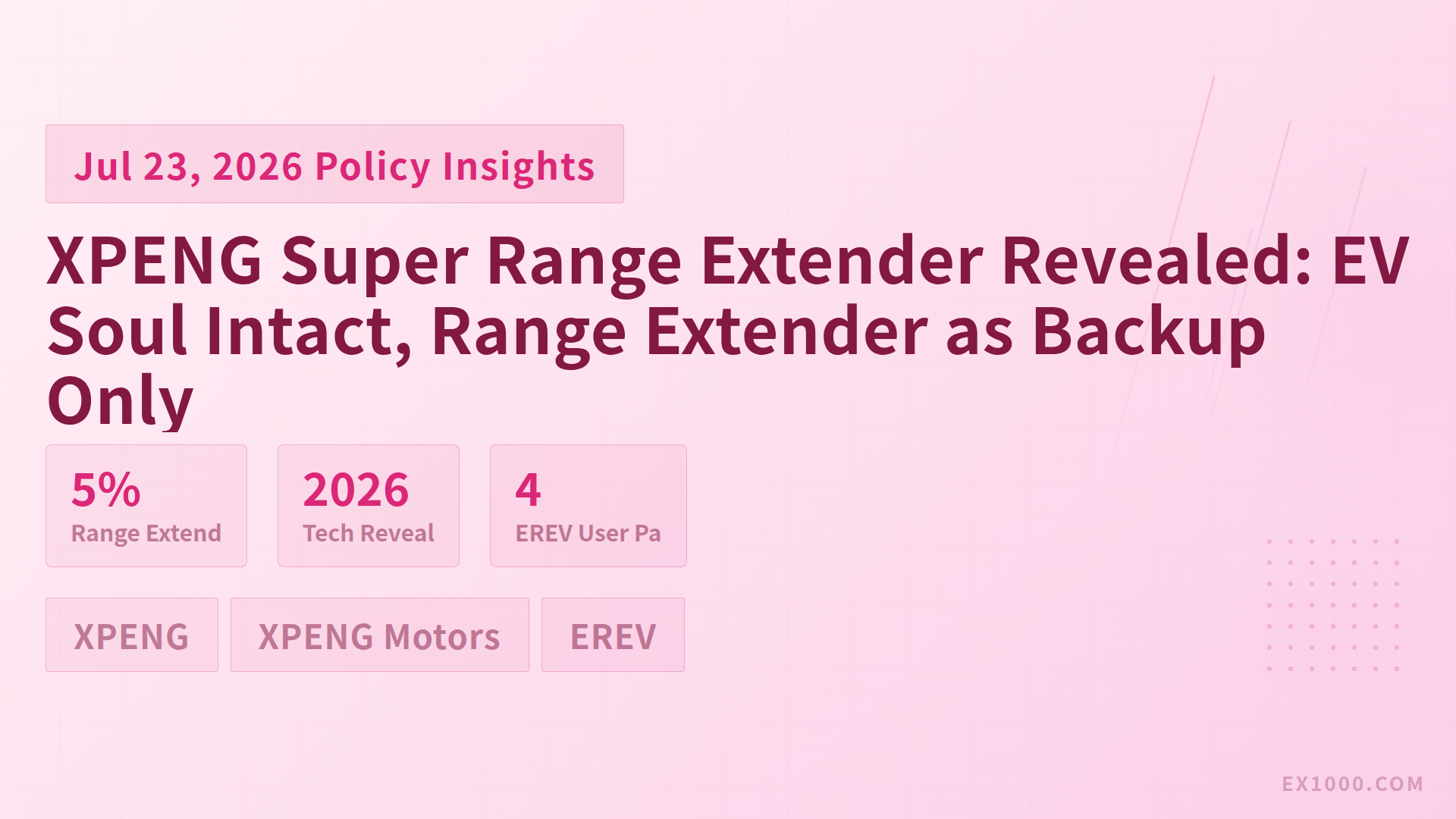
Amid market debate over XPENG's super range extender technology, Gu Jie, senior director of powertrain, publicly clarified: the core logic is not a pivot to hybrids but preserving the pure-EV driving experience while eliminating range anxiety. The range extender serves purely as an emergency backup, with daily driving remaining fully electric.
Technical Positioning: EV Essence, Range Extender as Safety Net
In 2026, as the debate over new energy vehicle technology routes intensifies, XPENG's official interpretation of its super range extender technology offers a clear answer: this is not a strategic shift from pure electric to hybrid, but a defense and extension of the "EV experience."
Gu Jie, XPENG's senior director of powertrain, used a simple analogy to explain the system — a smartphone paired with a power bank. In this analogy, the phone itself is the core (electric drive), while the power bank is merely a backup for preventing shutdown when away from home (range extender). For daily commutes and short city trips, the vehicle runs entirely on battery power, maintaining the handling quality, energy efficiency, and quietness unique to pure EVs. Only when users face long road trips or extreme scenarios with insufficient charging infrastructure does the range extender intervene as an emergency power source.
Four Major Pain Points of Traditional EREVs
Gu Jie's explanation directly targets the structural flaws of most range-extended electric vehicles (EREVs) currently on the market:
- Space intrusion: To accommodate the range-extended powertrain, most EREVs compromise on cabin space and storage layout
- Chassis compromises: Changes in powertrain layout affect suspension tuning and vehicle center of gravity, weakening handling performance
- Fractured experience: The driving feel when fully charged versus when battery-depleted is like two different cars — power decay, noise surge, and driving quality discontinuity
- ADAS interference: Power fluctuations during battery mode switching can even disrupt the smooth operation of advanced driver-assistance systems and onboard electronics
The root cause of these problems lies in the fact that traditional EREVs are designed with the range extender as a "primary" rather than a "backup" power source, creating an unbridgeable gap between pure electric and fuel-powered modes.
Core Differences of XPENG's Approach
| Dimension | Traditional EREV | XPENG Super Range Extender |
|---|---|---|
| Design Priority | Fuel/Electric Balance | EV Experience First |
| Range Extender Role | Primary Power Source | Pure Emergency Backup |
| Daily Driving Mode | Frequent Oil/Electric Switching | Always Electric |
| Depleted Battery Experience | Power Decay, Noise Increase | Maintains EV Quality |
| ADAS Stability | Mode Switching May Disrupt | Unaffected by Range Extender |
| Space Impact | Significant Cabin/Storage Intrusion | Minimized Layout Impact |
The key to XPENG's solution is minimizing the presence of the range extender. It does not pursue "ICE-comparable range" in extended mode, but rather ensures that in the rare scenarios where the range extender must be used, users don't feel the jarring switch from "driving an EV" to "driving a gas car." Behind this design philosophy is XPENG's long-term confidence in pure-electric technology — the range extender is merely a patch covering the last 5% of use cases, not a compromise that changes the product's essence.
Market Context and Strategic Considerations
In 2026, China's NEV market shows a clear trend: brands once firmly committed to pure-electric routes are now deploying range-extended product lines. Li Auto achieved great success with its EREV approach, while brands like AITO, Leapmotor, and Deepal have also gained considerable sales in the EREV segment. For a brand like XPENG, known for intelligent driving and pure-electric technology, launching a range-extended product is both a pragmatic response to market pressure and an answer to user demand.
However, XPENG has chosen a differentiated entry approach — not to become a "better Li Auto," but rather a "pure-electric XPENG with a range-extended backup." This positioning preserves the brand's technology label in intelligent driving and pure-electric domains while covering potential users with strong range anxiety through the range extender.
Technology Maturity and Production Outlook
Currently, XPENG has not disclosed specific technical parameters of its super range extender, such as engine displacement, generator power, or fuel tank capacity. From Gu Jie's statements, the system's core goal is not pursuing extreme range in extended mode, but maintaining the pure-electric driving feel as much as possible when the range extender is operating.
The feasibility of this technical path largely depends on XPENG's engineering capabilities in several areas:
- Efficient engine-motor coordination: Ensuring power matching between range extender generation and motor drive
- NVH control: Maintaining cabin quietness when the range extender is running
- Thermal management: Integrated optimization of range extender cooling and battery temperature control systems
- Software algorithms: Intelligent judgment of when to activate the range extender, optimizing energy usage strategies
If XPENG can achieve breakthroughs in these engineering challenges, its super range extender could become a new benchmark in the EREV market — not the longest-range EREV, but the EREV that feels most like a pure EV.
For overseas observers and potential buyers tracking the development of China's new energy vehicle technology, XPENG's technology release is worth watching. Detailed technical specifications and overseas market access information for the full XPENG lineup are available through EX1000.COM.