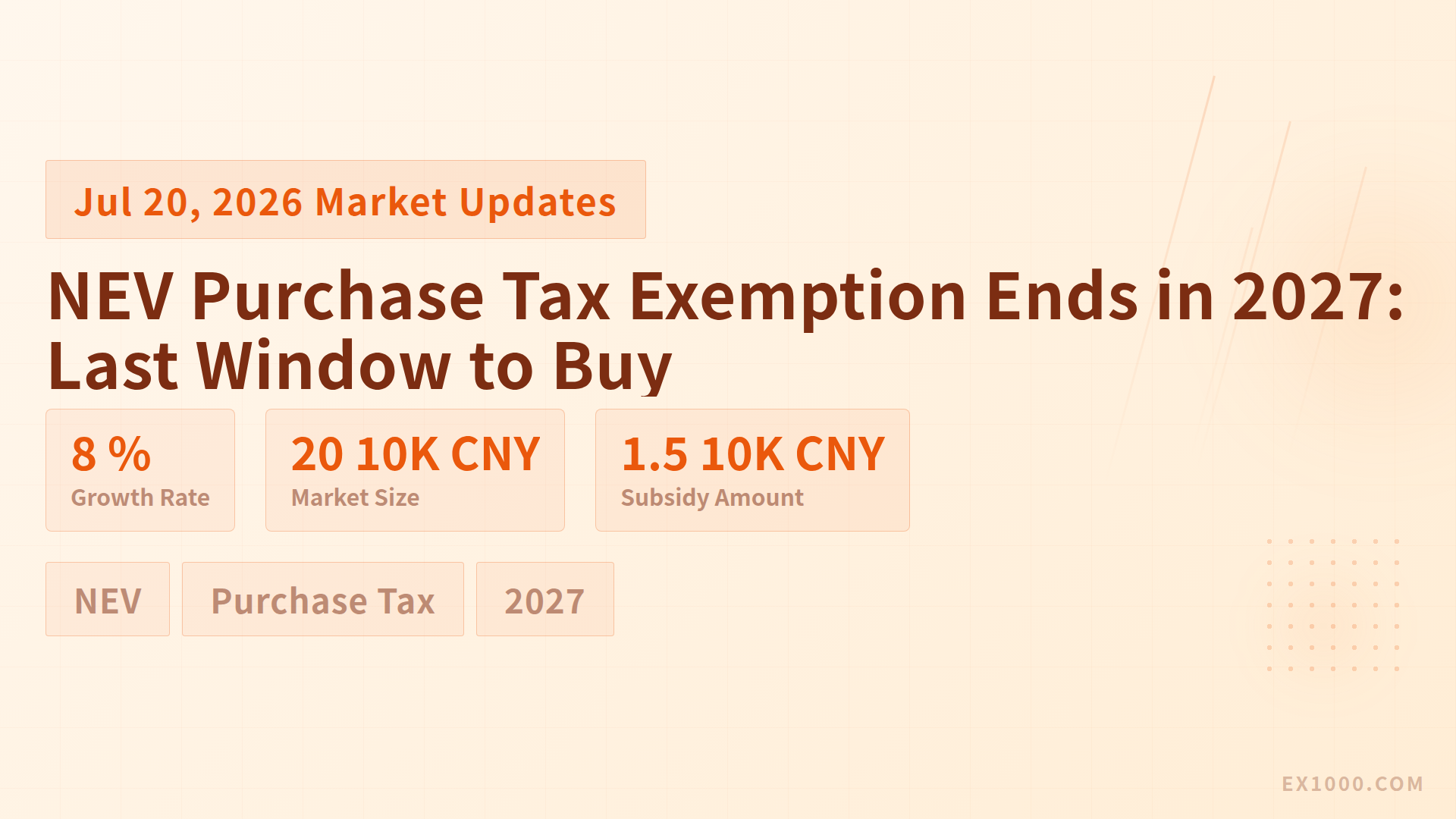
On July 16, 2026, China's Ministry of Finance, Customs, and Taxation jointly announced that lithium battery consumption tax will be restored from September 1, 2026, ending the 11-year battery tax exemption. The first-year rate is 2%, rising to 4% from September 2027. Industry estimates suggest pure EV manufacturing costs will increase by RMB 396–1,200 per vehicle. This is seen as a key signal of NEV tax incentives gradually phasing out and aligning with ICE vehicle taxation.
EX1000 Introduction
For automotive buyers in Central Asia, Russia, and emerging markets, understanding China's battery tax policy is crucial for anticipating export pricing trends and technology shifts in Chinese NEVs. This analysis breaks down the policy mechanics and market implications.
Policy Core: From Tax Holiday to Gradual Taxation
On July 16, 2026, three ministries issued Announcement No. 20 (2026), marking China's battery industry transition from "policy nurturing" to "market regulation."
Tax Timeline:
- September 1, 2026 – August 31, 2027: Lithium batteries taxed at 2%
- From September 1, 2027: Rate rises to 4%
- April 1, 2027: Solar batteries taxed at 2%, rising to 4% from April 1, 2028
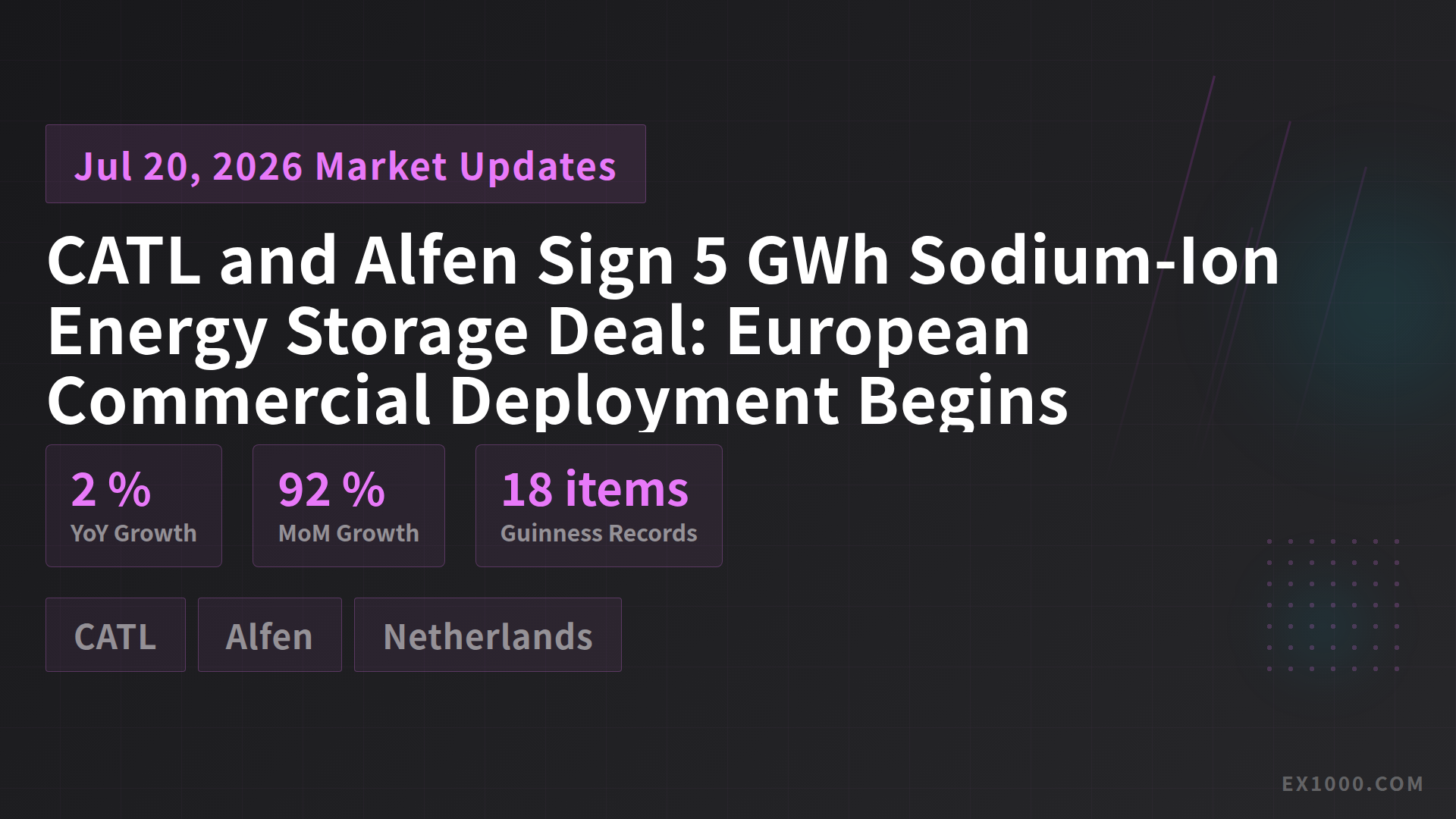
Accompanying Tax Exemption Window: From September 1, 2026 to December 31, 2028, sodium-ion batteries, solid-state batteries, fuel cells, and emerging solar technologies remain tax-exempt. This sends a clear industry signal: policy encourages migration toward higher energy density, safer, and greener technologies.
Cost Pass-Through: Who Bears the New Tax Burden
As an ad valorem tax, consumption tax is paid by battery producers but passes through the supply chain to vehicle retail. Industry estimates:
| Vehicle Type | Battery Capacity | Cost Increase (2%) | Cost Increase (4%) |
|---|---|---|---|
| Pure EV | 55–100 kWh | RMB 396–1,200 | RMB 792–2,400 |
| PHEV/EREV | 36–55 kWh | RMB 260–660 | RMB 520–1,320 |
Current LFP cell prices are RMB 0.36–0.4/Wh, with NMC at RMB 0.55–0.6/Wh. Though the new tax accounts for less than 1% of vehicle price, the auto industry's profit margin is only about 1.5%, making the cost pressure significant.
Industry Impact: Restructuring Supply Chain Pricing
Industry experts note the policy will affect the NEV industry chain across multiple dimensions:
- Battery manufacturers under pressure: Tax directly increases production costs, potentially amplifying second-tier manufacturers' price advantages and accelerating industry consolidation
- Automaker strategy divergence: OEMs with in-house battery capabilities (e.g., BYD, GAC Aion) gain relative cost advantages; NEV startups relying on external sourcing face greater pressure
- Export pricing challenges: If cost increases pass through to export models, Chinese NEVs' price competitiveness in cost-sensitive markets like Central Asia and Russia may face slight erosion
As early as June 2026, rumors circulated about "oil-electric parity" tax reforms. CPCA Secretary-General Cui Dongshu views the battery tax as a strong catalyst for OEMs to develop in-house batteries, benefiting the industry's long-term competitiveness.
Spillover Effects on Overseas Markets
For buyers in Central Asia, Russia, and other markets, the battery tax policy impacts through three channels:
- Export pricing pressure: If battery cost increases fully pass through, Chinese NEVs in Central Asia and Russia may face slightly reduced price competitiveness
- Technology dividend: Sodium-ion and solid-state batteries enjoy tax exemption, accelerating Chinese OEM investment in these technologies. Long-term, this may deliver battery solutions better suited to cold climates like Russian winters
- Localization incentive: To avoid the tax, Chinese battery firms may accelerate overseas factory construction (e.g., Gotion in Germany), shortening supply distances to Central Asia and Europe
Automaker Response Strategies
Facing impending cost pressure, OEMs and battery manufacturers are adopting three strategic directions:
- Internal absorption: Leading OEMs will likely absorb some cost increases to maintain stable retail prices and avoid volume decline
- Technology substitution: Accelerated migration to sodium-ion and solid-state batteries—especially for cost-sensitive entry-level models
- Overseas capacity: Battery firms accelerating overseas factory construction to avoid tariff and tax costs while positioning closer to target markets
For more analysis on China's NEV policy changes and overseas market pricing, follow EX1000.COM.