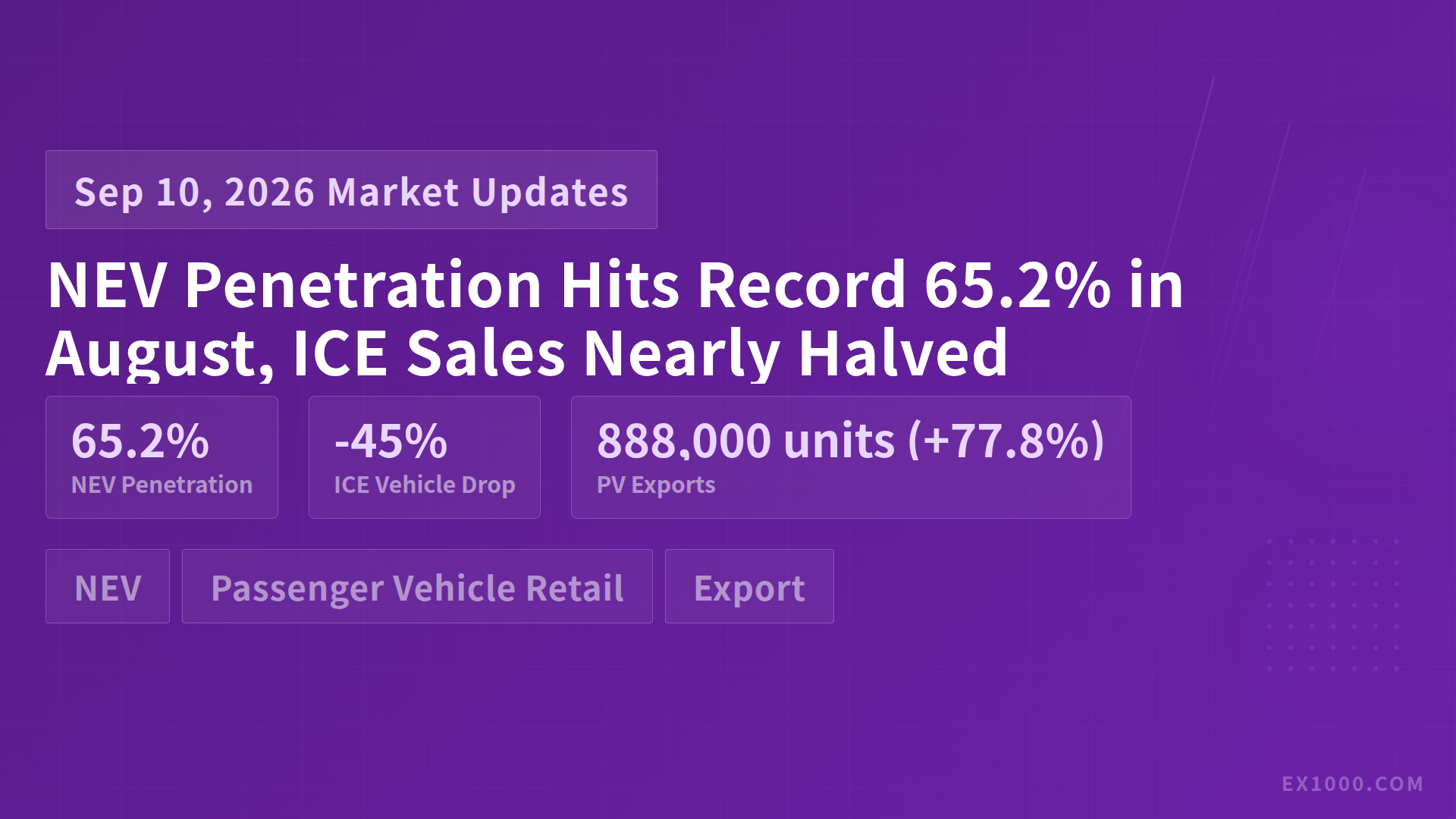
In June 2026, China's fuel passenger vehicle retail sales plunged 39% year-on-year, with conventional fuel vehicles' market share dropping to just 37.2%. Some joint venture brands offered discounts exceeding 30%, with certain models selling at 40% off original prices. Meanwhile, new energy vehicle penetration has exceeded 60% for three consecutive months.
The Accelerating Collapse of the Fuel Vehicle Market
June 2026 marked a historic turning point for China's fuel vehicle market. Fuel passenger vehicle retail sales plummeted 39% year-on-year, with conventional fuel vehicles' market share falling to just 37.2% — the first time it has dropped below the 40% threshold.
Some joint venture brands offered discounts exceeding 30% to clear inventory, with certain models selling at 40% off original prices. This price collapse was particularly evident at GAC Honda, which sold only 68,300 units in the first half of the year, a staggering 55.82% year-on-year decline. In contrast, GAC Toyota maintained growth with 356,000 units sold, up 3.29% year-on-year, highlighting the internal divergence within Japanese brands.
New Energy Vehicles Dominate
In stark contrast to the fuel vehicle market's decline, new energy vehicle penetration has exceeded 60% for three consecutive months. This means that for every 10 new cars sold, more than 6 are new energy vehicles.
- Battery electric vehicles achieve penetration rates above 75% in tier-1 and new tier-1 cities
- Plug-in hybrid models are growing rapidly in tier-3 and tier-4 cities, becoming the primary replacement for fuel vehicles
- Extended-range technology has gained market recognition, with brands like Li Auto and AITO seeing sustained sales growth
The Deeper Logic Behind the Price War
The sustained decline in fuel vehicle prices is not accidental — it results from multiple overlapping factors:
- Policy Pressure: Upgraded China 6 emission standards and the gradual withdrawal of fuel vehicle purchase tax incentives
- Technological Gap: New energy vehicles have formed overwhelming advantages in intelligence, energy consumption, and operating costs
- Consumer Migration: Young consumers show extremely high acceptance of new energy vehicles, while fuel vehicle brands face aging perception issues
| Brand/Metric | H1 Sales | YoY Change | Market Segment |
|---|---|---|---|
| GAC Honda | 68,300 units | -55.82% | JV Fuel |
| GAC Toyota | 356,000 units | +3.29% | JV Fuel |
| NEV Penetration | — | >60% for 3 months | Overall Market |
Implications for Central Asian and Russian Markets
The collapse in fuel vehicle prices has created a historic window for Chinese automakers' exports. Large inventories of fuel vehicles are entering Central Asian and Russian markets at highly competitive prices, becoming popular choices for local consumers' replacement purchases.
- The Russian market shows strong demand for Chinese fuel vehicle imports, with high price sensitivity
- The five Central Asian countries are in an automotive consumption upgrade phase, where cost-performance ratio is the key decision factor
- Relaxed used car export policies have opened new channels for fuel vehicles to "go global"
Outlook
The contraction of the fuel vehicle market has become an irreversible trend. For overseas dealers, the present represents a golden period for low-cost procurement of Chinese fuel vehicle inventory. However, as new energy technology continues to iterate, Central Asian and Russian markets will also face a new energy wave within 2-3 years.