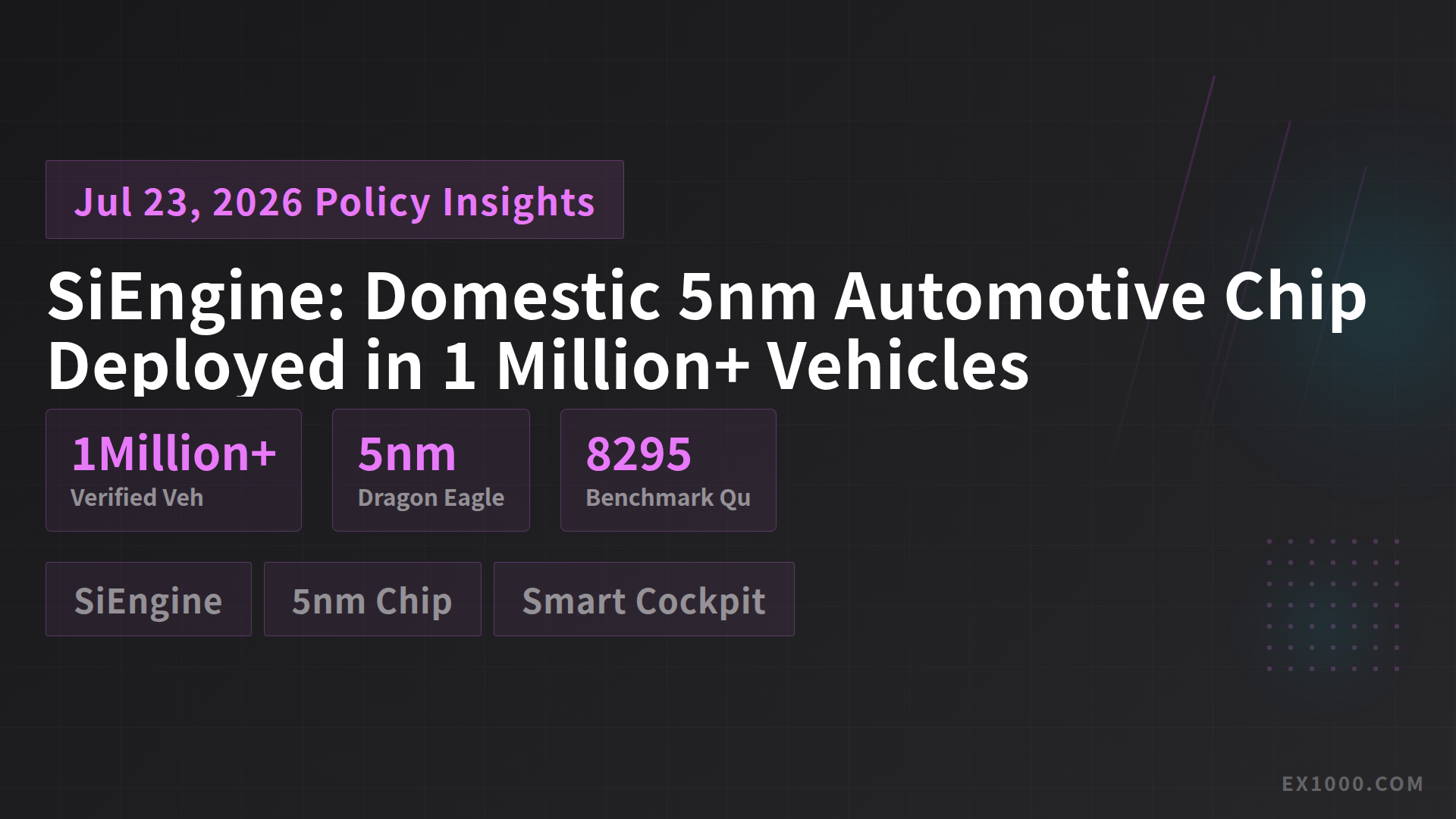
At the 2026 China Automotive Forum, SiEngine CEO Wang Kai stated that domestic automotive-grade chips have moved beyond low-end import substitution to a critical stage of global competition, with the 5nm Dragon Eagle No. 2 chip supporting premium smart cockpits and cabin-driving fusion.
Beyond Substitution: The Qualitative Leap of China's Auto Chips
At the 2026 China Automotive Forum, Wang Kai — founder and CEO of SiEngine — delivered a pivotal assessment: domestic automotive-grade chips have moved beyond the stage of low-end import substitution to a critical stage of global competition.
This assessment carries significant weight. For the past decade, the core narrative of China's automotive chip industry has been "domestic substitution" — using local products to replace imported low-end chips and solve "chokepoint" issues. Today, the narrative has fundamentally shifted: Chinese companies are no longer content to fill gaps; they aim to compete head-to-head with global giants like NVIDIA, Qualcomm, and Mobileye on the world stage.
Wang emphasized a frequently overlooked fact: chips require large-scale market validation for industry recognition. SiEngine's automotive-grade chips are verified in over 1 million vehicles, matching advanced international products in performance. This one million is not lab data — it's the result of long-term operation on real roads.
Dragon Eagle No. 2: The 5nm Automotive Chip Breakthrough
SiEngine's current product matrix covers three major domains: smart cockpits, autonomous driving, and AI acceleration. The most representative product is the Dragon Eagle No. 2 — an automotive-grade chip manufactured using a 5-nanometer process.
What does a 5nm automotive chip mean for the industry?
- Process leadership: The 5nm process places it in the first tier of automotive chips, in the same generation as Qualcomm's SA8295
- Cabin-driving fusion capability: Supports premium smart cockpits while enabling compute fusion between cabin and driving assistance
- Full coverage from entry to flagship: A single chip architecture covers differentiated needs from entry-level to premium vehicles
| Product Dimension | Dragon Eagle No. 2 | Industry Benchmark |
|---|---|---|
| Process Node | 5nm | Same generation as Qualcomm SA8295 |
| Validation Scale | 1M+ vehicles | Large-scale mass production validation |
| Application Scenarios | Smart cockpit + cabin-driving fusion | Primarily single-scenario |
| Ecosystem Coverage | Passenger cars/Tier 1/robotics/drones | Mainly automotive-focused |
| Computing Platform | Ark Platform (full-stack integration) | Usually chip-only offering |
This "chip + platform" integrated strategy is SiEngine's core differentiator from traditional chip suppliers.
Ark Computing Platform: Ecosystem Thinking Beyond the Chip
Wang highlighted the Ark Computing Platform at the forum. This is not merely chip companion software, but a complete computing platform integrating operating systems, middleware, algorithms, and supply chains.
The strategic intent of the Ark Platform is to lower deployment barriers for automakers and edge-intelligence enterprises:
- OS layer: Provides an automotive-grade verified underlying system
- Middleware layer: Standardized data interaction and algorithm scheduling framework
- Algorithm layer: Pre-integrated mainstream perception, planning, and decision-making algorithms
- Supply chain layer: Connects the full chain from chip manufacturing to packaging and testing
For automakers, this means the time-to-market from chip selection to mass production can be significantly shortened. For Tier 1 suppliers and robotics companies, it means they can build on the Ark Platform for secondary development without constructing a tech stack from scratch.
Global Competitive Landscape: The Window for Chinese Chip Companies
Behind Wang's assessment lies a structural shift in the automotive semiconductor industry:
Reversed supply-demand dynamics: The global automotive chip market has moved from the severe shortages of 2021-2022 toward structural oversupply. Traditional chip giants' capacity expansion has simultaneously created more market opportunities for new entrants.
Diverging technology roadmaps: As intelligent driving evolves from L2+ toward L3/L4, compute demand grows exponentially. This requires not only more advanced processes but also architecture designs optimized for automotive scenarios. Chinese companies possess a natural advantage in scenario understanding and iteration speed.
Geopolitical catalyst: Supply chain security has become a core concern for global automakers. Chinese automakers' acceptance of domestic chips is rising rapidly, and this "domestic demand-driven" momentum is transforming into "global export" capability.
The SiEngine case demonstrates that China's automotive chip industry is completing a three-stage leap from "usable" to "good" to "leading." For global buyers monitoring China's automotive supply chain, this signals two things: first, the degree of technological self-controllability of Chinese smart EVs is rapidly increasing; second, smart cockpit and driving assistance systems based on Chinese chip platforms will become an important dimension of future product differentiation. For more in-depth analysis, visit EX1000.COM.