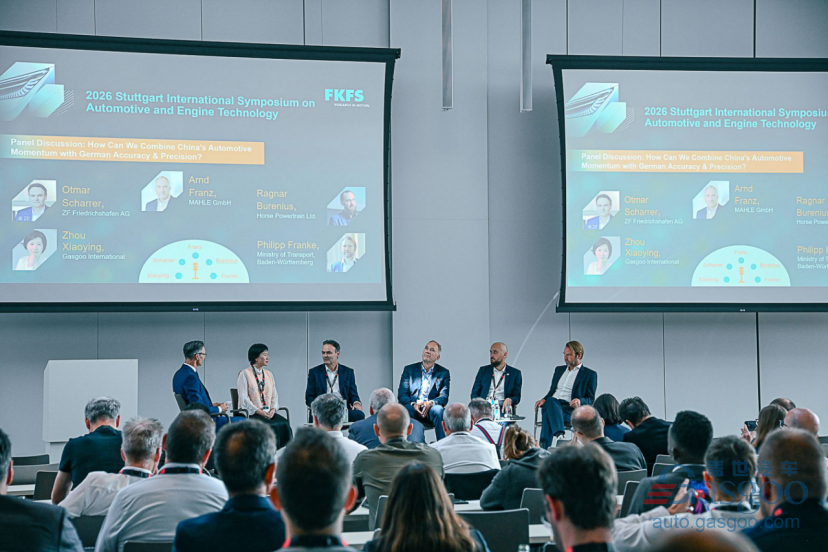
At the 2026 International Symposium on Automotive and Powertrain Technology in Stuttgart, a panel on combining China's automotive momentum with German engineering precision revealed the deep challenges Chinese automakers face entering Europe—companies racing to transform, governments preserving stability, and ordinary people fearing job losses.
The Core Proposition Behind the Panel: The Collision of Efficiency and Precision
At the 2026 International Symposium on Automotive and Powertrain Technology in Stuttgart, a panel discussion posed a sharp central question: How can the momentum of China's automotive industry be combined with the precision and rigor of German engineering?
This seemingly technical question touches on the deepest social fabric of Chinese automakers' European expansion. As Gasgoo commentator Zhou Xiaoying observed on-site: "Companies are racing to transform, governments are trying to preserve stability, and ordinary people fear losing both their jobs and their way of life. As China's automotive industry enters Europe, it is confronting more than a market—it is entering an entire social system."
The questions prepared by German organizers were sharp and challenging, reflecting the European automotive industry's complex mindset toward Chinese competitors: eager to leverage China's electrification and intelligentization momentum to drive their own transformation, yet vigilant about the rapid expansion of Chinese automakers.
The Structural Contradiction of Three Clocks
To understand the current situation, one apt metaphor applies: One Germany, three clocks.
Corporate Clock: Racing to Transform
German automakers are not unaware of the urgency of electrification. Volkswagen, Mercedes-Benz, and BMW have all announced ambitious electrification strategies, but transformation speed is constrained by massive legacy gasoline vehicle assets—existing production lines, supply chains, and workforce skill systems. In contrast, Chinese automakers carry no historical baggage and can push product iteration at far more aggressive speeds. In terms of product development cycles, Chinese NEV models average 18-24 months, while European traditional automakers still typically require 36-48 months.
Government Clock: Steady Progress
EU policymakers play a complex role in the electrification transition. On one hand, the EU has set a 2035 ban on gasoline vehicle sales; on the other, temporary anti-subsidy tariffs on Chinese EVs and protective policies for domestic supply chains reflect policymakers' oscillation between "driving transformation" and "protecting employment." The German government faces a particular dilemma: excessive protection of domestic industry may delay electrification, while excessive openness could impact the employment base of traditional automotive regions.
Social Clock: Anxiety and Adaptation
For ordinary workers in Germany's automotive heartlands—Stuttgart, Wolfsburg, Munich—the entry of Chinese automakers means deep insecurity. Their concerns extend beyond factory relocations or job losses to the reconstruction of entire occupational skill systems. From internal combustion engine engineers to battery system specialists, from mechanical assembly technicians to software-defined vehicle architects, this transition is lengthy and painful for individuals.
| Dimension | Chinese Automakers | German Automakers | Core Contradiction |
|---|---|---|---|
| Product Development Cycle | 18-24 months | 36-48 months | Speed differential creates uneven competition |
| Supply Chain Strategy | Vertical integration + global sourcing | Traditional Tier system | Cost and flexibility gap |
| Intelligent Features | Standard smart cockpit/ADAS | Premium models optional | User experience generation gap |
| Pricing Strategy | Aggressive penetration | Brand premium protection | Market positioning conflict |
| Policy Environment | Industry support + standard leadership | Environmental regs + labor protection | Institutional friction |
Chinese Automakers' European Path: From "Selling Cars" to "Building Ecosystems"
Facing this complex social system, Chinese automakers' European strategy is evolving from pure "product export" toward "ecosystem building."
Factory investments in Hungary and Spain have already demonstrated that Chinese automakers recognize localized production is not merely a tariff-avoidance tactic, but a necessary path to integrating into local society and creating jobs. Chery's investment in Barcelona and BYD's investment in Szeged, Hungary, both come with explicit local employment commitments and supply chain localization targets.
But factories are only the first step. Deeper challenges include:
- Brand perception reshaping: Evolving from "value-for-money alternative" to "technology leader"
- After-sales network building: European consumers' expectations for service radius and response speed far exceed those in China
- Data compliance adaptation: The EU Data Act and AI Act impose requirements on vehicle data collection and algorithm transparency
- Union relationship management: Germany's powerful labor unions hold substantive voice on working hours, compensation, and layoffs
Implications for Emerging Market Buyers
This collision happening in Europe carries reference value for automotive industry participants in emerging markets like Central Asia and Russia as well.
The "three clocks" problem Chinese automakers face in Europe manifests differently in emerging markets, but the essence is the same: policy stability, industrial supporting infrastructure, and social acceptance—these three dimensions determine whether Chinese automakers can truly take root in a market.
For dealers and buyers in Central Asia and Russia, the core opportunity in the current window is this: in Chinese automakers' global expansion strategy, emerging markets often enjoy higher priority and more flexible cooperation terms than European markets. Europe's high barriers may instead drive Chinese automakers to direct more resources toward markets with greater policy friendliness and lower competitive intensity.
Meanwhile, the brand building, compliance experience, and after-sales systems Chinese automakers accumulate in Europe will ultimately spill over to other global markets. For dealers who establish early positions in Central Asian and Russian markets, the partnerships and brand recognition built now will convert into hard-to-replicate competitive advantages over the next 3-5 years. For more global automotive industry updates, visit EX1000.COM.