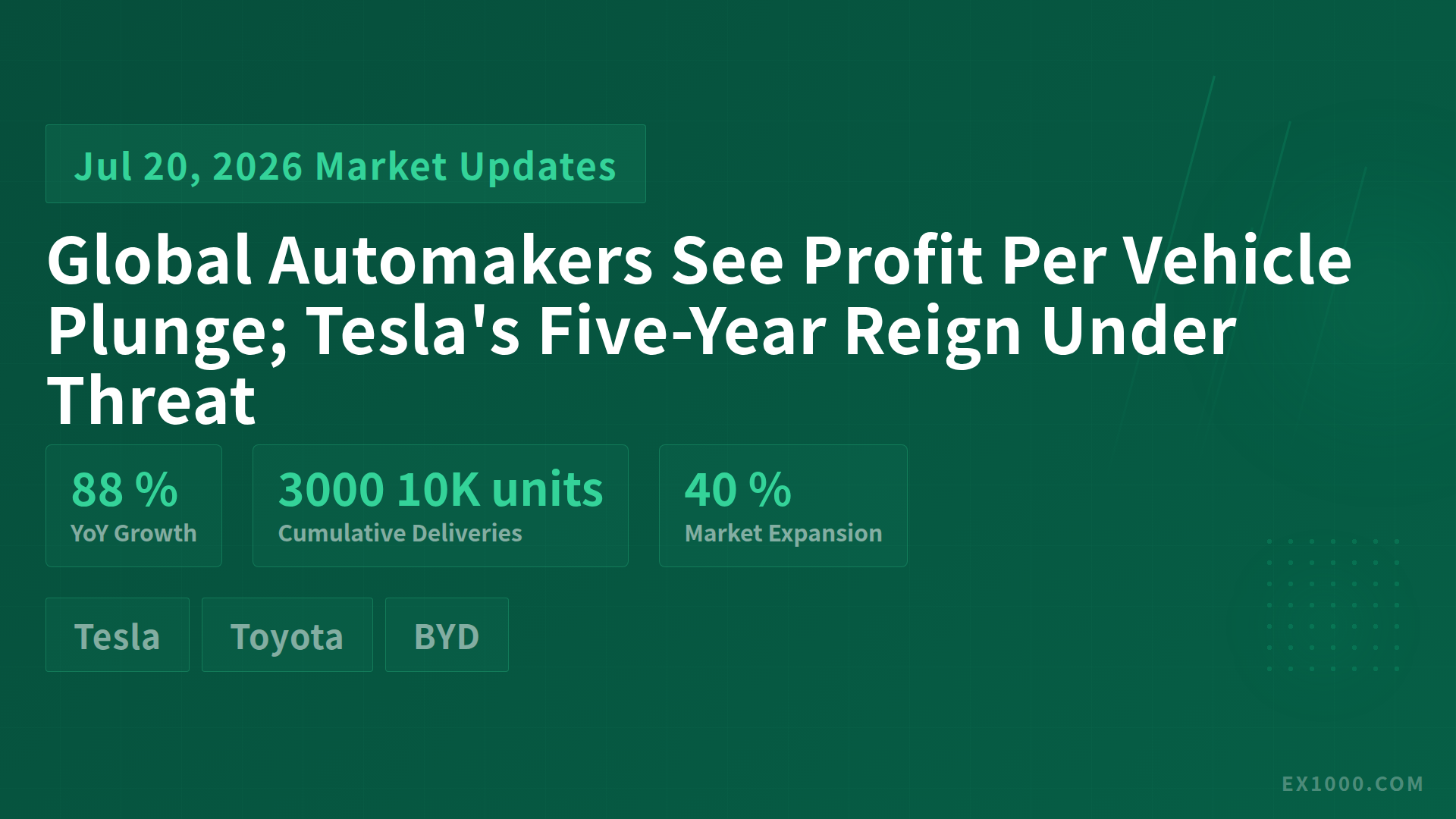
In FY2025, profit per vehicle declined across all seven major global automakers. Tesla led for the fifth consecutive year at approximately 348,000 yen ($1,460) per unit, but plunged 40% year-on-year. Toyota followed closely at 341,000 yen, narrowing the gap to under 10,000 yen. BYD ranked third, pressured by purchase tax policy adjustments. GAC Group faces a deepening loss of over 4 billion yuan in H1 2026.
Global Auto Profit Landscape: Universal Profit Compression
FY2025 marked a broad-based decline in profit per vehicle across the world's seven largest automakers, reflecting the profitability challenges of the EV transition era. Tesla maintained its top position for the fifth consecutive year at approximately 348,000 yen (about $1,460) per vehicle, yet this represented a plunge of roughly 40% from the previous fiscal year. The primary driver was a corresponding ~40% reduction in carbon credit revenue.
Toyota secured second place at approximately 341,000 yen (about $1,430) per vehicle, down 20% year-on-year. Notably, the profit gap between Toyota and Tesla has narrowed to under 10,000 yen, signaling Toyota's enduring profitability resilience. For FY2026, Toyota projects net profit to decline 22% to 3 trillion yen, marking three consecutive years of decline.
BYD ranked third, with analysts attributing the profit pressure to adjustments in purchase tax incentives. As NEVs transition from policy-driven to market-driven growth, subsidy phase-out is accelerating industry consolidation.
Chinese Automakers' Volume-Profit Dilemma
The GAC Group epitomizes the scale-versus-profitability challenge confronting Chinese automakers. In H1 2026, GAC achieved the milestone of 30 million cumulative vehicle production, yet projected losses of 40.6 billion to 45.7 billion yuan, expanding 60%-80% year-on-year.
Key drivers of GAC's predicament:
- Joint venture deceleration: Traditional JV brands continue losing market share
- Volume-for-price strategy in self-owned brands: Aggressive pricing erodes margins
- Upstream squeeze: Core vehicle profit margins compressed by battery and upstream suppliers
| Metric | Figure | YoY Change |
|---|---|---|
| Tesla profit per vehicle | 348,000 yen | -40% |
| Toyota profit per vehicle | 341,000 yen | -20% |
| GAC H1 projected loss | 40.6-45.7 billion yuan | +60% to +80% |
| Toyota FY2026 net profit forecast | 3 trillion yen | -22% |
Policy Rollback Accelerates Industry Consolidation
2026 stands as a pivotal year for NEV policy environment shifts. From the halving of NEV purchase tax exemptions at the start of the year, to the July cancellation of select NEV vessel and tonnage tax exemptions, to the September reinstatement of power battery consumption tax (starting at 2%, rising to 4% after one year), these measures signal the structured, phased withdrawal of NEV tax incentives.
The auto industry is formally entering the oil-electric parity era. For overseas buyers and distributors, this implies changing cost structures for Chinese NEV exports, with potential price advantage adjustments. In the long term, market-driven competition will filter out enterprises with genuine technological strength and cost control capabilities.
Overseas Market Implications and Outlook
Despite domestic profitability pressure, Chinese automakers' export strategies are opening new growth avenues. In H1 2026, Chinese NEV exports to Brazil surged, accounting for 88% of Brazil's NEV imports. BYD and Great Wall Motor have established local production bases in Brazil to address the 35% tariff hike on select NEVs effective early July.
XPeng chose Munich, Germany for the global debut of the L03, with European pricing starting at €35,600—significantly higher than the domestic starting price of 123,800 yuan. The L03 is planned for sale in 65 countries in 2026. For more industry data and market insights, visit EX1000.COM.