RoboSense unveiled its second-generation all-solid-state perception platform E2 at WAIC 2026. Built on the self-developed "Peacock" SPAD-SoC chip, it delivers tripled precision and million-level point frequency, already entering mass production.
Technical Architecture: Full In-House Chain from Chip to Perception
At the 2026 World Artificial Intelligence Conference (WAIC), RoboSense officially released its second-generation all-solid-state perception platform, the E2. Built on the company's self-developed "Peacock" SPAD-SoC chip, the platform achieves a complete technical chain spanning from underlying chips and spatial perception products to real-world data acquisition.
The core innovation of the E2 platform lies in its all-solid-state architecture, leveraging the self-developed "Peacock" SPAD-SoC and 2D VCSEL chips to handle everything from signal transceiving to data processing at the chip level. Compared to the first-generation E1, the E2 series achieves significant breakthroughs across multiple key metrics.
E2 vs E1: Key Performance Comparison
| Performance Metric | E1 Platform | E2 Platform | Improvement |
|---|---|---|---|
| Field of View (FoV) | Standard | Wider | Significantly expanded |
| Product Form Factor | Larger | More compact | Reduced volume |
| Precision | Baseline | Baseline ×3 | Tripled |
| Point Frequency | Lower | Million-level | Million-level achieved |
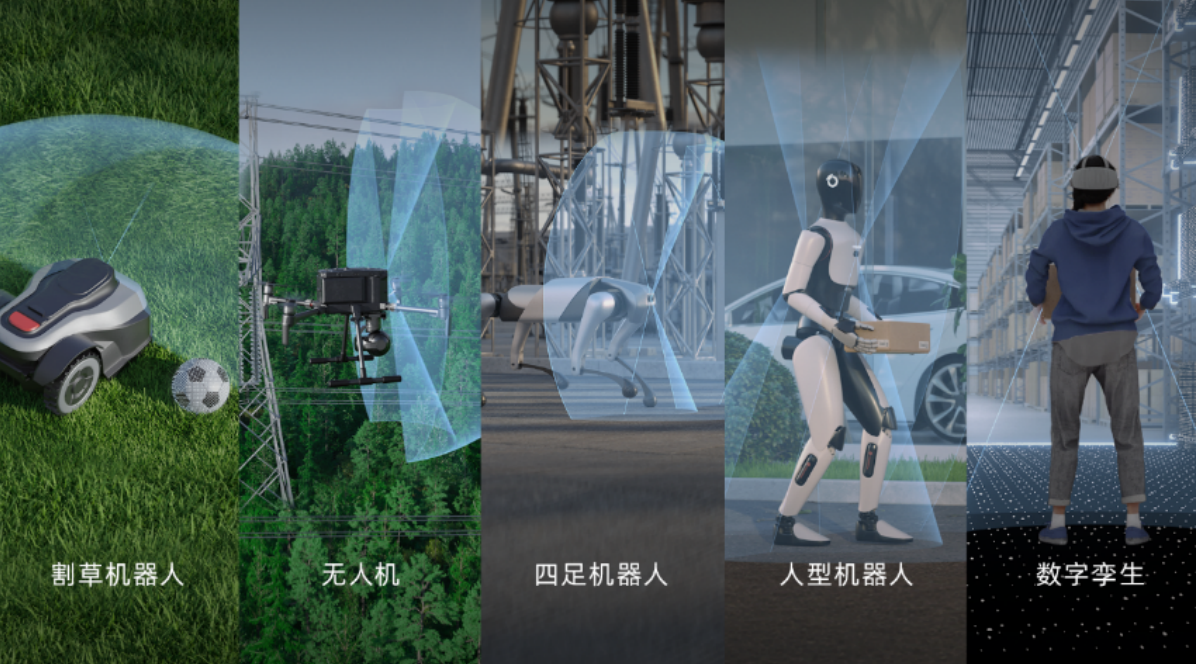
| Application Scenarios | Automotive-focused | Lawn robots, humanoids, quadrupeds, drones | Greatly expanded |
Application Scenario Expansion: From Automotive to Pan-Robotics
The E2 platform's applications have far exceeded traditional automotive LiDAR, covering multiple emerging domains:
- Lawn-mowing robots: Providing high-precision environmental perception for yard automation, achieving centimeter-level positioning
- Humanoid robots: Supporting navigation and obstacle avoidance in complex indoor environments
- Quadruped robots: Enhancing terrain perception capabilities for outdoor complex terrain
- Drones: Improving obstacle detection and path planning during low-altitude flight
The E2 has already secured orders from leading global players in yard robotics, smart hardware, and consumer electronics, moving swiftly into the mass-production phase. RoboSense has also established strategic partnerships with BeingBeyond, Origen, and Lightwheel in the physical AI ecosystem, focusing on spatial perception and real-world data acquisition.
Chip Strategy: Dual-Chip Collaborative Digital LiDAR Matrix
At the WAIC exhibition, RoboSense showcased its digital LiDAR and fusion sensor product line powered by both the "Peacock" and "Phoenix" chip platforms.
- "Peacock" Chip (SPAD-SoC): Focuses on solid-state perception for mid-to-short range, high-precision scenarios
- "Phoenix" Chip: Targets long-range, high-channel-count automotive LiDAR requirements
This dual-chip collaborative strategy enables RoboSense to cover the complete spectrum of perception needs from consumer-grade robots to premium autonomous driving, forming a differentiated competitive advantage.
Market Competition and Mass Production Outlook
Solid-state LiDAR is considered the core direction of next-generation perception technology. Compared to traditional mechanical rotating LiDAR, solid-state solutions offer:
- Higher reliability: No rotating parts, stronger vibration and shock resistance
- Lower costs: Chip-based design reduces mass production costs, enabling scalable applications
- Smaller form factor: Suitable for integration into various robots and consumer electronics
- Faster response: Solid-state architecture achieves microsecond-level detection latency
Currently, the global solid-state LiDAR market is at a critical stage transitioning from prototype validation to mass production ramp-up. RoboSense's E2 platform has already secured orders from leading customers and entered mass production, establishing a first-mover advantage in the Chinese market. For importers and dealers in Central Asian and Russian markets, smart driving and robotics products equipped with domestic solid-state LiDAR will gradually become available over the next 2-3 years and are worth monitoring. For more cutting-edge technology updates, please visit EX1000.COM.