Between January and May 2026, China's market launched 542 new models at a record pace of 3.6 per day. Yet overall market capacity slipped 20% year-on-year, with severe supply-demand imbalance pushing industry competition from a "growth race" into a "brutal fight for existing share."
Data Spectacle: 542 New Models Flood the Market in Five Months
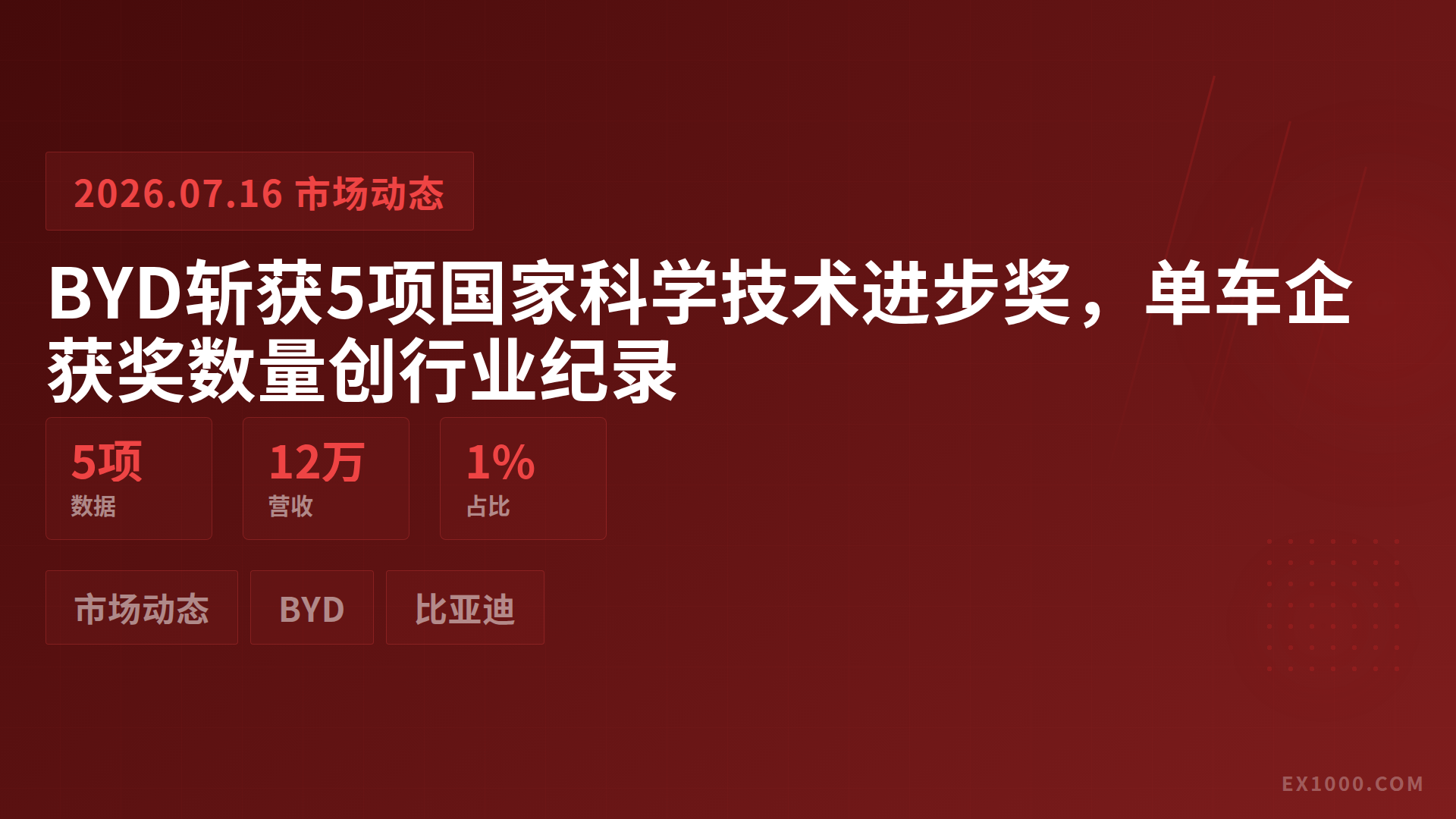
On July 14, BYD Executive Vice President He Zhiqi shared a set of figures that shook the industry: between January and May 2026, China's domestic passenger vehicle market launched 542 new models, averaging 108 per month or 3.6 per day — an unprecedented pace of product rollouts in industry history.
Spanning everything from all-new nameplates to annual refreshes and configuration tweaks, new vehicle launches have become as routine as daily meals. Yet behind this data lies an unsettling contradiction: overall domestic market capacity slipped 20% year-on-year during the same period. The frantic expansion of supply stands in stark contrast to the continued contraction of demand, dramatically magnifying the supply-demand imbalance.
- 542 new models launched in January-May, covering all-new nameplates, annual refreshes, and trim adjustments
- An average of 108 per month and 3.6 per day — an industry-first rollout pace
- Market capacity down 20% year-on-year, with limited demand unable to absorb the flood of new models
The Input-Output Paradox: 1 Billion Yuan R&D Can't Buy Three Months of Buzz
By traditional automotive industry logic, developing a brand-new model typically requires at least 1 billion yuan in investment and over two years of R&D. But in today's market, a vehicle that took two years to develop often loses its buzz in under three months after launch, drowned out by even newer product iterations.
Product lifecycles are being compressed indefinitely, with new vehicles becoming "old models" before they even reach peak sales volume. This anomaly of high investment, short cycles, and low returns is a stark portrait of the extreme "involution" — or hyper-competition — defining China's auto market in 2026.
| Dimension | Traditional Auto Logic | 2026 Market Reality | Trend |
|---|---|---|---|
| Development Cycle | 2+ years | 2+ years (unchanged) | Cycle not shortened |
| R&D Investment | 1 billion yuan+ | 1 billion yuan+ (unchanged) | Investment not reduced |
| Market Buzz Duration | 12-24 months | Under 3 months | Compressed to one-quarter |
| Average Per-Model Sales | Stable climb | Most fail to establish a base | Significant decline |
| ROI Expectation | Recovered in 3-5 years | Most fail to recover | Severely pressured |
Competition Escalation: From "Growth Race" to "Brutal Market Share Fight"
He Zhiqi put it bluntly: industry competition has moved well beyond "fierce competition" into something far more brutal. Automakers keep pouring resources into new sheet metal, hoping a sprawling model matrix will capture every niche segment. Yet finite market demand simply cannot absorb this tidal wave of new vehicles.
- Most new models fail to build stable sales volumes, peaking at launch and fading immediately
- Excessive model matrix expansion dilutes R&D resources and compromises quality
- Price wars become the only competitive tool, severely squeezing industry profit margins
The essence of this "involution" is that the market has shifted from incremental expansion to stock-based competition, yet automakers' behavior remains stuck in the growth era. More new models mean lower average per-model sales, making R&D investment harder to recover — a vicious cycle. The overall passenger vehicle market has contracted 20% from a year earlier, yet new model launches have hit record highs. This widening scissors gap is the core of the industry's current dilemma.
The Way Forward: From Quantity Competition to Quality Breakthrough
For overseas observers and potential buyers, the dense iteration of China's new car market presents both opportunities and warnings. On one hand, rapid iteration brings abundant product choices and cutting-edge technology applications. On the other, excessive product homogenization undermines long-term individual model competitiveness and actually raises consumers' decision-making costs.
China's auto industry needs to fundamentally rethink its development logic:
- Shift from pursuing model quantity to honing core product competitiveness
- Move from blindly expanding model matrices to focusing on advantageous segments
- Transition from price wars to value wars, enhancing per-unit profitability
By tracking the dynamic evolution of China's auto market through EX1000.COM, overseas buyers can sift through the sea of new products to identify truly competitive models with long-term staying power, seizing the optimal procurement window during the transition from "wild growth" to "refined cultivation."