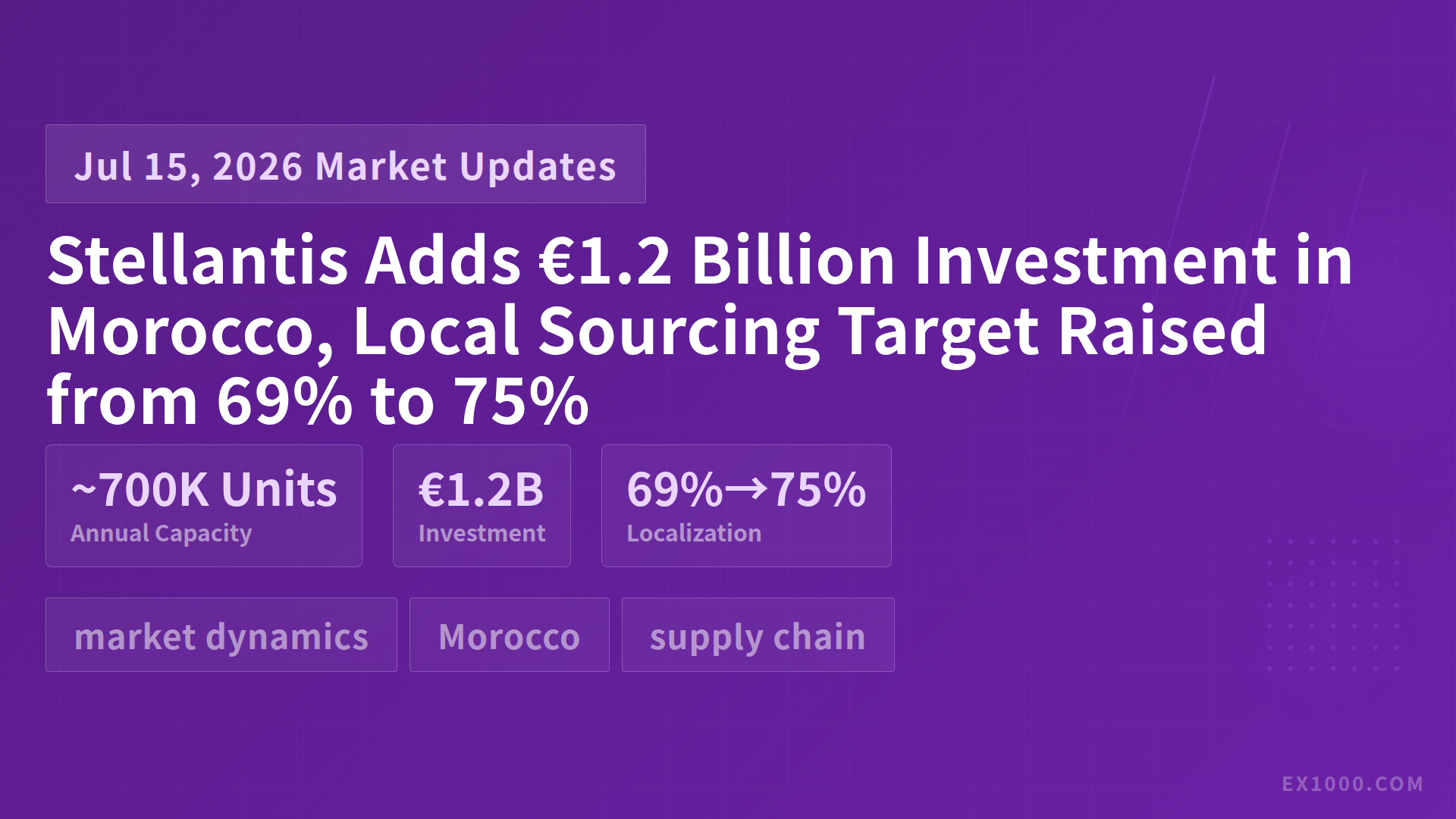
Morocco's established automotive supply chain is creating new gaps through electrification that existing suppliers cannot fill alone. Stellantis announced an additional €1.2 billion investment, targeting local sourcing rate increases from 69% to 75%.
Morocco: Europe's Nearshore Manufacturing Hub
Positioned at the crossroads of Europe and Africa, Morocco has become one of the most important nearshore production bases for European automotive manufacturing.
- Renault and Stellantis serve as the two anchor players in Morocco's automotive industry
- Combined annual production capacity: approximately 700,000 units
- Key advantage: Free trade agreements with the EU plus geographic proximity
Stellantis Expansion Plan
Stellantis recently announced a major investment program:
- Additional investment of approximately €1.2 billion in its Kenitra plant
- Raising annual production capacity to about 535,000 vehicles
- Pushing local sourcing rate from around 69% to 75% by 2030
This means the Moroccan market will need a significant influx of new suppliers in the coming years to fill the supply chain gaps created by capacity expansion.
Renault's Invitation Signal
During the Renault Tech World Tour Morocco event, company executives clearly communicated:
- Renault is actively encouraging more Chinese suppliers to establish operations in Morocco
- The opportunity lies not in replicating China's entire EV ecosystem
- But in providing specialized, engineering-driven capabilities that existing Moroccan and European suppliers cannot fill independently
The Tier 2 Window Is Opening
Morocco's traditional Tier 1 supplier landscape is already well established, dominated by European legacy suppliers. However, electrification is changing the rules of the game:
| Emerging Demand Area | Required Capability | Chinese Tier 2 Advantage |
|---|---|---|
| Battery management systems | Electromechanical engineering | Deep technical accumulation |
| Electric drive systems | High power density design | Product maturity |
| Thermal management | Advanced heat pump systems | Scale experience |
| Intelligent connectivity hardware | Software-hardware integration | Rapid iteration capability |
Challenges and Recommendations
Entering the Moroccan market is not without challenges:
- Language and cultural differences and local regulatory compliance
- Talent acquisition and development system building
- Coordination with existing supplier networks
- European automakers maintain extremely high standards for quality systems, engineering capabilities, and delivery stability
Strategic Value and Globalization Lessons
For observers in Central Asian and Russian markets, the Morocco model carries important reference value:
- By setting up operations in Morocco, Chinese suppliers can better serve the European market
- Accumulating international operational experience that can later be replicated in emerging markets such as Central Asia
- As policies such as the EU Carbon Border Adjustment Mechanism (CBAM) advance, the advantages of nearshore manufacturing will become even more pronounced
EX1000.COM will continue to provide in-depth analysis on the globalization of China's automotive supply chain, offering decision-making references for Tier 2 suppliers going overseas.