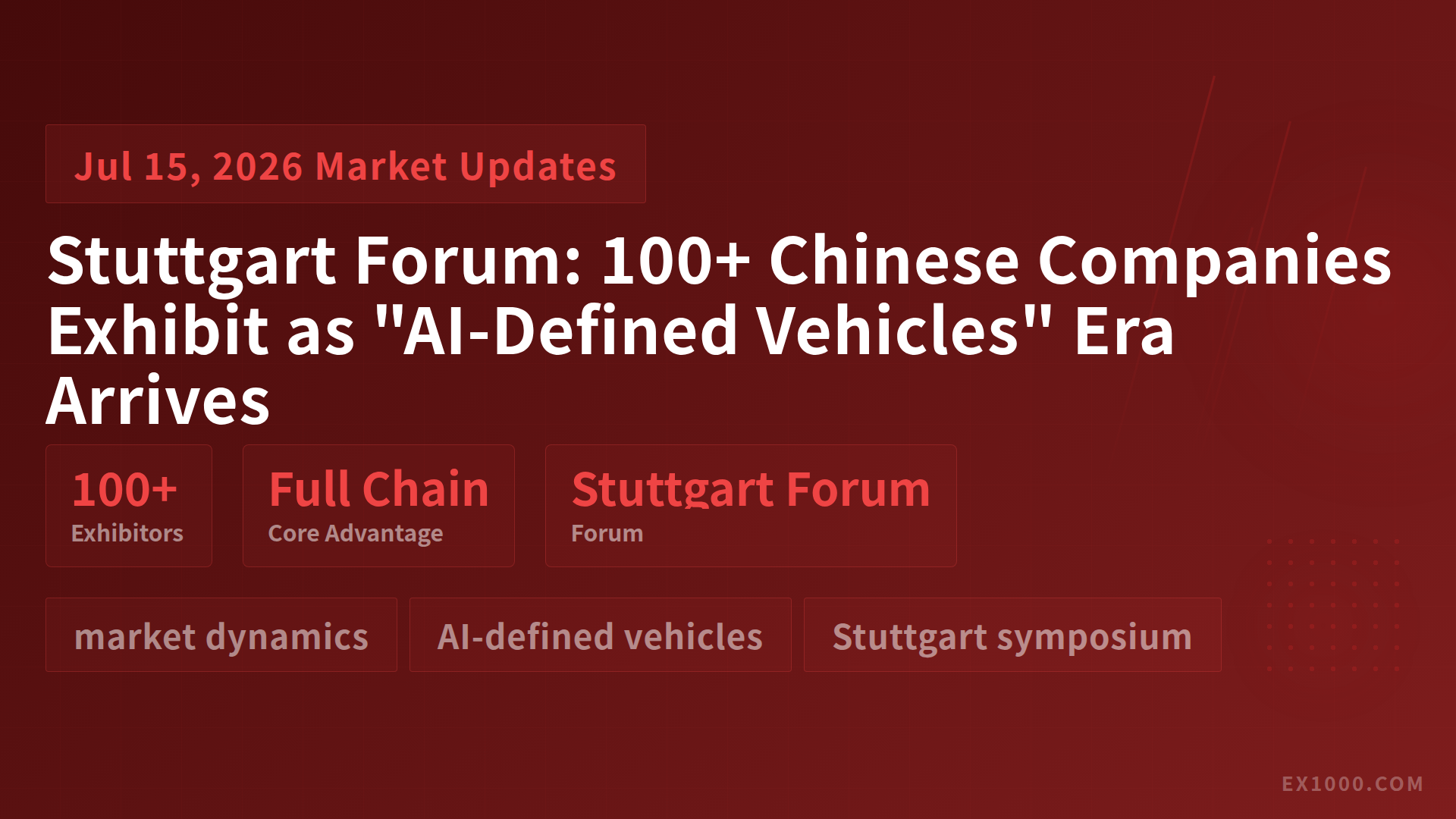
At the 2026 Stuttgart International Symposium on Automotive and Powertrain Technology (July 8-9), Gasgoo CEO Xiaoying Zhou highlighted China's shift from market scale advantages to system-level innovation. The "AI-defined vehicles" era has arrived.
Forum Background and Core Insights
The Stuttgart International Symposium on Automotive and Powertrain Technology was held July 8-9, 2026, co-organized by the Stuttgart University Institute of Automotive Engineering (IFS) and Tongji University College of Automotive Studies.
- Xiaoying Zhou, CEO and Editor-in-Chief of Gasgoo International, delivered the keynote speech
- Keynote title: "China's Automotive Momentum: From Market Scale to System-Level Innovation"
- Core message: Chinese automakers are no longer merely scale competitors, but are building competitive advantages centered on system-level capabilities
China's Systematic Advantages
Zhou emphasized that China's automotive industry possesses the following core strengths:
- The world's most complete industrial chain supporting system
- Massive tiered consumer demand supporting rapid iteration
- Efficient industrial cluster collaboration capabilities
- Long-term industrial planning and engineering talent dividend
Combined, these factors have laid a solid foundation for the rapid iteration of intelligent electric vehicles.
"AI-Defined Vehicles" New Phase
The industry has entered a new phase of "AI-defined vehicles":
- High-level ADAS has achieved large-scale commercial rollout
- Intelligent cockpits and digital user experience have become core competitive differentiators
- Last year's IAA Munich Motor Show attracted over 100 Chinese exhibitors, covering OEMs, battery manufacturers, vehicle chip firms, and autonomous robotics startups
High-Level Panel Discussion Consensus
Zhou joined technical leaders from ZF, HORSE, MAHLE, and the Baden-Württemberg Ministry of Transport for a panel discussion:
| Participant | Representative | Discussion Focus |
|---|---|---|
| ZF | Otmar Scharrer | E-mobility R&D |
| HORSE | Ragnar Burenius | New product lines |
| MAHLE | Arnd Franz | Group strategy |
| Baden-Württemberg | Ministry of Transport | Policy coordination |
Panelists agreed that:
- Competition and collaboration can coexist
- Digitalization has become a fundamental expectation rather than a competitive advantage
- Long-term success depends not on being first to market, but on delivering the right products at the right time
Implications for Central Asia and Russia
For buyers and dealers in Central Asia, Russia, and other emerging markets, this transformation means that the resilience and technological iteration speed of China's automotive supply chain are continuously strengthening. China's shift from scale-driven growth to capability-driven global expansion is creating fresh opportunities for international collaboration.
EX1000.COM recommends tracking Chinese suppliers' latest advances in intelligent driving, smart cockpits, and supply chain synergy to capture the dividends of this industrial upgrade.