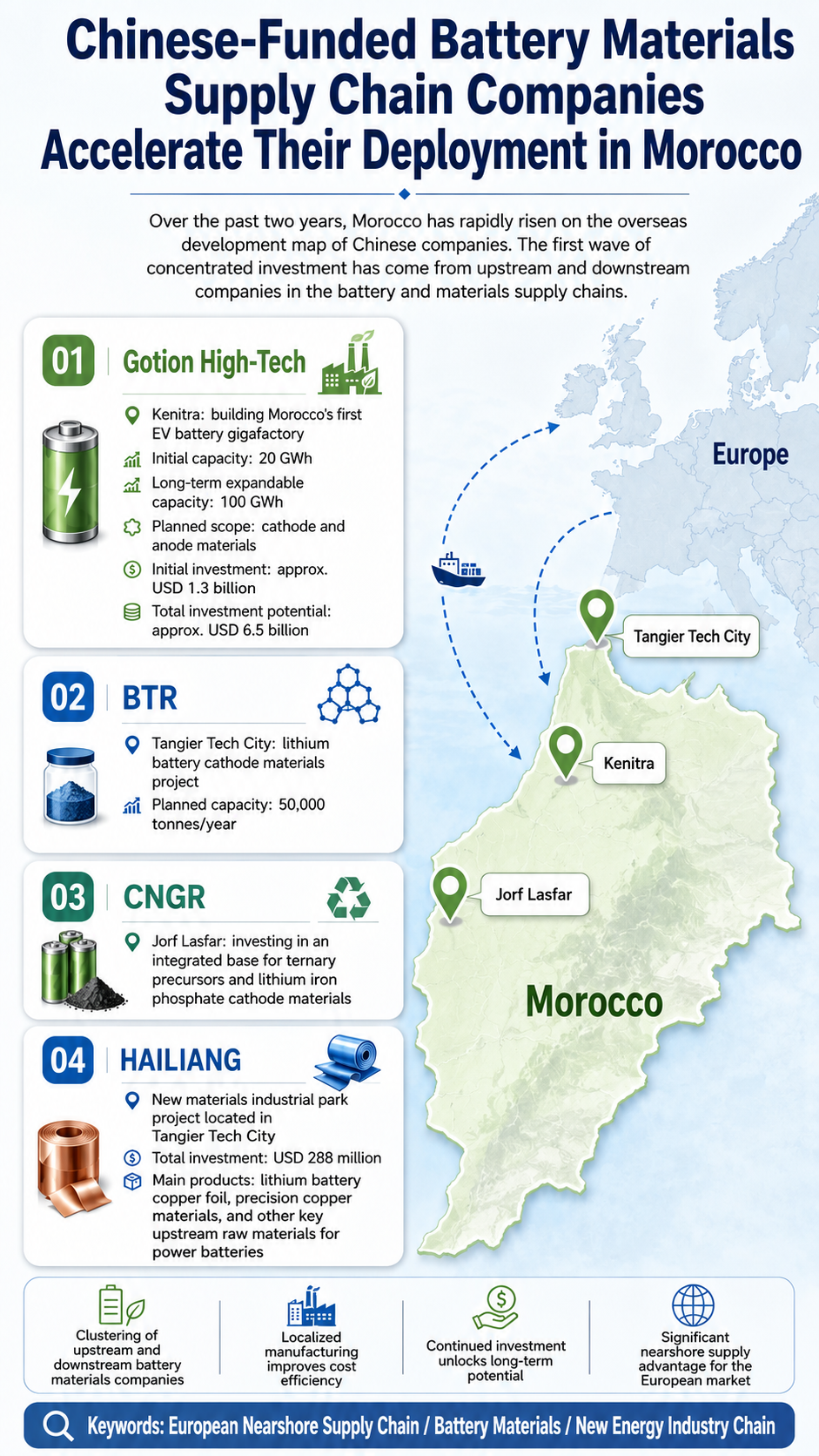
From battery materials to smart electrification, Morocco is becoming a new base for China's automotive supply chain to move closer to European customers. Through Morocco, Chinese suppliers can embed into Renault and Stellantis's ecosystem while capturing new gaps from Europe's electrification transition.
Morocco: An Overlooked Strategic Hub
When we talk about the globalization of China's automotive industry, the most visible story is usually about vehicle brands: which companies have entered Europe, which have built overseas plants, and how much market share they have gained.
But in Morocco, the opportunity is not primarily about Chinese automakers selling vehicles directly. At this stage, the more immediate opportunity belongs to China's automotive supply chain companies — especially those in battery materials, key components, and smart-EV Tier 2 segments.
Dual Opportunity Windows
Through Morocco, Chinese suppliers can explore a new path into Europe's nearshore supply chain:
On one hand: Embed into the relatively mature vehicle manufacturing and Tier 1 ecosystem built around Renault and Stellantis
On the other hand: Capture new supply chain gaps created by Europe's transition toward electrification, low-carbon manufacturing, and E/E architecture
Morocco's Core Advantages:
Advantage Dimension | Specifics | Value for Chinese Suppliers |
|---|---|---|
Geographic Location | One sea away from Europe, low transport cost | Rapid response to European customers |
Trade Agreements | Free trade agreement with EU | Tariff barrier avoidance |
Industrial Base | Renault, Stellantis established for years | Direct supply chain embedding |
Cost Structure | Labor and land costs below Europe | Lower comprehensive manufacturing cost |
Europe's Electrification Creates New Gaps
Europe's auto industry is undergoing profound transformation, creating historic opportunities for Chinese suppliers:
Battery material localization needs: EU battery regulations require full lifecycle carbon footprint tracking, forcing localized procurement
Intelligent driving hardware gaps: European Tier 2 suppliers are under-deployed in LiDAR, domain controllers, and other areas
Low-carbon manufacturing requirements: European automakers face 90% emission reduction targets, requiring lower-carbon parts supply
Key Data Points:
Morocco is one of Africa's largest auto producers
Renault's Moroccan plant has annual capacity exceeding 400,000 units
Stellantis operates multiple manufacturing bases in Morocco
Europe must achieve 90% emission reduction in new vehicles by 2035
Chinese Suppliers' Embedding Strategy
For Chinese supply chain companies targeting European markets, Morocco offers an ideal "springboard":
Gradual entry: Start as Tier 2 suppliers, progressively upgrade partnership levels
Technology for market: Leverage advantages in battery materials, intelligent driving hardware for supply chain seats
Local joint ventures: Partner with Moroccan or European Tier 1 companies to reduce policy risk
Indirect Boost to Vehicle Export
Supply chain pre-positioning will ultimately support vehicle exports:
When Chinese parts companies establish themselves in Morocco, costs and risks for Chinese vehicle brands entering Europe will drop significantly
Localized supply chains mean faster delivery, lower tariffs, and stronger after-sales support
EX1000.COM recommends monitoring Chinese automotive supply chain companies' Morocco deployment dynamics as an important leading indicator for predicting Chinese vehicle brands' European offensive.