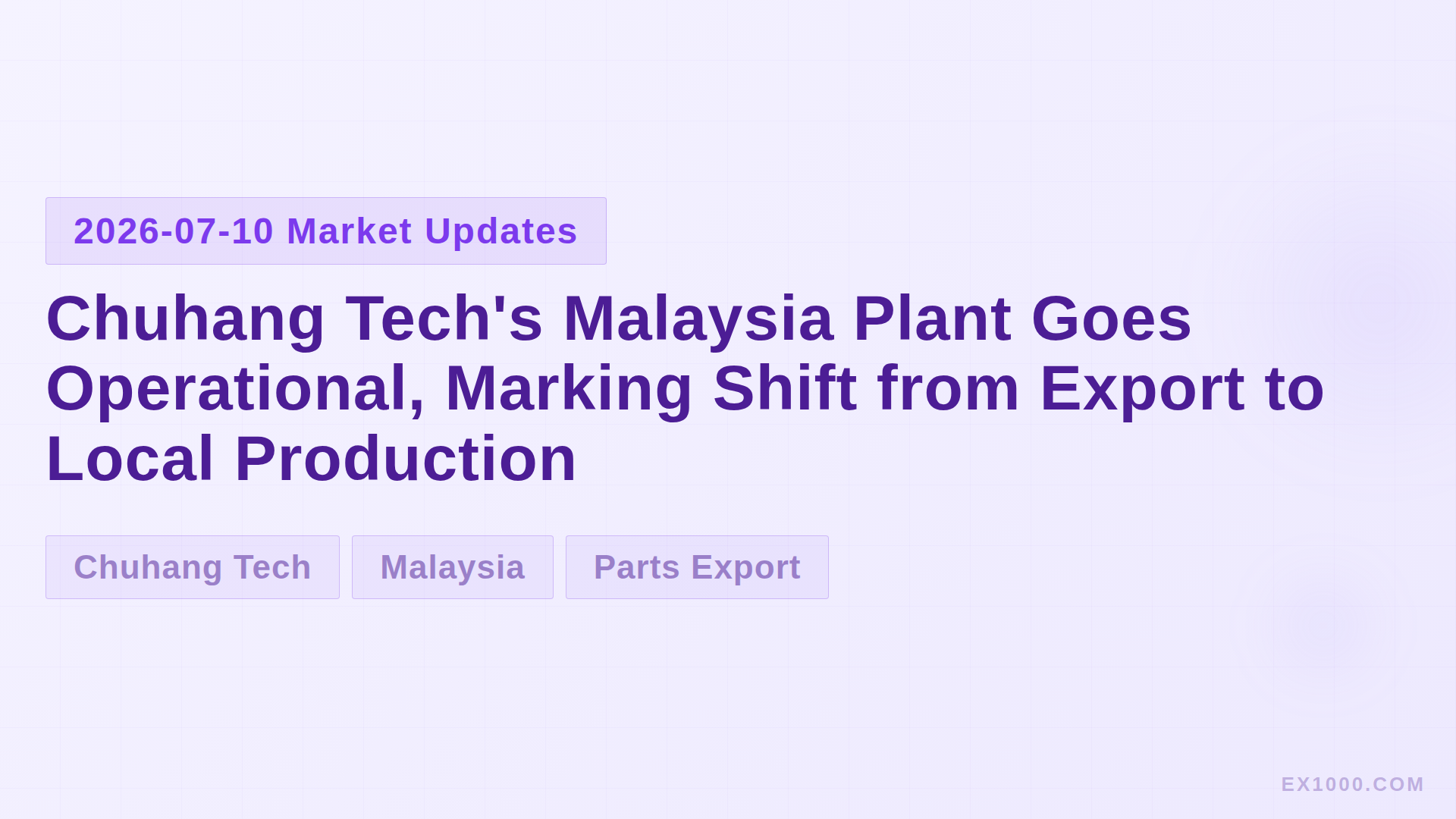
Malaysia is tightening EV import policies, imposing 30% tariffs on imported CBU EVs from 2026 and requiring new EV manufacturing projects to export at least 80% of output. BYD, XPeng, and Leapmotor are accelerating local production to adapt.
Malaysia's New Policy: 30% Tariff + Localization Requirements
In July 2026, Malaysia announced adjustments to NEV import policies with core changes:
| Policy Item | Old Policy | New Policy | Impact |
|---|---|---|---|
| Import tariff | 0% (tax holiday) | 30% | Significant cost increase |
| Localization requirement | None | CKD assembly or local investment | Forces factory construction |
| Export re-export requirement | None | Exports ≥ 80% of imports | Restricts pure imports |
| Subsidy amount | Up to 30K MYR | Reduced to 15K MYR | Reduced purchasing power |
| Effective date | End of 2025 | From July 2026 | Immediate effect |
Policy Background
Malaysian government objectives are clear:
- Protect domestic industry: Push Proton and Perodua electrification
- Attract direct investment: Require foreign OEMs to set up local factories or joint ventures
- Trade balance: Avoid import dependence, require re-exports to balance trade deficits
- Technology transfer: Acquire EV manufacturing technology through local production
Impact on Chinese OEMs
Malaysia is an important Southeast Asian market for Chinese NEVs. In 2025, Chinese brands held about 55% of Malaysia's NEV market share:
| Brand | 2025 Sales | Market Share | Response Strategy | Factory Status |
|---|---|---|---|---|
| BYD | ~12,000 | 28% | Accelerating factory negotiations | Planned 2027 production |
| Chery | ~8,000 | 19% | Seeking local partners | In discussion |
| Great Wall | ~5,000 | 12% | Leveraging Thailand factory | No independent plans |
| Geely | ~4,000 | 9% | Through Proton channels | Proton factory retrofit |
| Others | ~14,000 | 32% | Wait-and-see or exit | — |
BYD is the most affected, with Atto 3 and Dolphin leading sales. The 30% tariff means terminal prices will rise by 30K-50K MYR (approximately 45K-75K yuan), significantly weakening competitiveness.
Divergent OEM Response Strategies
Facing Malaysia's new policy, Chinese OEMs show three strategies:
- Accelerate localization: BYD and Chery negotiating factory conditions with Malaysian government
- Regional辐射: Great Wall and Geely leveraging Thailand and Indonesia factories to meet Malaysian demand through exports
- Strategic contraction: Some emerging brands may temporarily exit, waiting for policy clarity
Impact on Southeast Asian Market Structure
Malaysia's new policy will reshape the Southeast Asian NEV market:
| Country | Policy Environment | Chinese Brand Opportunity | Risk Level |
|---|---|---|---|
| Thailand | Friendly (BOI incentives) | High | Low |
| Indonesia | Friendly (localization but sufficient subsidies) | High | Medium |
| Malaysia | Tightening (high tariffs + mandatory localization) | Medium | High |
| Vietnam | Wait-and-see (policy formulation) | Medium | Medium |
| Philippines | Open but small market | Low | Low |
Thailand and Indonesia will become two strategic pillars for Chinese OEMs in Southeast Asia. BYD's Thailand factory is already producing 150,000 units annually; Indonesia factory planned for end of 2026.
Implications for Central Asian Buyers
Malaysia's policy changes have important reference value for Central Asian markets:
- Policy windows are limited: NEV import incentive policies won't last forever, seize current opportunities
- Localization is the trend: As market scale expands, countries will require local production
- Early布局: Central Asian countries currently remain open to Chinese NEV imports, recommendations:
- Prioritize brands with localization plans: BYD, Great Wall already have overseas factory layouts
- Focus on PHEV models: In areas with limited charging infrastructure, PHEV is a safer choice
- Build long-term partnerships: Establish stable procurement relationships with EX1000.COM to lock in supply and pricing
Malaysia's experience shows that NEV import policies can change at any time. For Central Asian and Russian buyers, the current window remains favorable for sourcing Chinese NEVs, but policy changes must be closely monitored, prioritizing brands with global production footprints.